Watching the Gears Turn: A Puppy’s First Hunt
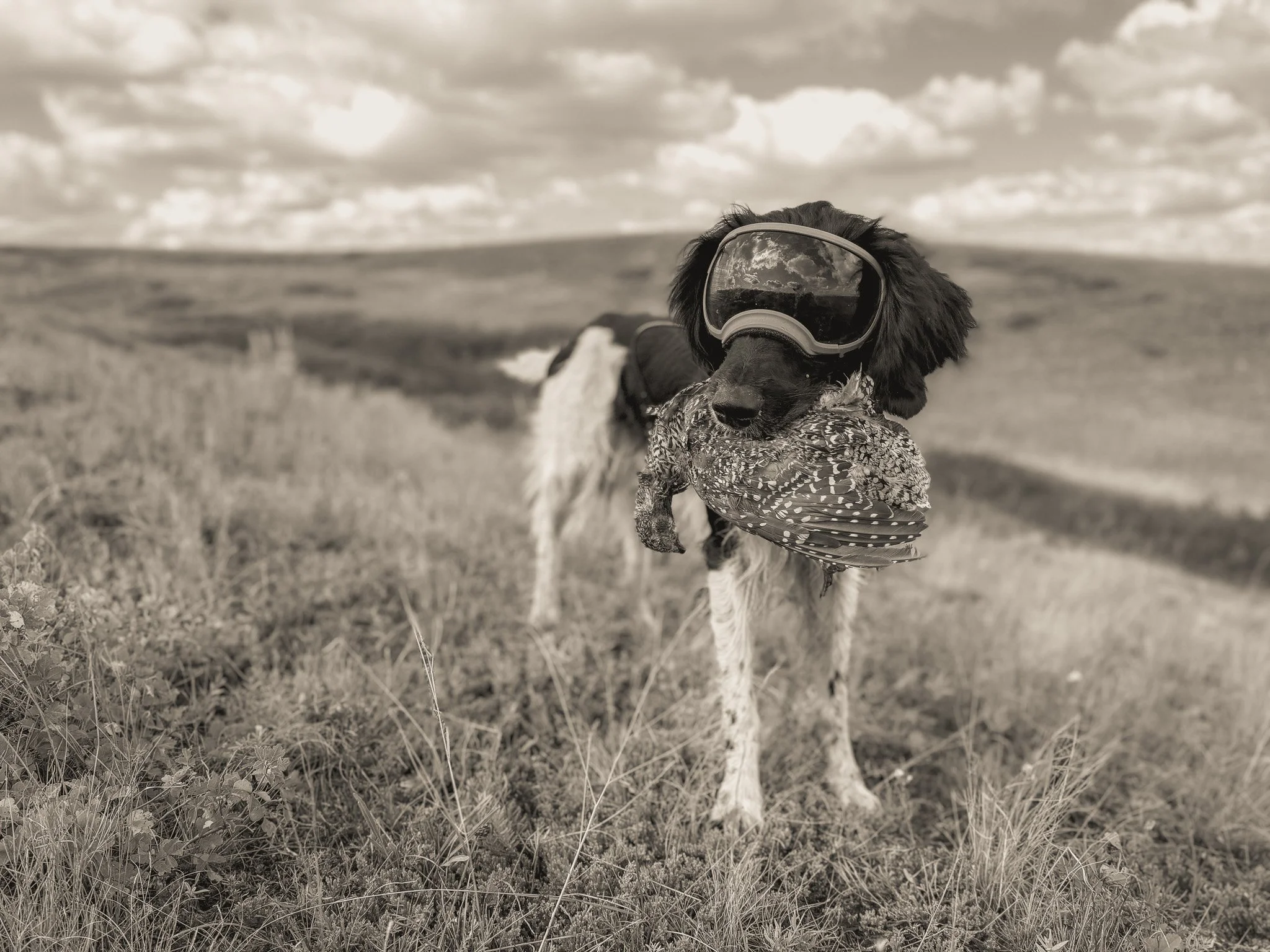
Amos, just over five months old, carrying his first bird - a Sharp-tailed grouse.
“Frolicking” is how I would describe it. It is what puppies do. They frolic—and that is okay. If every puppy entered the field as a bird-finding machine, I doubt raising one would be nearly as joyful or rewarding. Part of the privilege is watching the scattered enthusiasm of puppyhood gather into purpose: watching them grow, and, if we are paying attention, growing alongside them.
Amos spent his first days on the Montana prairie doing exactly that. He bounded through the grass because there was grass to bound through. He investigated whatever caught his attention and followed whichever impulse arrived next. He was moving through bird country, but he was not yet searching it.
But by the end of the week, that was beginning to change.
The puppy was still there, but his energy had found a channel. His movements became more deliberate. His nose—his “snorkel,” as I call it—began to dictate where he went. Then it produced two Sharp-tails from the prairie and led him, eventually, to a bona fide retrieve.
I was watching the gears turn.
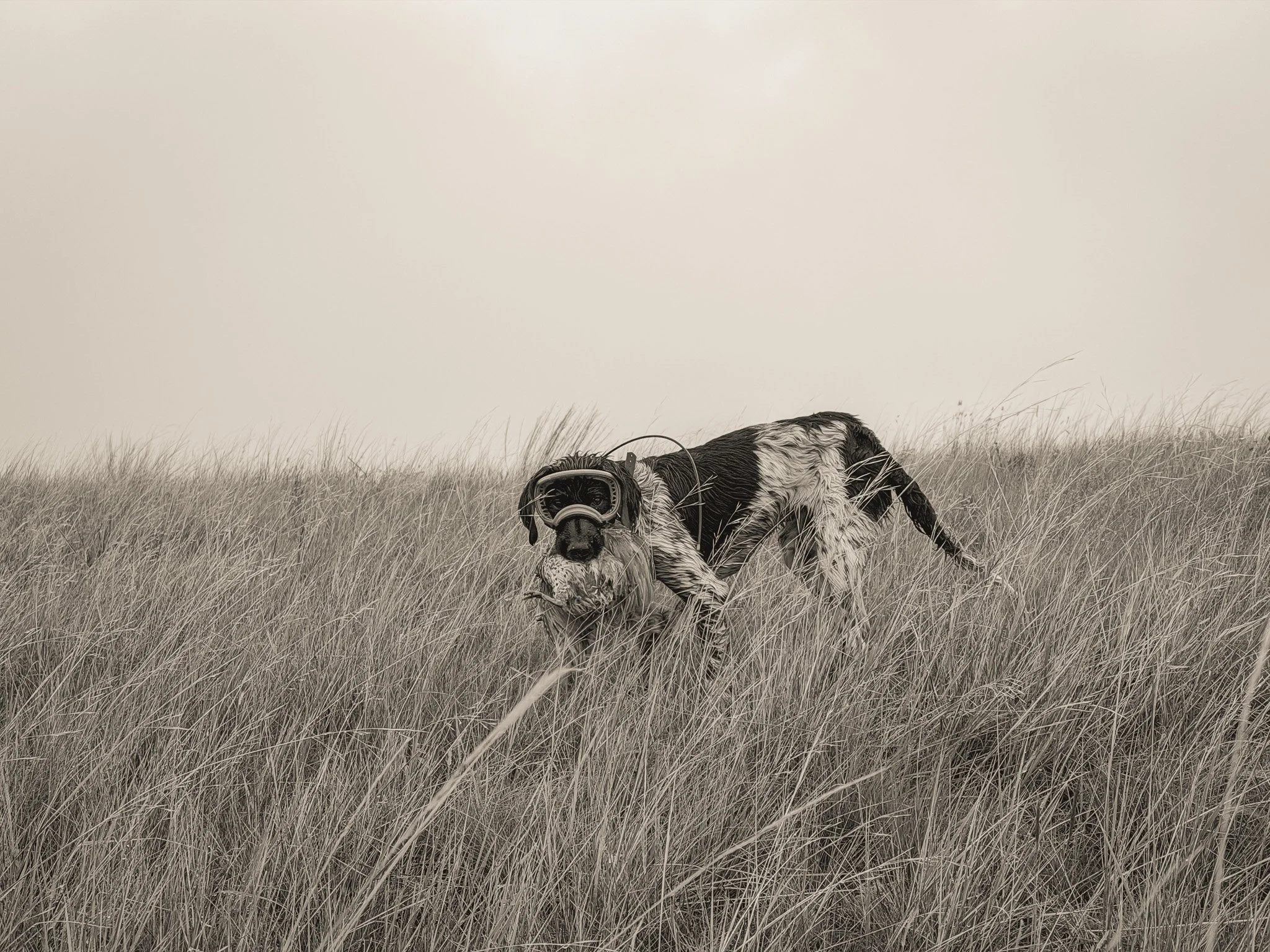
While this story is about Amos, everything—my love for bird dogs and the prairie—began with Aldo. I hunted the dogs together and separately on this trip, I wanted to make sure both dogs had opportunities to do what they were born to do.
I took my first bird dog, Aldo, to Montana in 2022, when he was about six months old. I had been on a few bird hunts before, but candidly, none had been all that remarkable. With a dog of my own, though, I thought, Why not? It could be fun.
And fun it was. It was limits of fun. I was hooked.
As best I can recall, Aldo mostly bounded about the prairie. There was, however, one remarkable retrieve of a Sharp-tailed grouse that remains etched in my memory.
Aldo and I returned to Montana in 2023 and again in 2024, each trip as fun as the last. During those years, I also became more involved with the North American Versatile Hunting Dog Association (NAVHDA), even becoming a board member of my local chapter, and discovered a genuine passion for the art of raising a bird dog.
That is not to say I am a trainer or an expert by any stretch of the imagination. Perhaps I am an enthusiast. An amateur.
Looking back, I believe that first trip to Montana was instrumental in shaping the dog Aldo became. Today, at four years old, he runs big in big country like Montana and hunts close on the small farm parcels of my native Kansas. He tracks, points, and retrieves. He lives for the hunt. Birb is life.
Aldo has his quirks, each one reflecting how I trained him (or, in some cases, how I did not). I am okay with that. Sometimes he bumps birds. Sometimes he gets a little too excited, becomes a little too noisy, and scares them away. But he means the world to me. We have traveled across the country together, chasing an assortment of species from the high plains prairies to the arid desert canyons and accumulating the experiences that made both of us who we are today.
I cannot say precisely what that first Montana trip did for Aldo. I only know that somewhere amid all that bounding about, something began.
Four years later, I returned to Montana with another Large Münsterländer puppy, Amos. This time, I knew there might be more happening than frolicking. This time, I knew what to watch for.
Six-month-old Aldo in Montana, before his eye injury, with a Hungarian partridge.
I had every intention of arriving in Montana the week before the nonresident opener to run the dogs, scout, and (with the gun locked securely in the truck) give Amos a few opportunities to encounter wild birds. But life, and hunting in particular, rarely proceeds according to plan.
I had hunted Montana three times before, and each trip had produced abundant bird contacts. I did not expect the birds to be standing precisely where I had left them, but I arrived with a certain confidence that I could find enough to begin Amos’s education. After four days of searching, that confidence had eroded.
We covered country that looked right. We walked familiar ground and explored promising new places. Still, the Montana I remembered seemed strangely empty. It seemed as if there would be no opportunity for a young dog to begin making sense of what we were asking him to find.
The experience was humbling. When it was all said and done, I would drive nearly 5,000 miles with the deliberate purpose of introducing Amos to wild birds in big country. Unlike my first trip with Aldo, this journey was supposed to be informed by experience and guided by intention. Yet there I was, once again reminded that experience does not amount to mastery. The birds had their own plans.
As my concern grew, my wife, Alexis, reached out to the Large Münsterländer Association of America (LMAA) community with something resembling an SOS. Within minutes, her inbox filled with phone numbers, invitations, and offers of help. I began making calls, and within hours the trajectory of our trip changed.
The assistance did more than point me toward birds. It reminded me that raising a bird dog is rarely a solitary pursuit. Whatever knowledge I had accumulated since that first trip with Aldo, there would always be more to learn—and people generous enough to help teach it. Because of the generosity of the LMAA community, Amos had the opportunity to discover birds for the first time in his life, and I am deeply grateful.
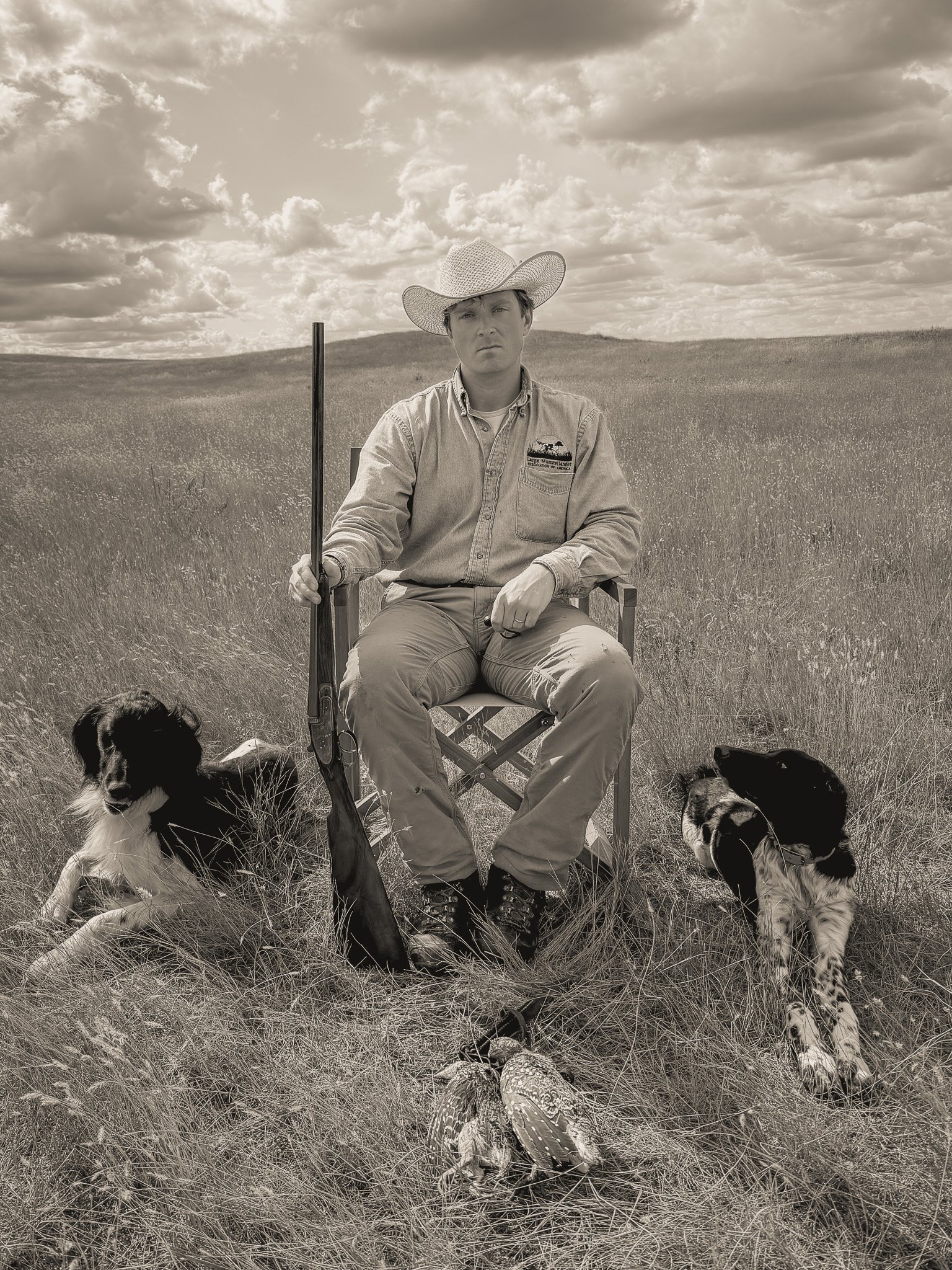
Doubles. Two barrels, two dogs, and two birds.
Amos’s first bird recovery offered an early glimpse of the purpose I would watch develop over the course of our week in Montana. As I slowly climbed over a spur on opening morning, thanks to a hot tip from a LMAA member that reached out, Amos chased a meadowlark through the adjacent wheat stubble. A covey of Sharp-tailed grouse flushed. The shot grabbed Amos’s attention, and he quickly abandoned the meadowlark.
I had marked the fallen bird and intended to find it myself and then guide Amos toward discovering it. That did not go according to plan. With whatever life remained, the Sharp-tail had rolled and stumbled into a snowberry thicket at the bottom of the coulee. I groaned. This is going to be an endeavor.
Then I saw the thicket shake. While I had been standing there lamenting, something had drawn Amos into the cover. To my surprise, he emerged with a Sharp-tail in his mouth. I couldn’t believe it. Then the game was on: keep-away. I could see it in his eyes. Whatever he had found was a prize, and he had no intention of surrendering it. Oh boy.
But a puppy is gonna do what a puppy is gonna do. After a few waves of my hat, some hoots and hollers, and a bit of negotiation, I eventually held a ragged, damp Sharp-tail in my hand while Amos bounced and jumped at my feet. I know he didn’t know what just happened, but he was excited, and what he did know was that he wanted that bird. It was encouraging to see but there were still so many pieces of the puzzle remaining to put together with him so I tucked my bird in the vest and we carried on.
That first recovery did not transform Amos into a finished bird dog, and I would never claim as much. There was still plenty of frolicking over the days that followed. Plenty of chasing meadowlarks, investigating distractions, and bounding across the prairie simply because he could. The gears did not turn all at once.
But they were turning.
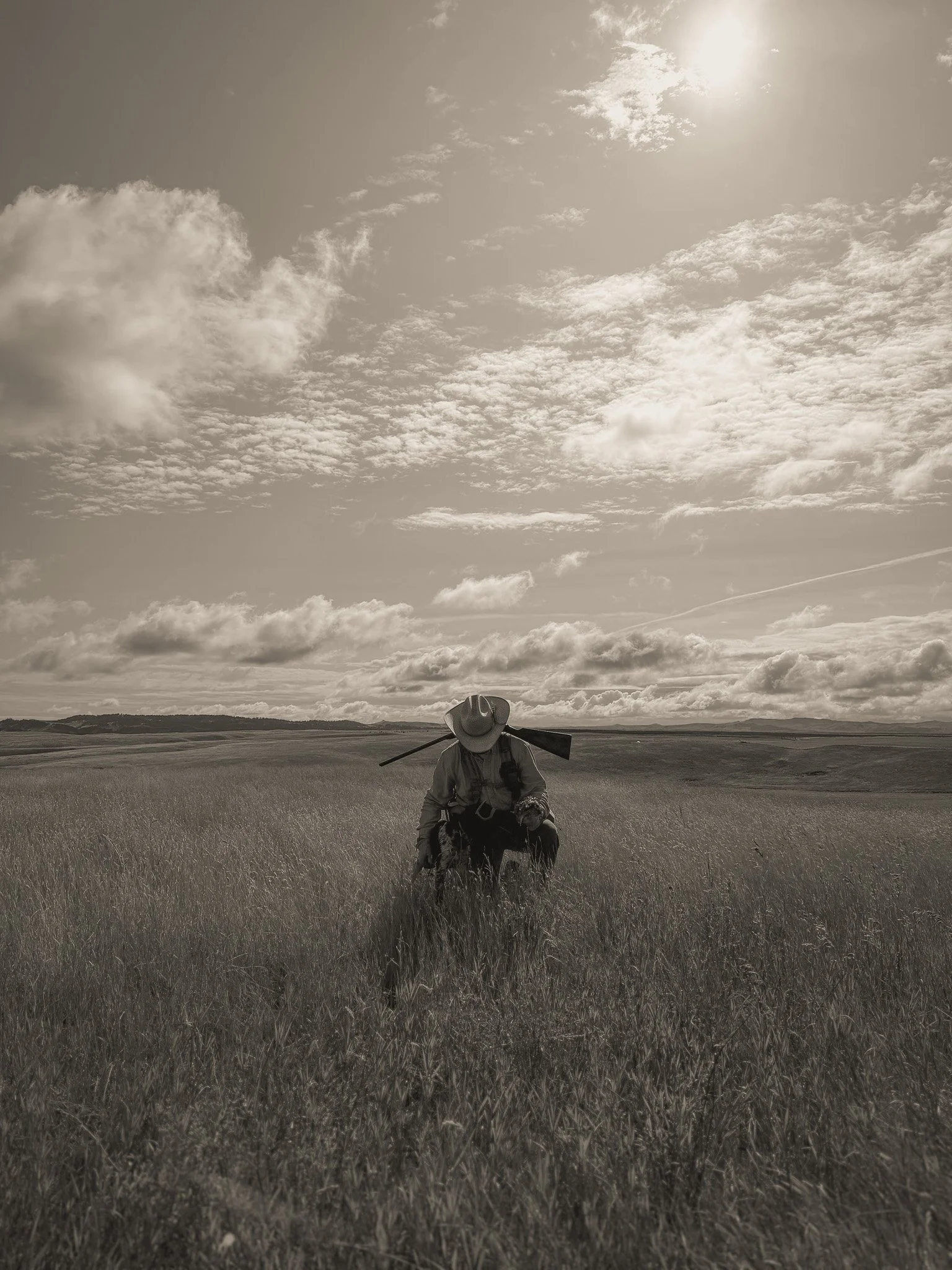
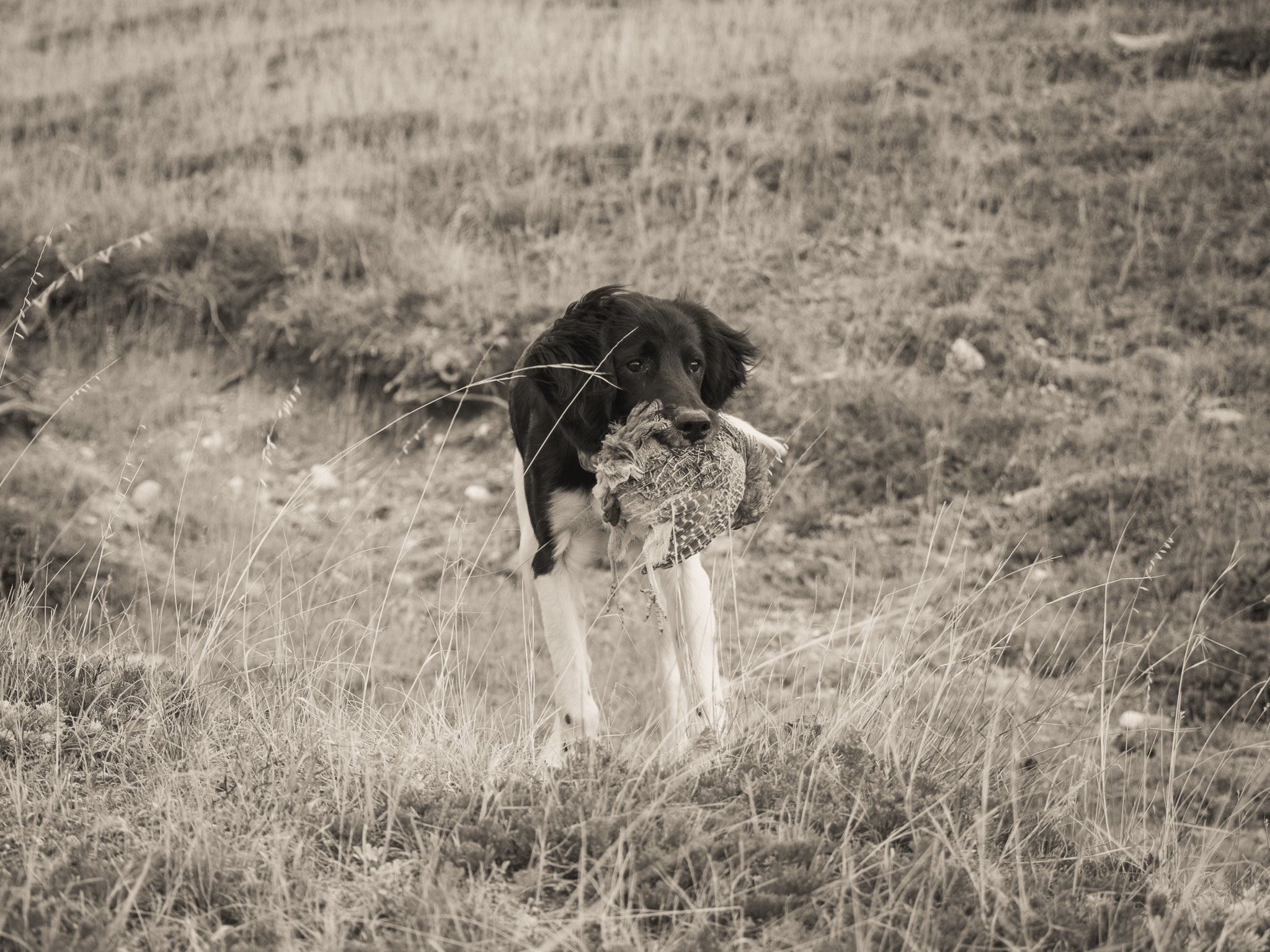
Amos with his first bird on the Montana prairie.
The following day, Aldo, Amos, and I had the privilege of hunting with fellow LMAA member Zach and his Large Münsterländer, Sable Point’s Chicory, better known as Poke. I had never seen a dog demonstrate such steadiness on wild birds. Watching Poke work was an education in itself: a picture of what experience, training, and countless hours afield can produce.
With all three dogs on the ground, I could see three distinct expressions of the same versatile breed. Poke hunted with remarkable composure and steadiness. Aldo worked the country with the drive and experience he had accumulated over four seasons afield—along with the enthusiasm and occasional excess that make him unmistakably Aldo. Amos, meanwhile, was still discovering what the prairie was asking of him.
That was precisely what made the opportunity so valuable. Amos did not need to perform like either of the experienced dogs beside him. He needed birds, time, and the freedom to begin connecting the pieces for himself. Running alongside Poke and Aldo gave him the opportunity to explore while two seasoned dogs showed him, each in his own way, what purposeful searching looked like.
Zach gave us the opportunity to do that in country he had every right to keep to himself. His generosity provided the bird contacts I had struggled to create on my own and reminded me that, while a dog must ultimately learn to hunt through experience, we rarely provide those experiences without help from others.
After a memorable morning afield with Zach and Poke, we said our goodbyes. Zach needed to get home and pack for an elk hunt. I wished him luck and did my best to express my gratitude—not only for the country and bird contacts he shared with us, but for the knowledge that came with them. Aldo, Amos, and I continued on alone, but Zach’s generosity had changed the trajectory of our trip. Amos now had wild birds to think about, and I had been reminded what purposeful dog work could look like. We parted ways, but the value of that morning followed us into the fields that came next.
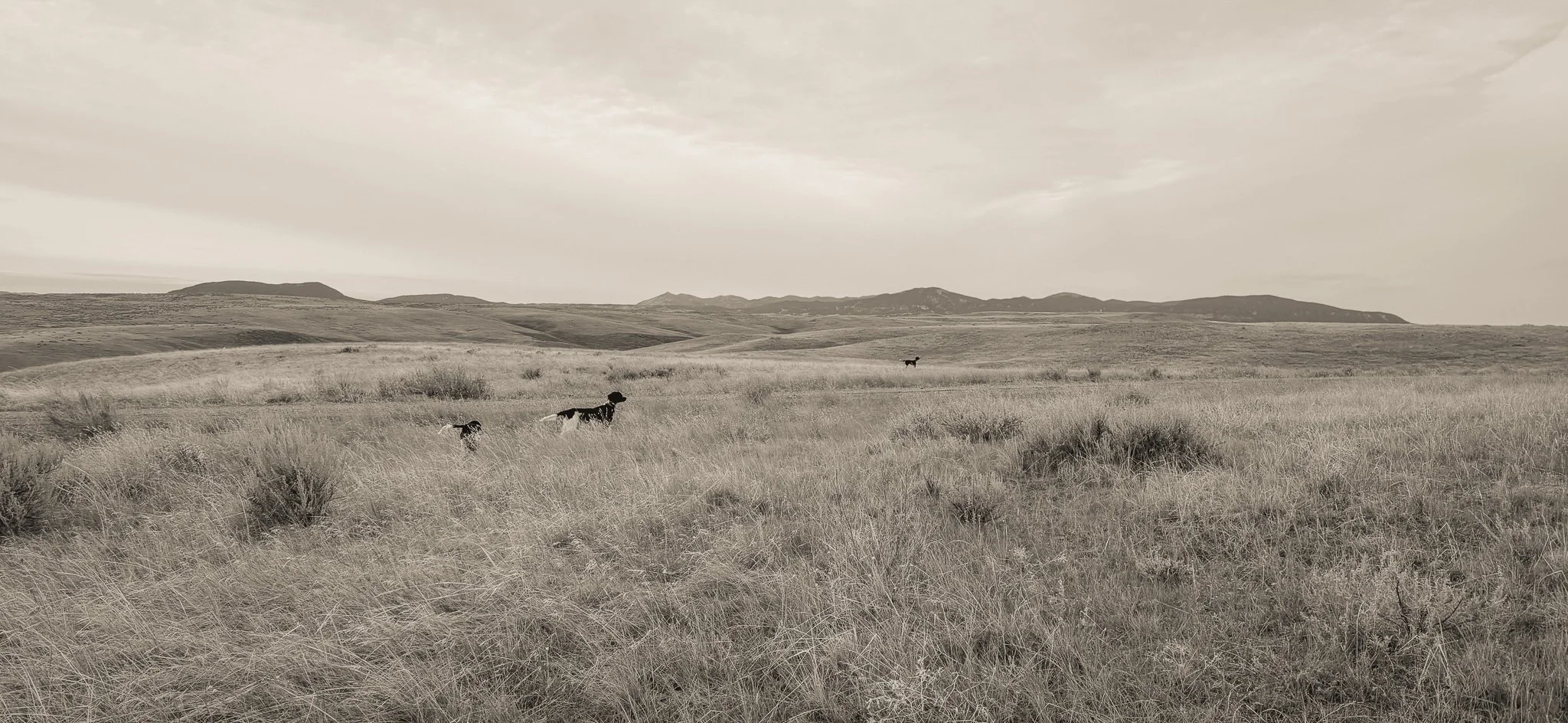
Three Large Münsterländers in the field. Poke, on point in the background, Aldo backing, and Amos, running up as if to say, “wait for me!”
For the remainder of our time in Montana, Amos’s movement continued to look less random. His enthusiasm remained, but increasingly, it found direction. He began reaching into likely cover with greater purpose, allowing his snorkel to guide him. The puppy had not disappeared. He was simply beginning to understand what all that country, wind, and scent might contain.
He also became a remarkably reliable helper when it came time to recover birds. Each remained a cherished prize, but the ensuing game of keep-away gradually diminished. Somewhere along the way, possession began giving way to cooperation. He was no longer merely finding something valuable for himself; he was beginning to understand that we were hunting together.
Still, recovering a bird produced by another dog—or stumbled upon by a hunter—was one thing. Finding birds with his own nose and putting them in the air would be something else entirely.
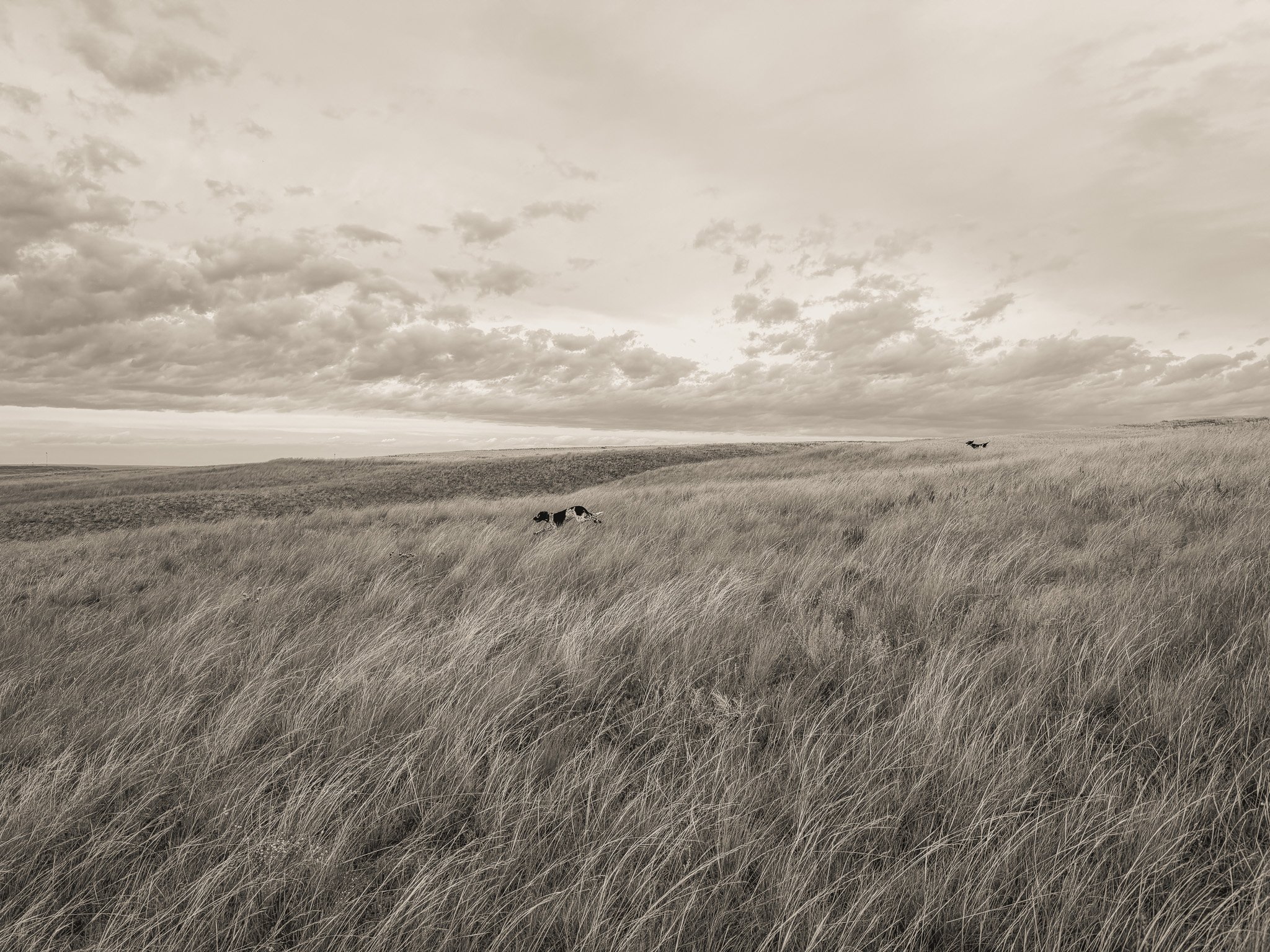
Amos, no longer following Aldo, is in the foreground on his own search for something. In the background, Aldo, a veteran of the Montana prairie, unimcombered by his “little brother,” searches further for Sharpies.
And then it happened.
I watched that little snorkel go to work among the sagebrush and prairie grass and produce a pair of Sharp-tails. I nearly failed to shoulder my gun in time. I was too elated watching Amos use the wind, follow something unseen, and discover that the something was a game bird.
The pair split across the coulee—one left and one right. My first shot dropped a bird into a distinct opening between two patches of snowberries. The second did not appear to be hit as cleanly and continued toward cover where it could easily disappear into the landscape.
Out of the corner of my eye, I could see that Amos pivoted toward the first bird. Given the reliability he had begun demonstrating on recoveries on the last few birds, I trusted him to keep looking. I knew where that bird had fallen and, more importantly, where to return if he needed help. I called Aldo and headed after the less certain bird.
Up and over we went. Aldo and I searched the area where I had last seen it. Feathers told me we were in the right vicinity, but there was no bird. I stopped and turned in a circle, trying to decide where to look next. To my surprise, Amos was standing directly behind me with a Sharp-tail in his mouth.
Man, he’s good at finding these things, I thought.
Because Amos had joined us where Aldo and I were searching, I assumed he had recovered the second bird. I rubbed his ears, took a few pictures, and then called for Aldo. We set off back down and up the coulee to recover the first.
We looked and looked. There were feathers, but no bird. Well, that’s what I get for being so confident I knew where it dropped. Then another possibility occurred to me: What if Amos had retrieved the first bird and carried it all the way across the coulee to find me? What if Aldo and I simply had not recovered the second bird yet? What if…
It was still early, and we had plenty of time to scrounge through the brush. Down and up the coulee we went again, returning to where Amos had found Aldo and me. I watered the dogs, and then we fanned out. And we found a bird.
Holy cow.
While Aldo and I had been searching for the second Sharp-tail, Amos had located the first, picked it up, and carried it down one side of the coulee and up the other to deliver it to me.
No keep-away. No hat waving. No negotiation.
A bona fide retrieve.
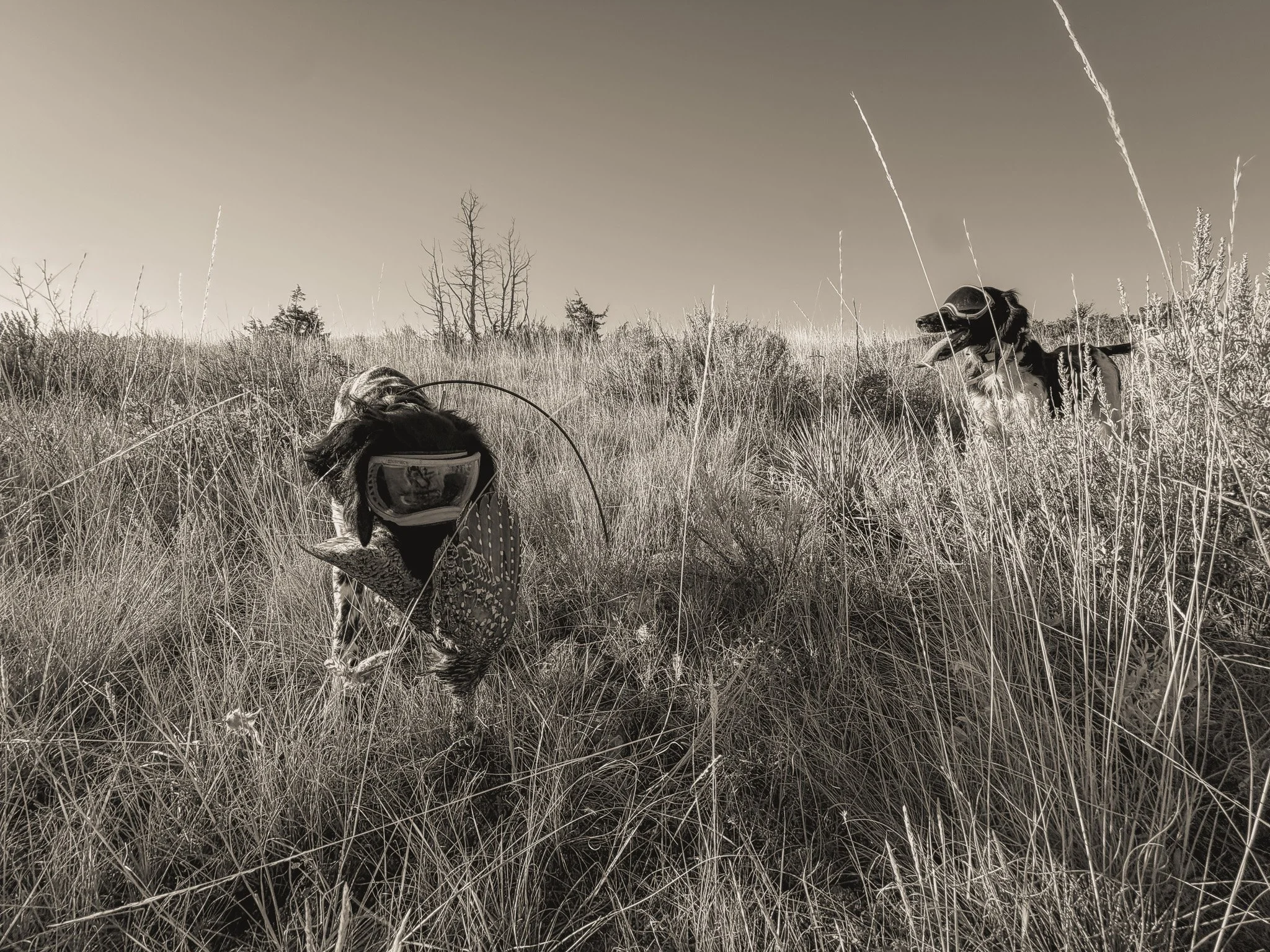
Amos’s first bona fide retrieve. Aldo waits patiently while Amos decides whether or not to part with the Sharp-tail.
As I write this, we are headed home from Montana. Both dogs are stretched out and sleeping, worn down by a week of scouting and a long weekend of hard hunting. The prairie has a way of wearing out both dog and man. It exhausts the body but breathes life into the soul.
I am returning home deeply indebted to the people who helped us. When I could not find the birds Amos needed, members of the Large Münsterländer community answered phone calls, shared knowledge, opened their country, and gave a young dog opportunities they had no obligation to provide. I will not forget that generosity and I can only hope to repay it tenfold some day.
I know this trip was formative for Amos. He left home as a five-month-old puppy who mostly frolicked through the field. He is returning as that same puppy—still playful, still distractible, and still possessing far more enthusiasm than polish—but now with a growing understanding of what his snorkel is capable of finding.
We have much more work ahead of us. There will be more hunts in new places for different birds, lots of mistakes with bumped birds and missed shots, and I suspect a few more games of keep-away. One week in Montana did not make Amos a finished bird dog. It did, however, give us a meaningful first step in what I hope will be a long and promising career as a versatile hunting dog.
Years ago, Aldo began such journey on the same Montana prairie, though I did not yet know enough to recognize it. This time, I knew what to watch for.
This time, I got to see the gears turn.
Thank you to everyone who helped make that possible.
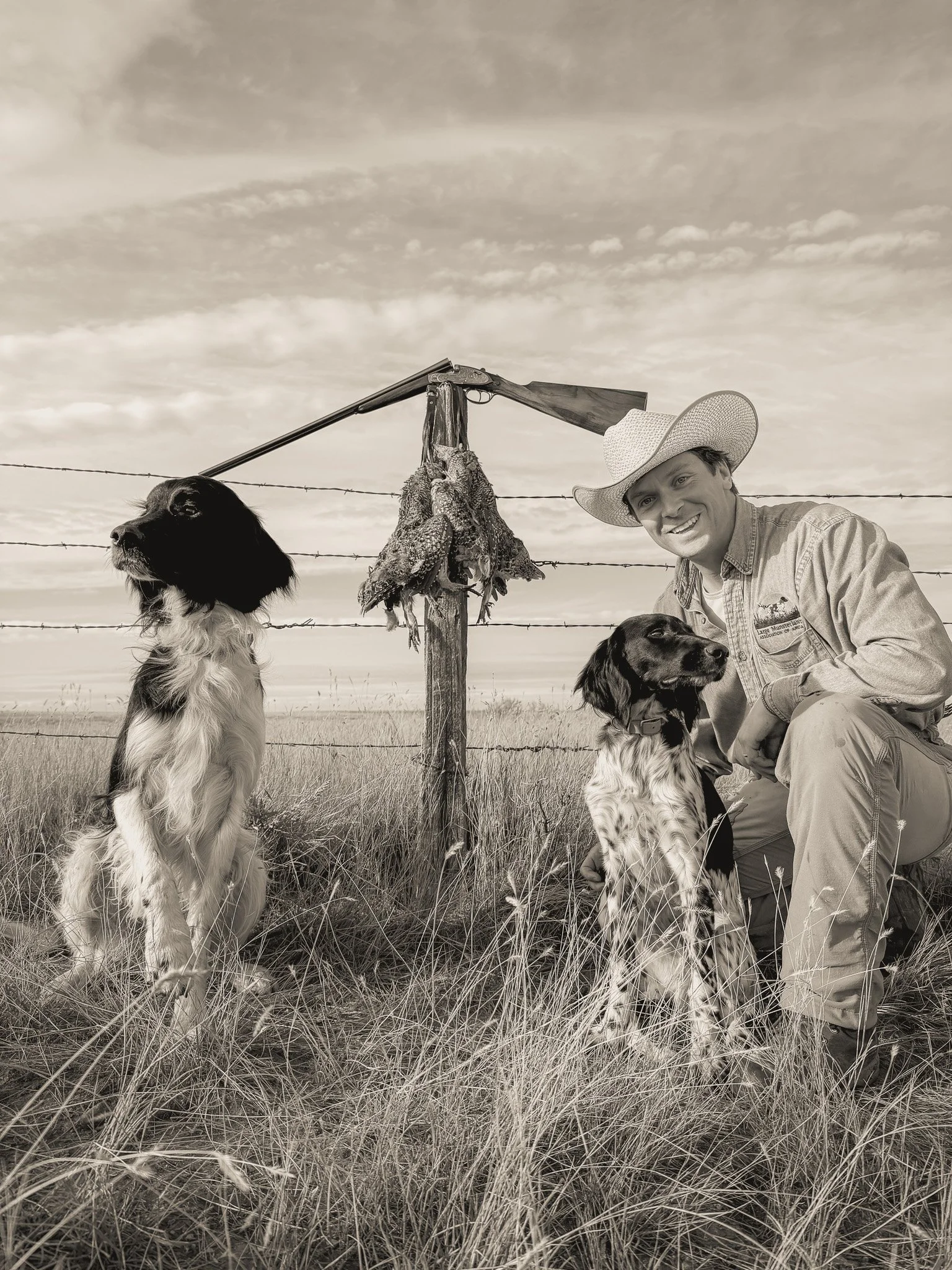
Pride and joy on the Montana prairie. Amos’s first limit.