Big Upland Abhors a Vacuum
I do not know what Big Upland wants me to buy this year.
This is one of the subtler benefits of leaving social media before I became serious about bird dogs. I do not know which vest has been declared indispensable, which shotgun has become embarrassing, or which obscure piece of European dog equipment is presently separating the committed from the casual. If upland hunting has trends, controversies, and accepted poses, most reach me late or not at all.
I take some pride in this, probably too much.
Unfortunately, the dining-room table, where I am simultaneously unpacking from Wisconsin and packing for South Dakota, provides contradictory evidence.
It is covered with chargers, maps, dog medicine, extra socks, and enough ammunition to suggest either extraordinary confidence or a complete absence of it. Nearby sit the new BioThane collars Alexis made for the dogs before Wisconsin. A traditional buckle adjusts each collar to the dog’s neck; a quick-release snap allows me to take it off without losing the fit. They performed well in Wisconsin. South Dakota will give them another opportunity to prove themselves.
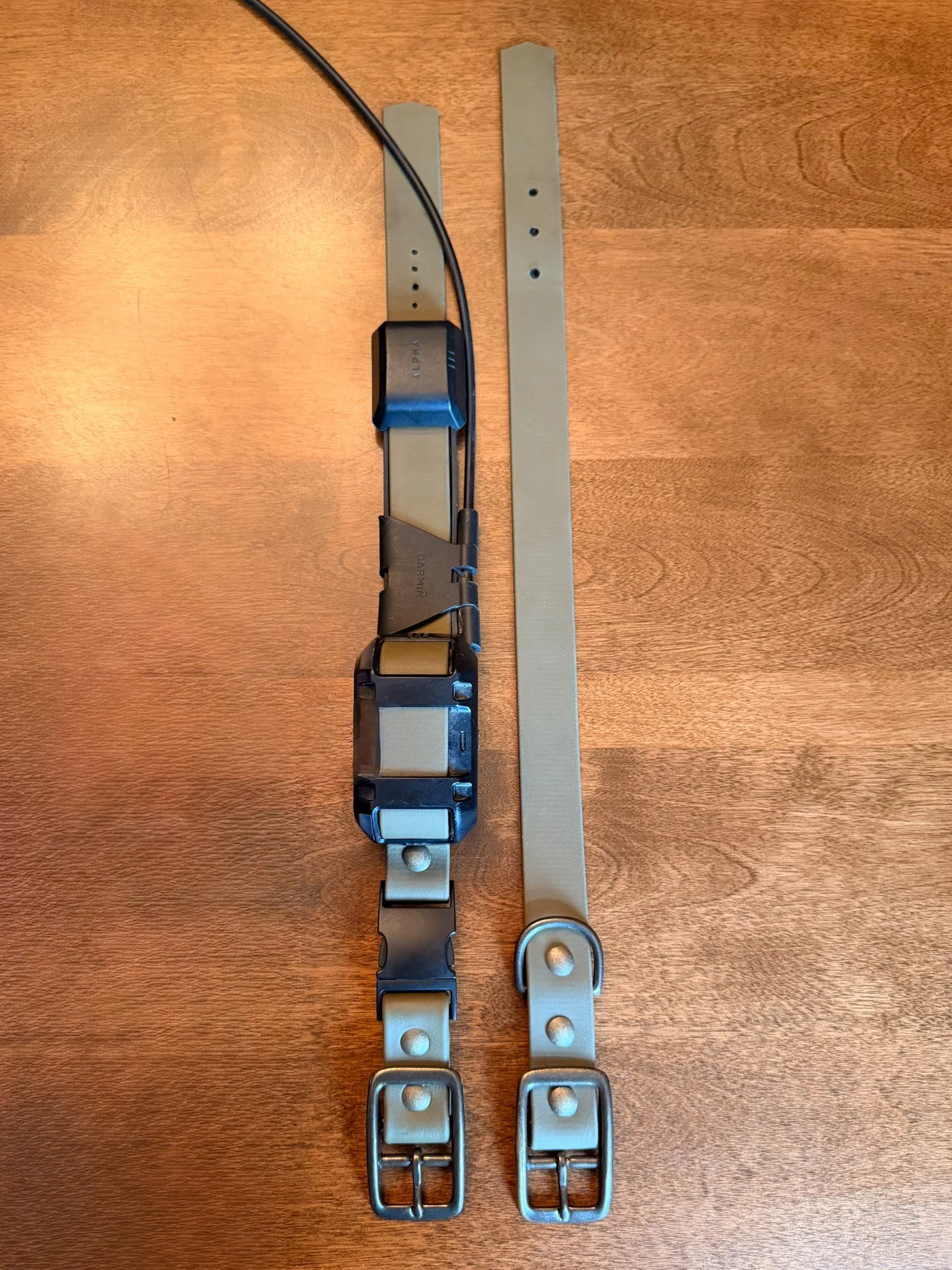
My wife made both sets of collars, the traditional as well as for the Garmin TT25.
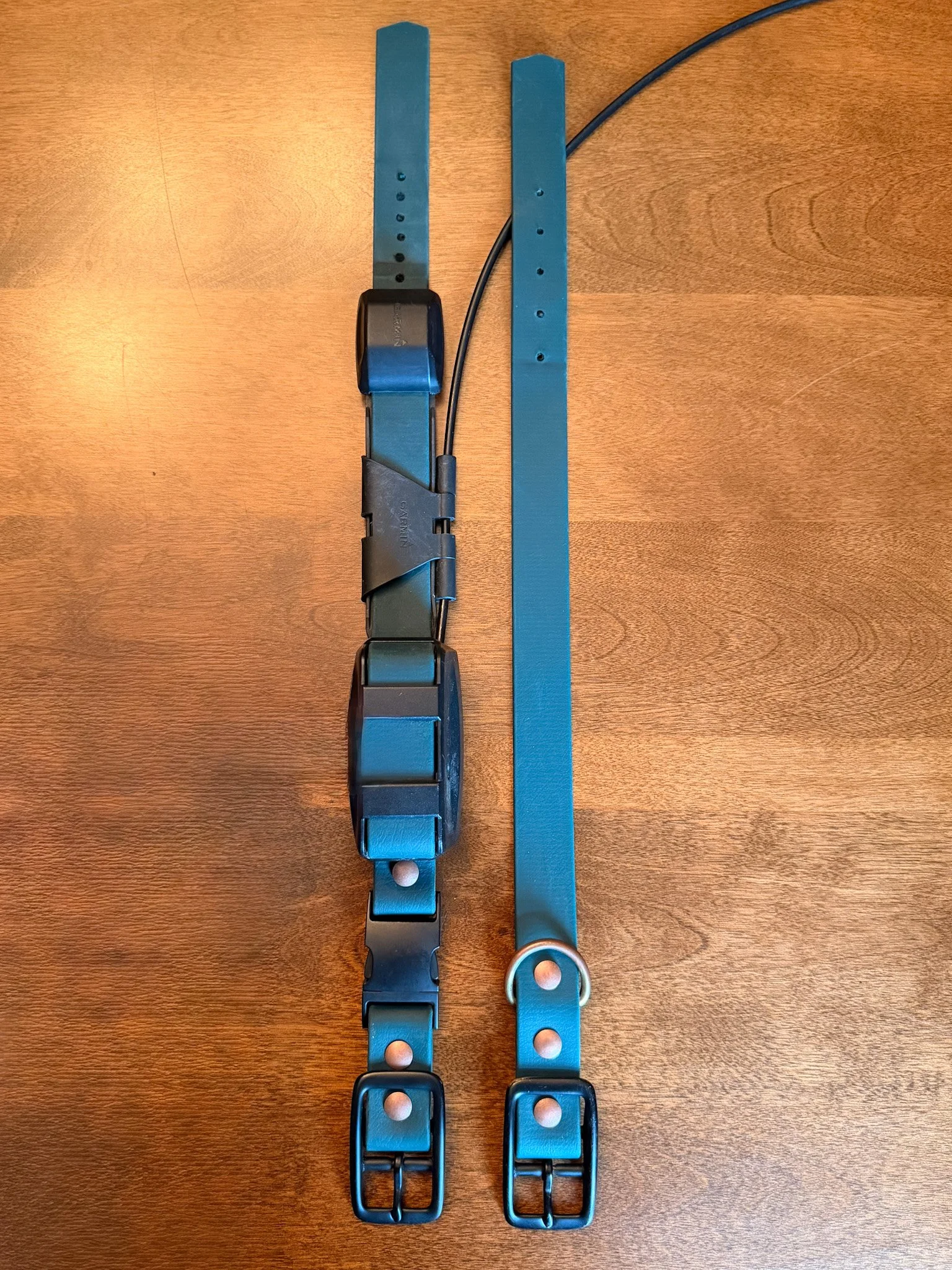
My wife made both sets of collars, the traditional as well as for the Garmin 15x.
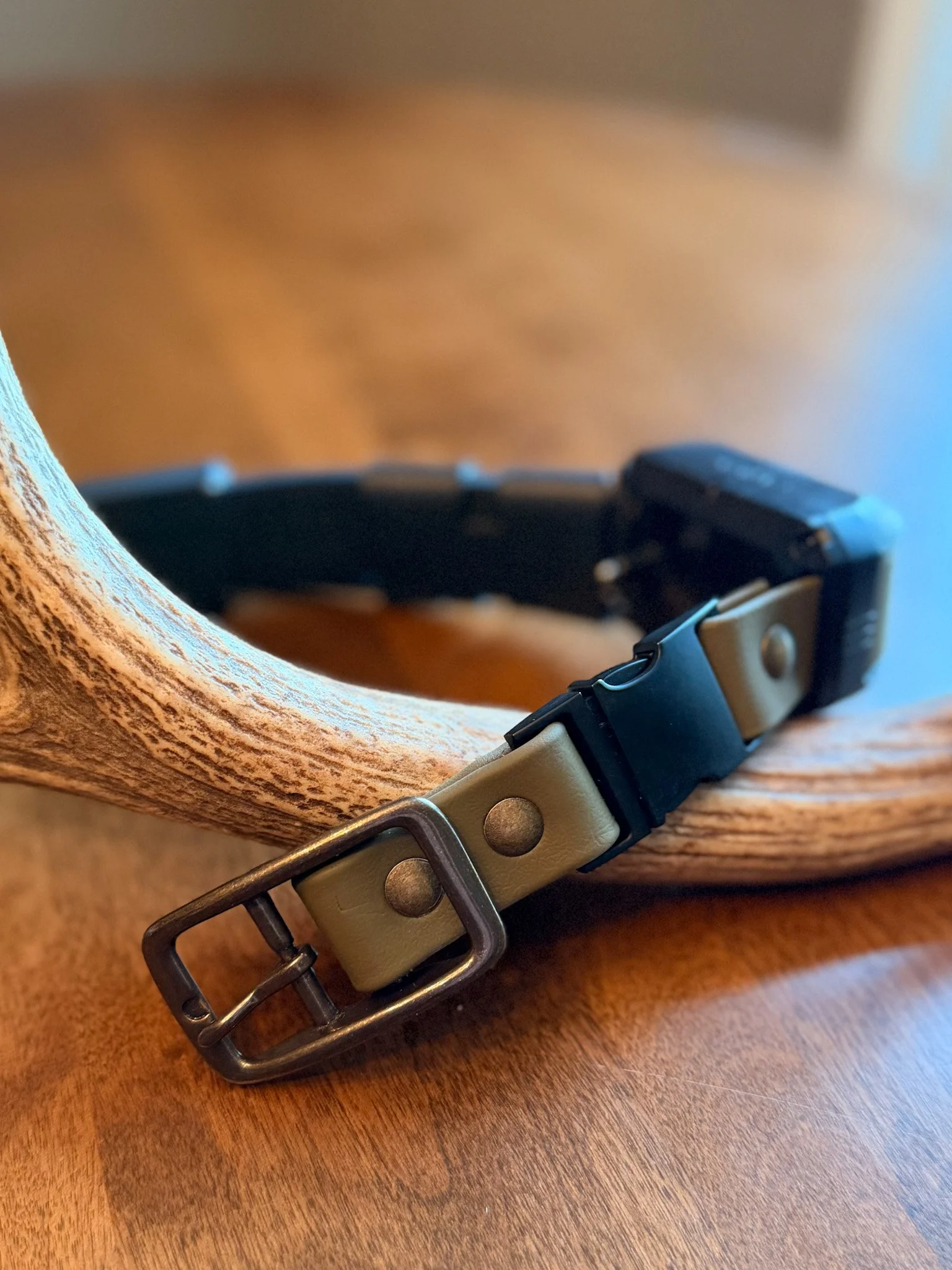
Hand-made by my wife for our dogs, these collars have a buckle to adjust to the dog’s neck. Once adjusted, the collar is then quick to don or remove with the metal snap.
Then there is the dog food. Buckets of it. Literally.
For long trips like this one, I used to haul dog food in capped PVC pipes. Like so many of my innovations in road-trip logistics, the system worked perfectly except when it didn’t, usually while I was spilling food across the tailgate. This time, I am trying smaller plastic tubs that once held protein powder. I am not convinced they will be the silver bullet for hauling 126 cups of dog food, but I am willing to let South Dakota decide.
By the time I add kennels, water, first aid, collars, chargers, leashes, bowls, and all 126 cups, the truck bed has shrunk considerably. I still need to pack my own underwear and lickies and chewies.
The sporting proposition itself remains simple: take a dog, a gun, and a few shells somewhere birds might be found. Yet despite years of trial and error, including the reduction of a full camp kitchen to a Jetboil and a freeze-dried meal, the truck feels no emptier. Big Upland abhors a vacuum. Remove one pair of boxers and the vacant space is immediately occupied by a backup charger, an extra dog bowl, or enough ammunition to defend the position.
Part of this can be blamed on a lesson delivered under the blazing sun somewhere near Saudi Arabia, after the hose on my CamelBak broke: “Two is one and one is none.” The maxim makes sense when water is spilling into the desert. Applied to bird hunting, it is useful only until it falls into the hands of someone incapable of distinguishing redundancy from anxiety.
Every item, along with its redundant counterpart, has a defense. Batteries die. Socks get wet. Dogs require bowls, medicine, water, food, and considerably more administrative support than they provide. Ammunition left at home is of no use in South Dakota, though experience suggests most of the ammunition taken to South Dakota will be of no use there, either. Individually, each decision is reasonable. Taken together, they have transformed the simple act of following a dog with a shotgun into a small expeditionary supply chain.
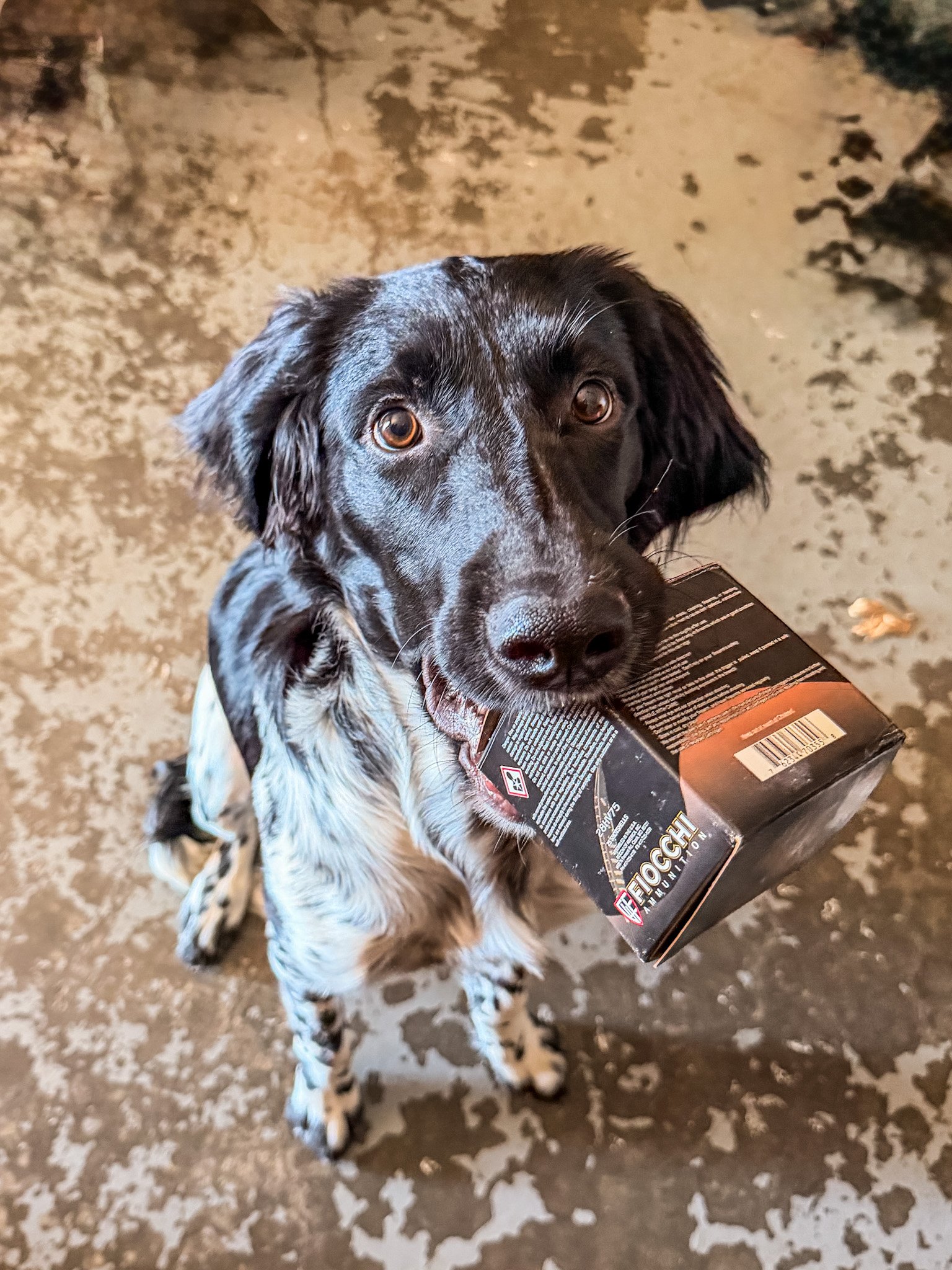
Pictured: Amos, “helping” me pack for our next trip. Not Pictured: the 25 shotgun shells strewn across the house that dumped out of this box as he gallivanted around.
This may be how Big Upland gets those of us who believe ourselves beyond its influence. It does not need to convince me that this year’s vest will make me a better hunter. It only needs to whisper that something might break, get wet, run out, disappear, or prove unexpectedly necessary several hundred miles from home. I supply the rest.
Wisconsin is still on my mind, although none of what happened there materially changes what I will pack for South Dakota. Alexis and I ate the ruffed grouse and woodcock last night. Both were delicious, arguably better than pheasant, though admitting that while packing for South Dakota feels vaguely disloyal.
I still want pheasants. I want to watch the dogs disappear into the grass and reappear somewhere farther ahead, their heads high and noses into the wind. I want to come home with a few birds, even if the amount of meat they provide cannot begin to justify the gasoline, dog food, ammunition, and freeze-dried stroganoff required to acquire them. Mostly, I want to return to a place where I understand how to hunt with my dogs.
The Northwoods complicated that understanding. In Wisconsin, Aldo could be twenty yards away and nearly invisible. I heard his bell moving through the cover, but I could not watch his search tighten or see his body change when he entered scent. I knew he was hunting. I simply could not participate in the usual way. Much of the conversation I had learned to conduct through his movement took place beyond a wall of timber and briars.
South Dakota offers the opposite, or at least I have decided that it will.
This will be my fifth trip there with my friend and dog-training mentor. We look forward to it each year. The country is familiar enough to inspire confidence and large enough to punish it. There are fields where I expect to find birds because we have found them there before, which is among the least reliable forms of evidence available to a pheasant hunter. Nevertheless, I have begun assigning South Dakota responsibilities it has not agreed to accept. Wisconsin frustrated me. South Dakota will restore the conversation. The grass will open before us, Aldo will run where I can see him, pheasants will rise, and the familiar order of things will return.

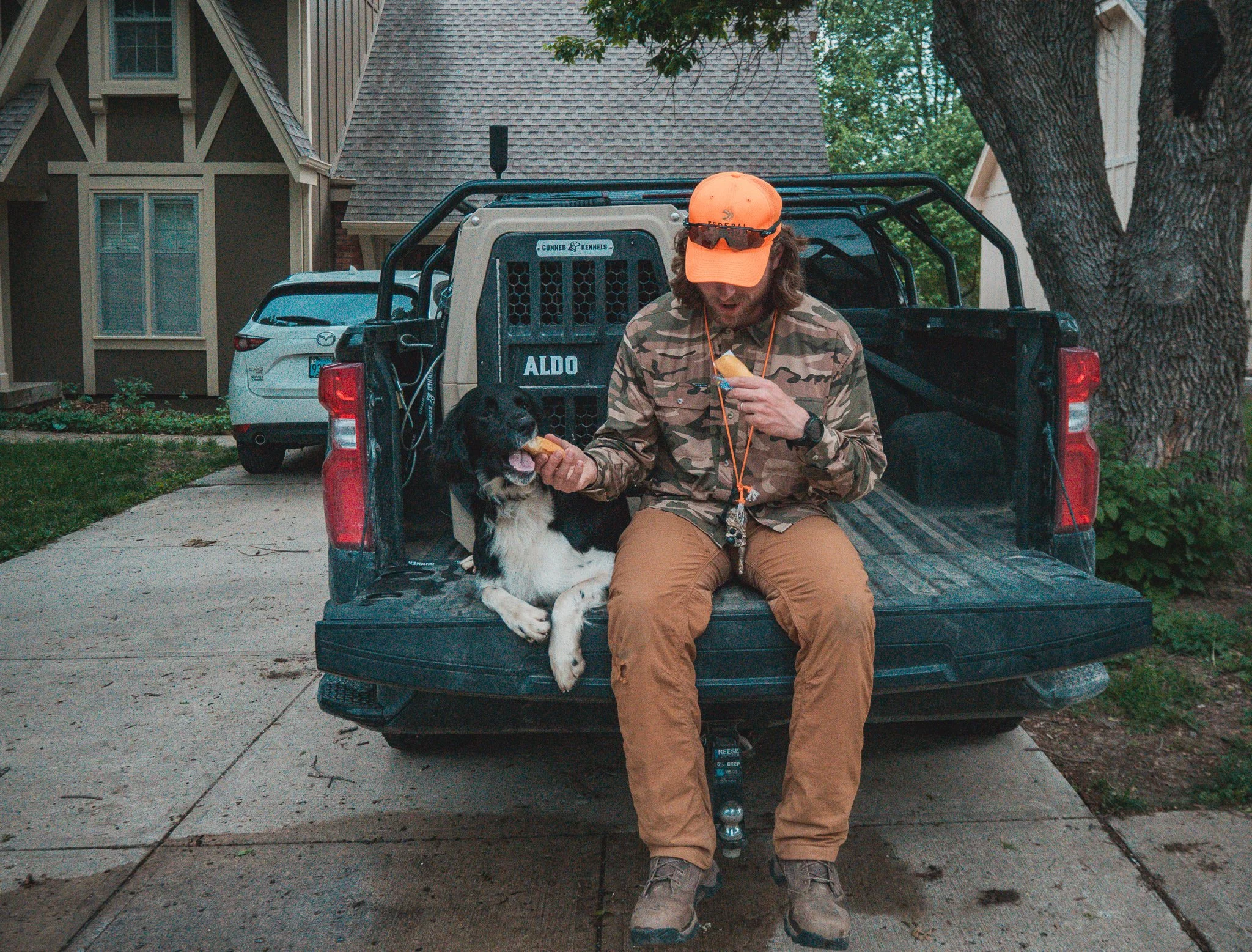
Aldo, bashful of the camera, and me with a pair of late-season South Dakota roosters, January 2026.
The pheasants, meanwhile, have done nothing to prepare. They have not studied the weather or inspected the equipment spread across my dining-room table. They do not know this is an annual tradition, that I am returning with expectations, or that I have brought enough ammunition to defend their home range against a substantially larger force. They are unaffected by the frustrations I carried home from Wisconsin. They will be wherever they are, and not necessarily where experience, optimism, or Big Upland’s back catalog suggests they should be.
The dogs are nearly as indifferent to the larger meaning I have assigned the trip. Amos needs wild birds. His education began in Montana, continued in Wisconsin, and will, I hope, advance considerably in South Dakota. At his age, there are lessons no training field can provide and no handler can reproduce. He needs scent laid down by birds that have their own intentions. He needs enough contacts for some of his scattered enthusiasm to gather into purpose. South Dakota may give him that opportunity. Or it may not.
Aldo presents a different problem.
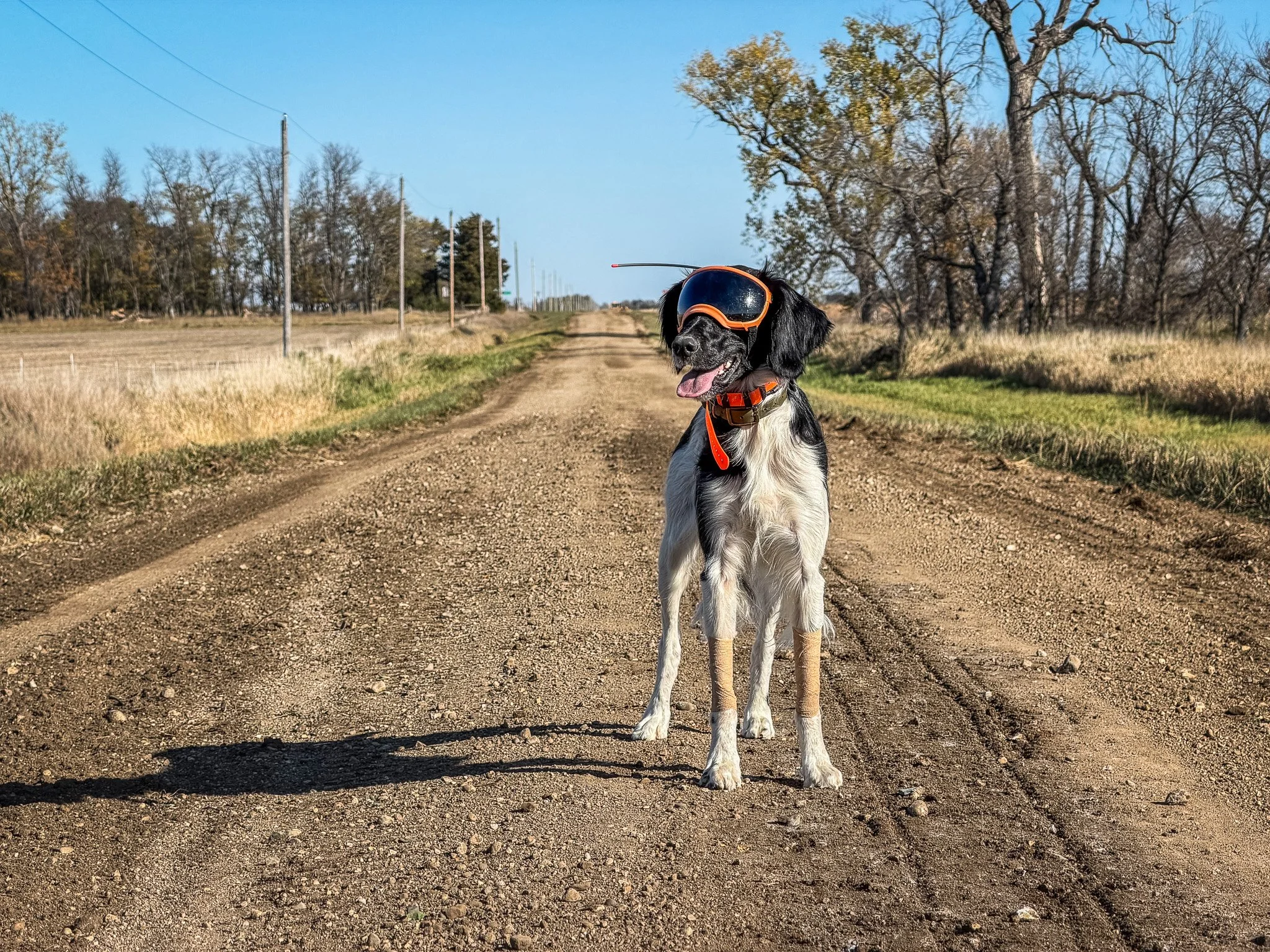
His body looks mostly recovered from Wisconsin. The sores have closed, but his fur remains too thin over the places the cover wore raw. I know him well enough to recognize the difference between healed and ready, just as I know that Aldo recognizes no such distinction. If the truck points toward bird country, he is prepared to hunt. If I reach for a shotgun, he assumes it belongs to us.
At some point in South Dakota, I will probably leave him in the truck and take Amos without him. Aldo will need the rest, and Amos deserves a larger share of the wild-bird exposure. It will be the correct decision. I have already rehearsed its logic.
Aldo will not be persuaded.
He will watch me remove Amos from the kennel. He will see the gun, hear the door close, and understand that the hunt is leaving without him. Then he will bark. He will continue barking as Amos and I walk away, perhaps until we are beyond his sight. I will know that leaving him behind is an act of care. It will not feel like one.
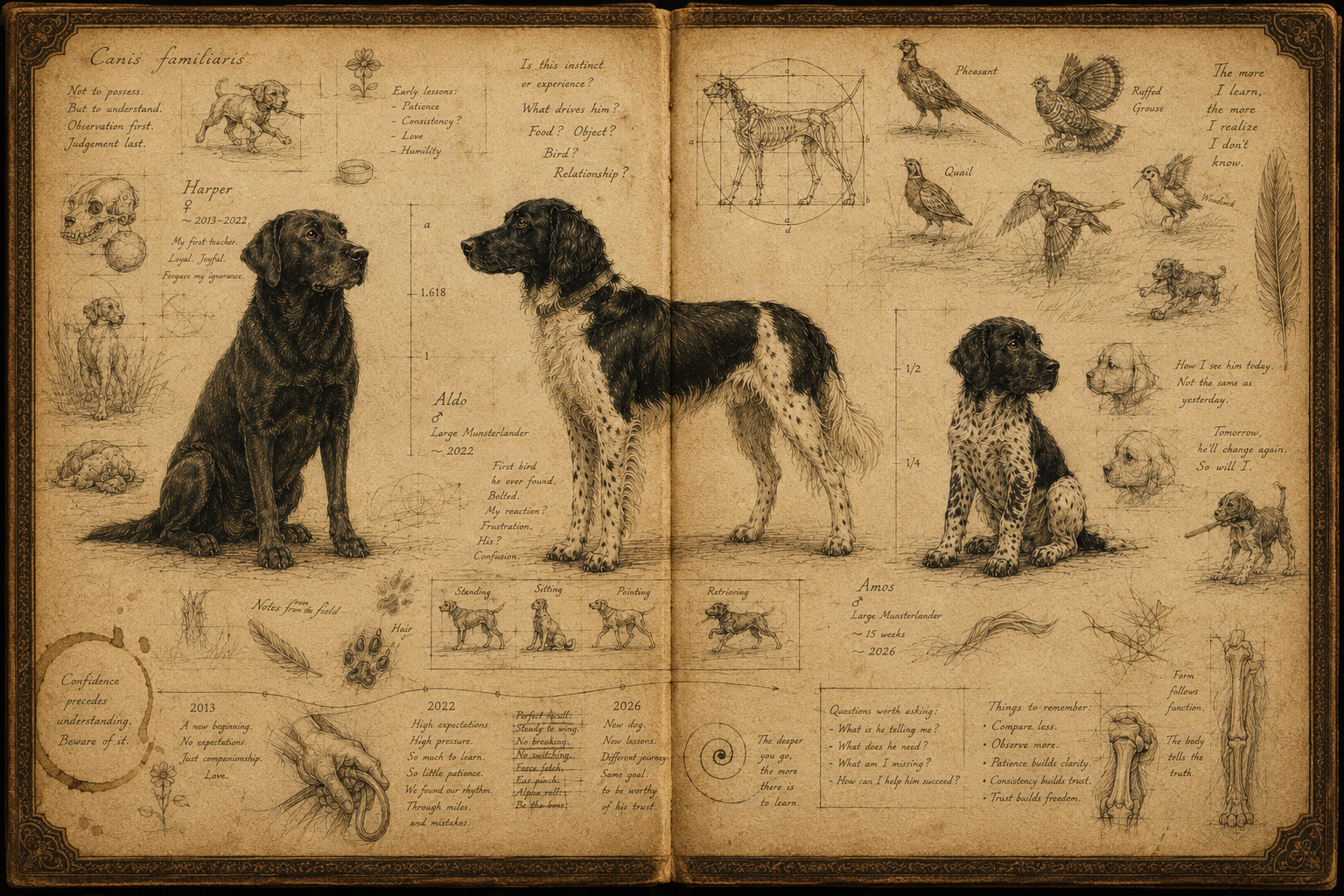
I can prepare for dead batteries, wet socks, spilled dog food, minor injuries, cold mornings, warm afternoons, and a surprising range of other contingencies. I can bring duplicates of almost everything. What I cannot bring is another Aldo. Amos is not his replacement, and Aldo is not an older version of Amos. One dog needs opportunities that the other dog helped teach me how to provide. The other needs me to recognize when wanting him beside me is not the same as doing what is best for him.
No item on the dining-room table makes that decision easier.
Perhaps that is the flaw in all this preparation. Every charger, first-aid kit, spare bowl, and box of shells suggests that another uncertainty can be anticipated and answered. The pile grows because preparedness occasionally works. A dead battery becomes a minor inconvenience when another is waiting in the truck. Forgotten food can be purchased. Wet socks can be replaced. Problems become objects, and objects can be packed.
But the most consequential parts of hunting with dogs are not logistical problems. They are judgments. No backup charger can tell me whether Aldo should hunt another field. No map can tell me whether giving Amos more opportunities is worth leaving Aldo behind. Big Upland can sell me the means to find a dog several miles away. It cannot tell me when to leave one in the truck.
For now, Aldo rests by my shotgun case, ensuring that it does not leave the house without him. Amos bounds from room to room, “helping” me pack. So far, his assistance has required me to retrieve the contents of three shot shell boxes from the floor. The collars are ready. The batteries are charging. One hundred and twenty-six cups of dog food wait in repurposed protein-powder tubs. Somewhere in South Dakota, the pheasants remain gloriously unprepared.
Soon enough, we will discover which of us was ready.
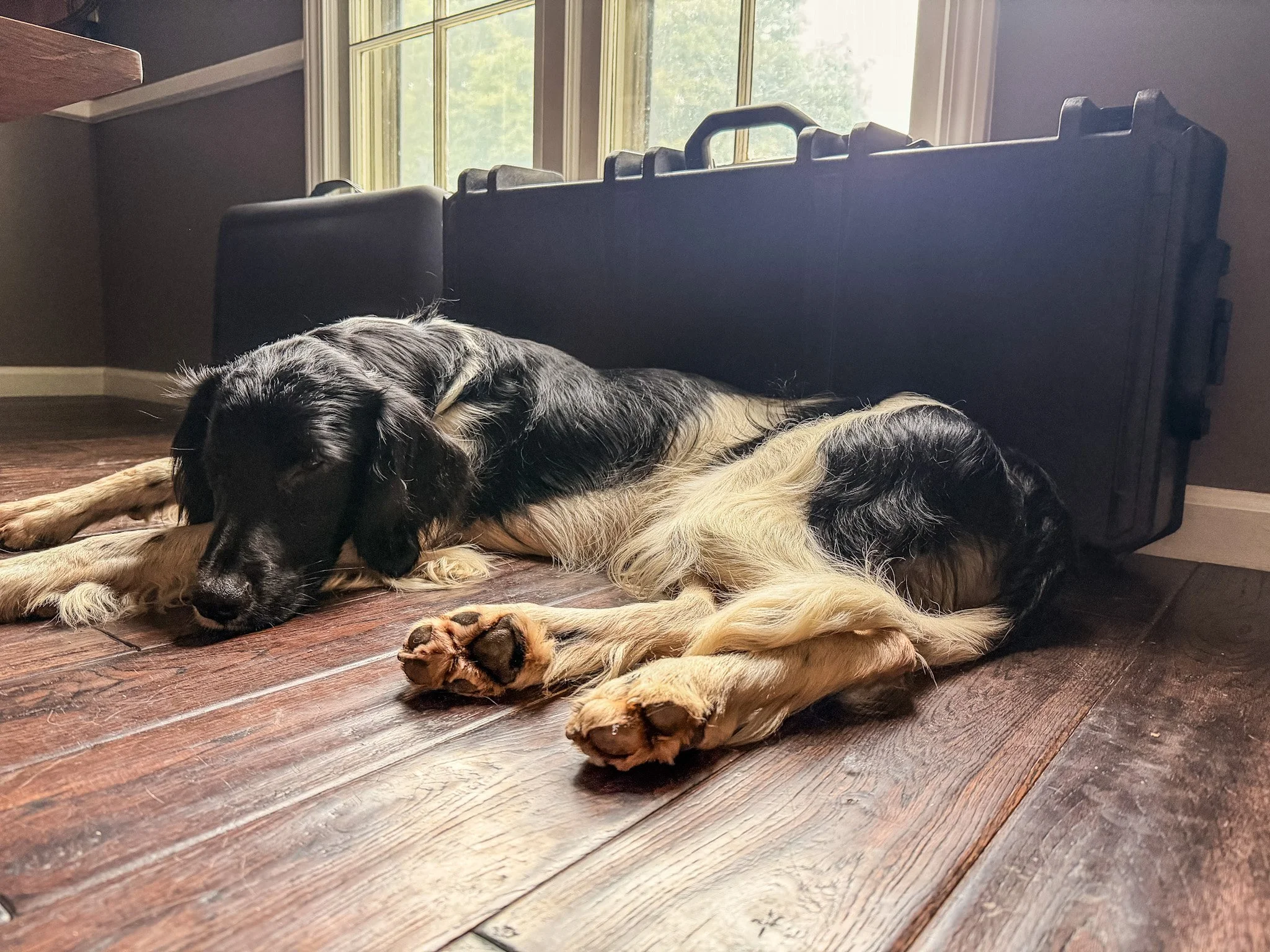
Aldo, resting against my shotgun case as I pack, ensuring it does not leave this house without him.
Read more Stories about Aldo and Amos