The Search for Amos
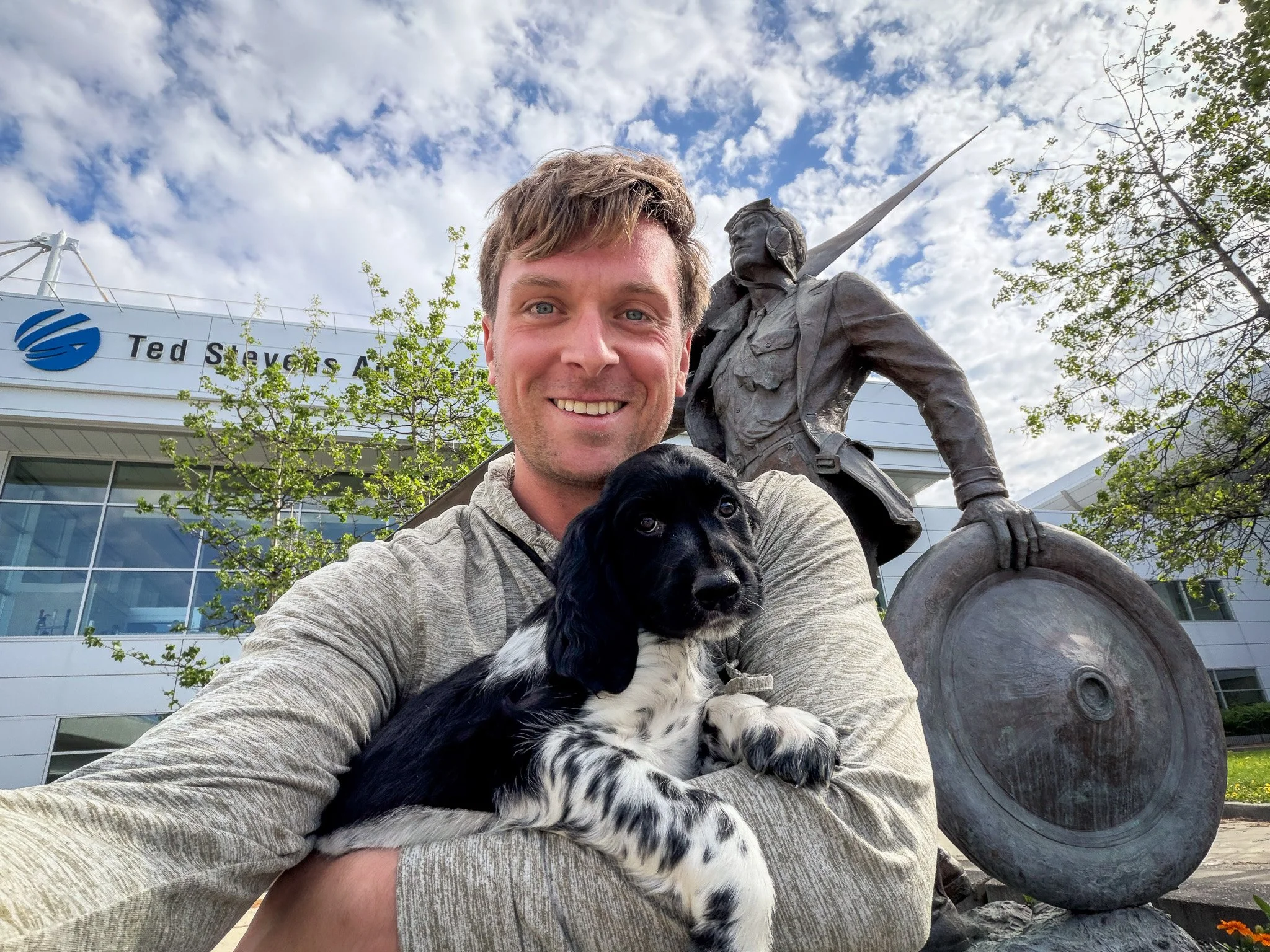
Amos and me waiting for our flight out of Anchorage to fly home to Kansas.
I found my first dog, Harper, among a checkerboard of classifieds of the Kansas City Star newspaper. “Black Lab Puppies” in bold typed above a phone number. It was succinct, to say the least. A few days later, I had a black lab puppy squirming in my arms. Admittedly, my expectations and criteria were nearly nonexistent—I just wanted a dog—and that surely played a role in how simple the acquisition was.
Years later, when I started the process to find Aldo, my search criteria was only slightly more refined. I was indifferent to breed, gender, or traits—I just wanted a hunting dog. I was a zealous big game hunter that enjoyed the occasional duck or pheasant hunt. I saw the next dog as an opportunity for efficiency and convenience afield, and I was oblivious to the breadth and depth of bird dogs and their breeding.
With no more than a baseline requirement of “hunting dog,” I gave my wife carte blanche to determine what the sex and breed would be of the next dog. She would have to live with it too, after all. She ultimately settled on a male Large Münsterländer, a breed that I, like so many others, didn’t even know existed.
“Large Münsterländers are good-looking, energetic, all-around gundogs. The breed has strong and dynamic clubs in Germany and North America focused on keeping Large Münsterländers in the hands of hunters and out of the show ring.”
I’m not sure how she came across it, but an Instagram post of one of these beautiful dogs is what initiated Alexis’ research into Large Münsterländers. We convened, I agreed that the dog was in fact beautiful, and what little information we could find indicated that such a dog would be a good fit for us.
Months of emails and phone calls (e.g. breeders “interviewing” us) made it apparent to me that finding a particular dog is extremely more complicated than perusing the Sunday classifieds. I couldn’t believe that there were wait lists for dogs. I was just as surprised to learn that many breeders, especially in the Large Münsterländer community, are particular on where their puppies are placed. Large Münsterländers are hunting dogs, and their breeders will only place their dogs in hunting households.
But you know how that story ends. We welcomed Daredevil Comanche (better known as Aldo) into our home in June 2022.
About two years ago, I began the search to add to my string. While Aldo wasn’t yet a finished dog (some may argue, still isn’t), he was a stalwart partner afield, and I was beginning to have the bandwidth to train the next dog. But this time, my wife didn’t have carte blanch on the puppy picks, and I certainly wasn’t going to entertain a local classified add. I had grown to be more discerning in what I wanted in a dog.
I had learned about hip dysplasia (which Aldo has), eye injuries, infections, and other ailments that can lurk in a dog’s genes. I had learned about the stress a dog can carry, how that can impact their willingness to eat and sleep on the road, and how that can influence the hunt. I was—and still am—enamored by the Large Münsterländer breed, but I wanted to take every step and precaution possible to ensure that this next dog would be healthy.
Armed with the bona fides of an established Large Münsterländer owner, a NAVHDA chapter board member, and a trove of photographs documenting a life well lived by both dog and man, the next round of emails and phone calls with breeders came with far less friction. The conversations still felt like interviews, but this time I was asking as many questions of the breeders as they were asking of me.
I didn’t choose to place my name on every breeder’s list. Perhaps I was gun shy and overly cautious, but a puppy is commitment measured in years—and not one to be taken lightly. Before reaching out to a breeder, I leveraged the NAVHDA testing portal to research the dam and sire. If the trends were positive (e.g. previous litters from this dam produce “4’s” in Use of Nose), then I would schedule a call with the breeder. The approach is far from perfect, especially given how few Large Münsterländers there are, but it provided a starting point for me.
I found myself hesitant to commit to the waitlists of breeders who were slow to respond or offered little more than generic answers. Instead, I was drawn to those who spoke passionately about their dogs and the breed itself, while also demonstrating a thoughtful understanding of their dogs' proficiencies afield. Again, this was a commitment measured in years, and while dogs have been humbling the expectations of men since time immemorial, I wanted to be as confident as possible in the potential of this next dog.
For nearly two years, my name was added and dropped from waiting lists as breedings were planned and later fell through. Or breedings occurred, but didn’t take. Possibly the most disheartening instance was when I was No. 3 on the list, but the dam only whelped two puppies. It was beginning to feel as if I was chasing the Golden Fleece.
Until my phone rang on a rainy drive home from a NAVHDA test in April 2026.
“Heya, are you still looking for a pup?” A breeder, who I had previously been on a waitlist with, but their breeding didn’t take, asked.
“Oh boy am I!”
“Well, we just heard of a litter that had a buyer back out. If you’re still interested, I can put you in touch?”
Before I called, I quickly looked up the kennel, Team Miracle. I wasn’t familiar with the name, which I found odd, after the last two years of searching. And then I saw the address—Alaska. Shit. That’s why. The cost and logistics of getting a pup from Alaska to Kansas wasn’t simple so in all my searching, I had simply omitted the breeders in Alaska.
On the heels of the last two failed breedings, I elected to give the kennel a call. They had a real, living and breathing, pup on the ground. I should at least talk to them…
It’s about 1:30am local time and I’m somewhere between Anchorage and Kansas City. Beneath my feet, here on Delta Flight 0377, seat 14C, is a soft sided pet carrier designed for cats. Inside, Team Miracle’s Famous Amos.
Every so often I glance down to make sure he’s still there. He is. I can see his black nose pressed against the mesh. I tell myself to get some rest. But repose will not come. I am too excited.
Years of searching, hoping, and dreaming lie beneath my feet. The search has run its course. The Golden Fleece has been found. And yet my mind races—recall, place, don’t pee in the house…
All of a sudden, these things have inexplicably escaped me. It’s as if my memory has been wiped from all of the lessons learned from Harper, Aldo, and all of the other dogs I’ve met along the way.
The ding of the airplane’s seatbelt policy temporarily breaks the spiral of unfounded fears. I unbuckle my seatbelt and begin to rise, pausing halfway out of my seat.
I’ll be right back, Amos.
And I smile.
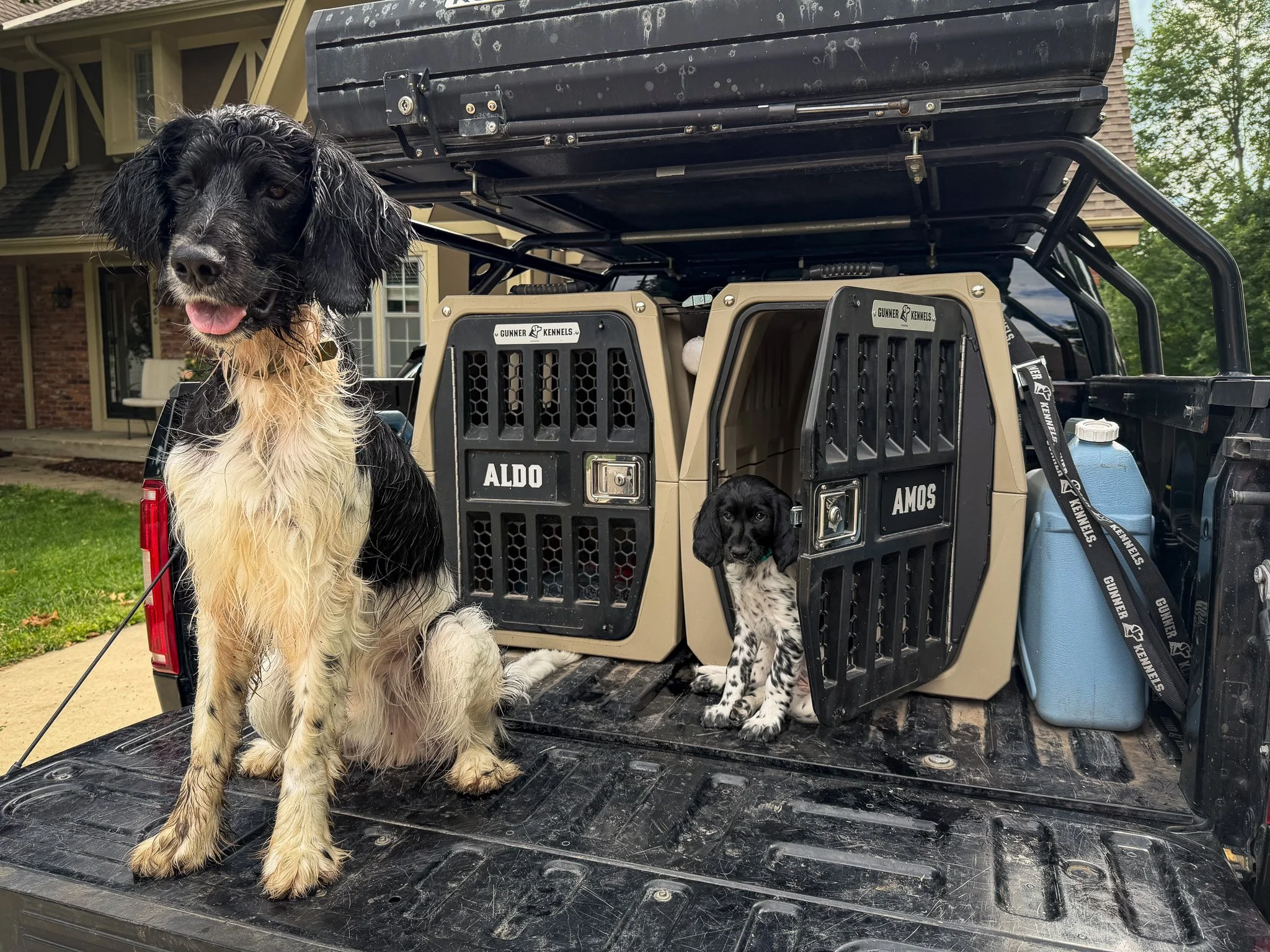
Aldo and Amos. After 12.5 hours and 2,762 miles of travel (double that, for me), Amos is home.