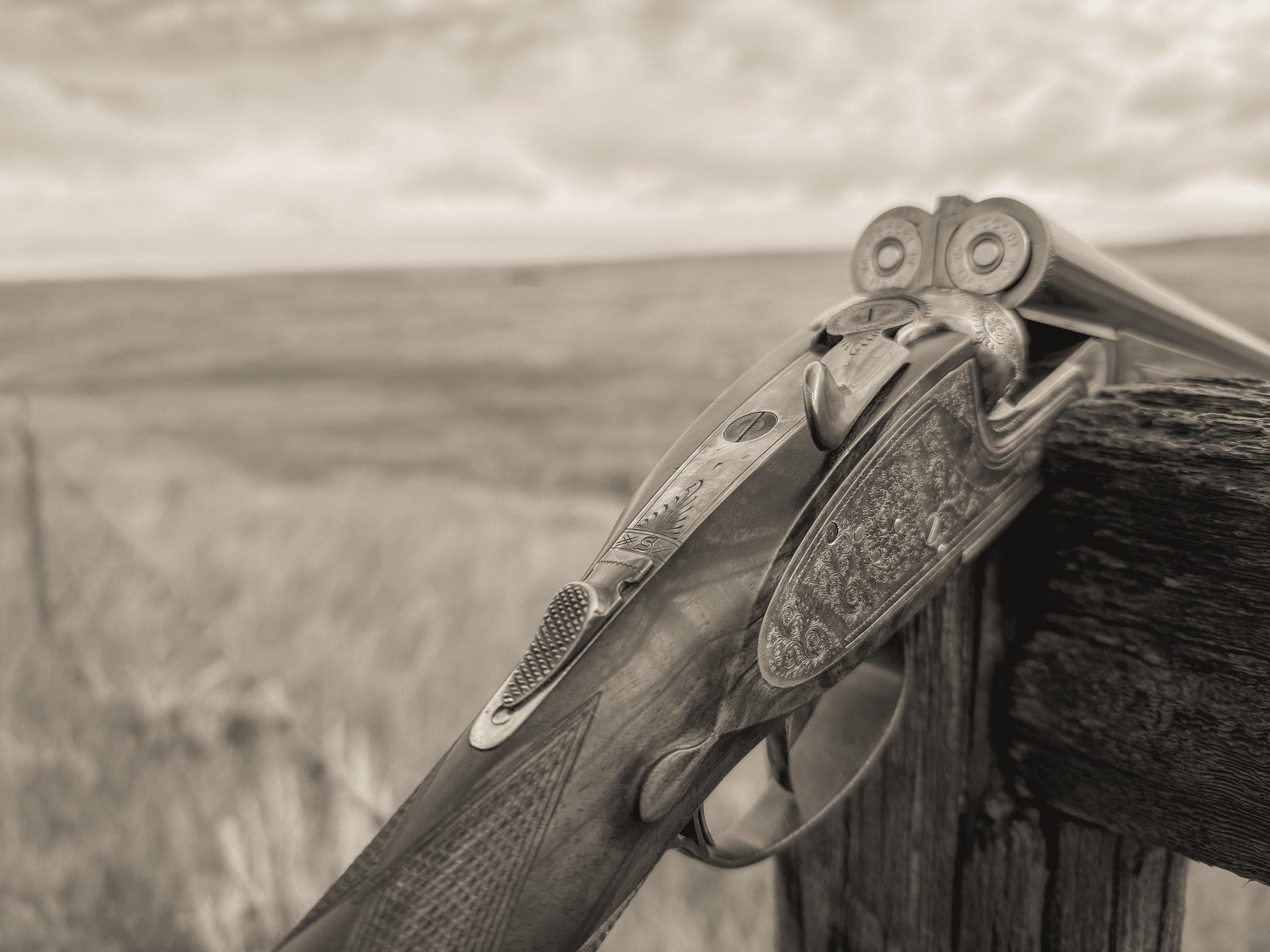
Dancing with Penelope: A Bespoke 28 ga Spanish Side by Side
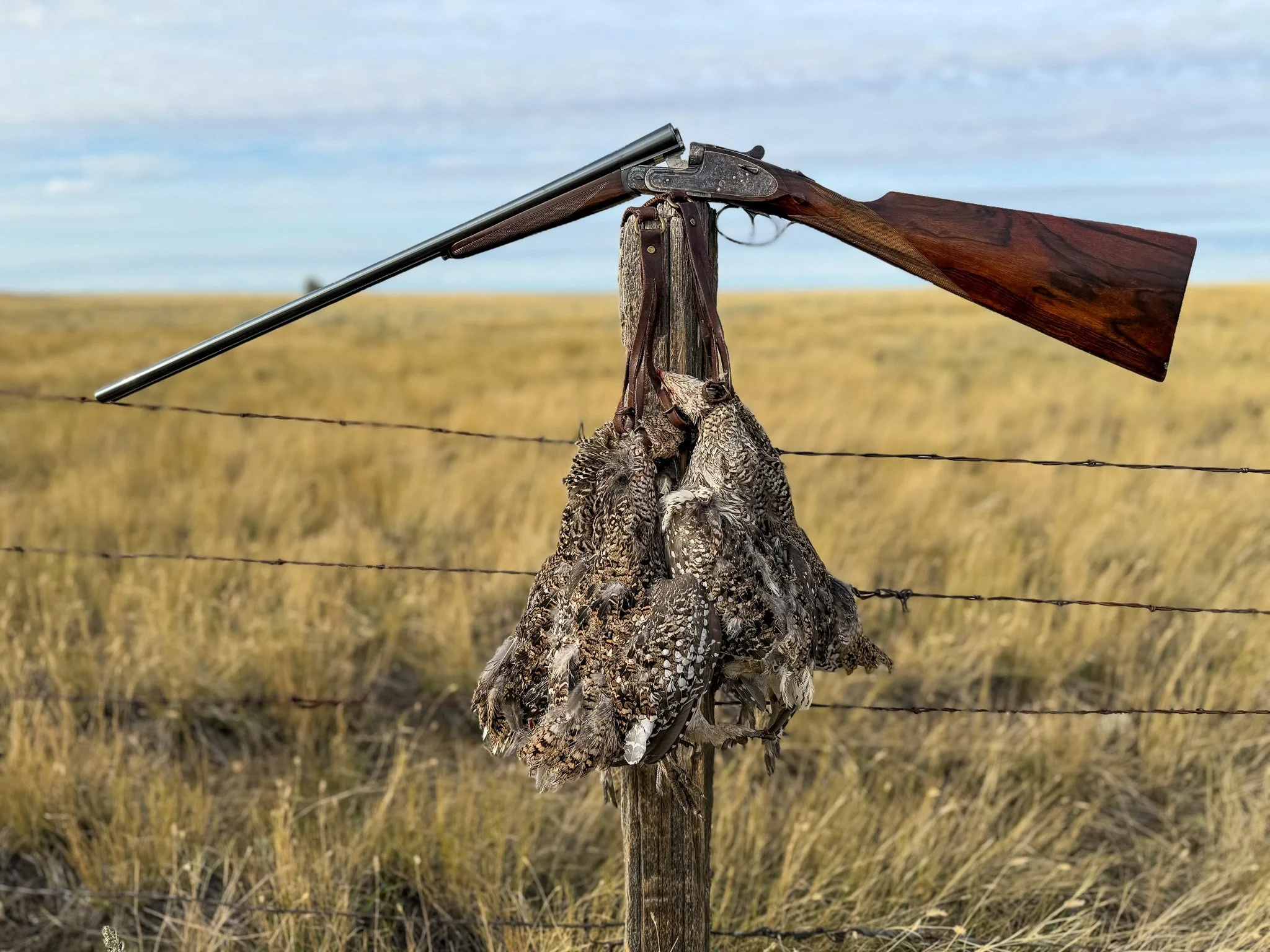
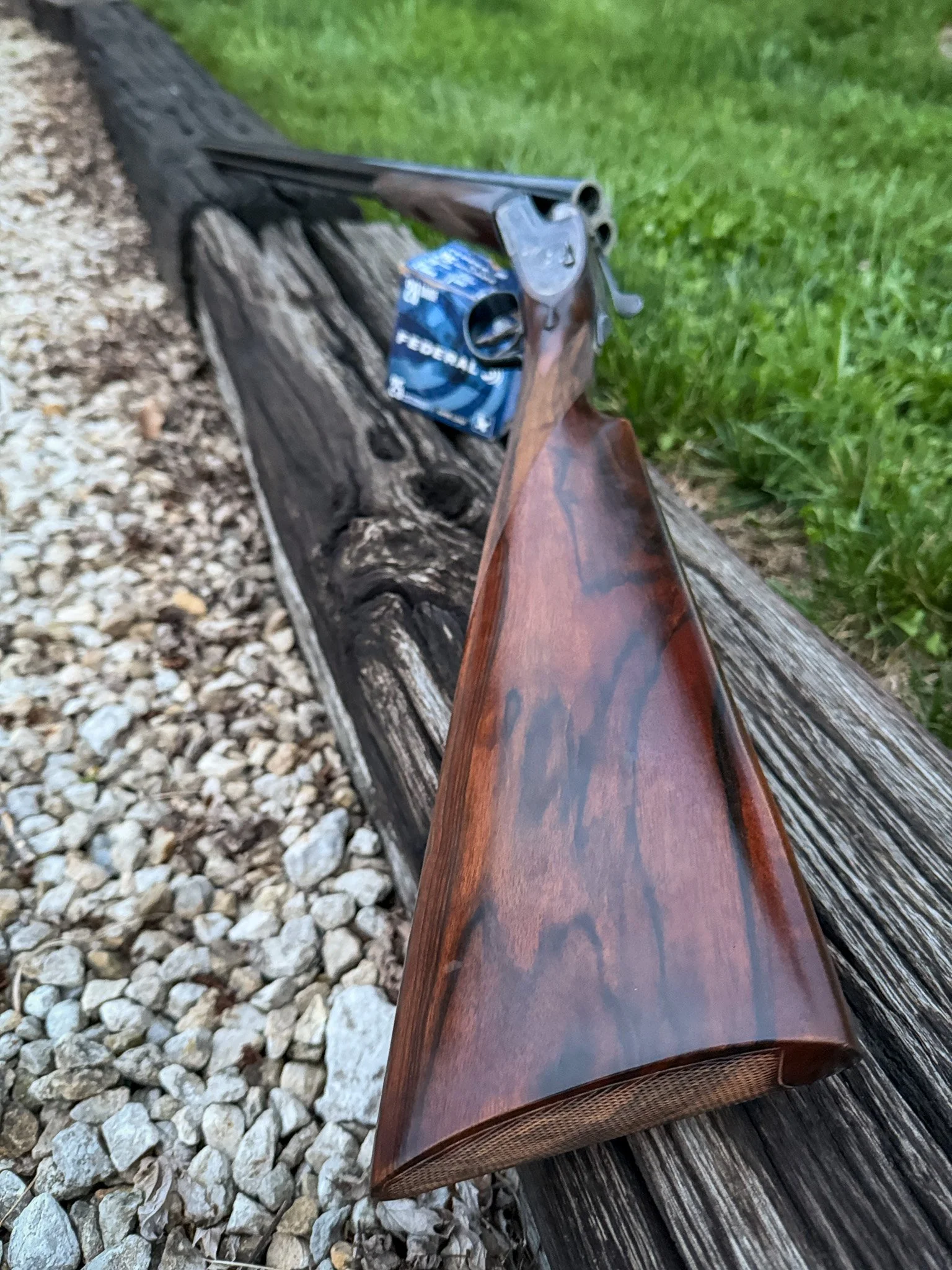
“Penelope,” my secondhand Spanish-made 28ga sidelock with a limit of Montana Sharp-tails. I also refer to her as The Spanish Lady.
The latest shotgun acquired and tested as part of my journey to find the “perfect” bird gun: In Pursuit of Bespoke.
“I bet he’d take $500 bucks off” my father-in-law said, with confidence, just loud enough for the man behind the booth to hear. The man, engrossed in his iPad watching the 2026 Masters golf tournament looked up. “Uhm, yeah, no problem,” and went back to watching the world’s most boring “sport.”
My father-in-law, brother-in-law, and I were at a gun show in Tulsa, Oklahoma. I had told myself I was merely tagging along to peruse, and had no intention of buying anything (this time). But, when we came across a private seller trying to offload his now deceased father’s collection, and this beautiful 28ga side-by-side, I began to question how devout I was to the idea of coming home empty-handed.
With the seller’s permission, I shouldered the gun with my eyes closed. I opened my eyes and, to my surprise (and my wallet’s dismay), all I could see was the bead. About as close as perfect fit as I could get without having a gun made for me. I eye-balled the price tag. Shouldered the gun again. Nothing but bead. A few scuffs and sweat stains here and there, but overall, excellent shape. The case coloring was largely intact. Higher grade wood than anything else I’d ever owned, intricate engraving, and a host of features I had only read about.
The seller couldn’t offer much information. No box, case, or papers. All he knew was, “my dad got fitted, told them what he wanted, and ordered it from Spain.” It was a bespoke gun, made for this man’s father years ago, meticulously hand-crafted in the Basque region of Spain. I had read about Spanish guns in Terry Weiland’s Spanish Best but I had never seen one before. I was impressed, the price felt like a steal, and its features would offer me an opportunity to further refine my own criteria of what I like, or don’t like, for the day that I [hopefully] have a bespoke gun made to my preferences and physiology.
Technical specifics of The Spanish Lady
Forend - Splinter
Stock - English
Triggers - Articulating double
Rib - Raised
Chokes - Fixed Light Modified and Improved Modified
Ejector/Extractor - Ejectors
Chamber - 2 ¾ “
Weight - 6.1lbs
Barrel Length - 27”
LOP - 15.5”
The iron ore found in the mountains of Spain’s Basque Country, coupled with swift rivers capable of powering its mills and forges, created the natural conditions for an arms-making industry. In that respect, the region bears an uncanny resemblance to Italy’s Trompia Valley—also known as the “Valley of the Gun”—where makers such as Beretta have operated for centuries. Centered in the town of Eibar, Basque arms production can be traced back to at least the late fifteenth century, although its craftsmen initially produced military arms rather than the fine sporting guns for which the region would later become known.
That transformation accelerated around the turn of the twentieth century under the influence of King Alfonso XIII. In 1906, Alfonso married Princess Victoria Eugenie of Battenberg, a granddaughter of Queen Victoria, strengthening his already close ties to Britain and its sporting culture. An enthusiastic shooter and patron of fine gunmaking, Alfonso owned guns from leading English houses such as Purdey and appointed Eibar maker Víctor Sarasqueta as his royal gunmaker in 1902. Through his personal enthusiasm and patronage, the king helped popularize wingshooting among Spain’s aristocracy and encouraged the country’s gunmakers to look toward England as the standard for the sporting gun.
Spanish craftsmen studied English guns, absorbed their methods, and reproduced their celebrated actions and proportions at the benches of Eibar. Many of Spain’s finest side-by-sides still follow the English ideal: restrained lines, hand-fitted locks, double triggers, splinter fore-ends, and actions patterned after designs made famous by Purdey and Holland & Holland. The result was not merely a Spanish imitation of the English gun, but a distinct gunmaking tradition that adapted English design to Basque craftsmanship and passed it from master to apprentice across generations.
Unlike the great English and Italian houses, however, many Spanish gunmakers struggled to maintain continuity through world wars, the Spanish Civil War, economic crises, and repeated political upheaval. Workshops opened, merged, changed names, and disappeared, leaving many individual makers largely lost to history despite the survival of their craft. This is speculation on my part, but I suspect that instability helps explain an enduring paradox of Spanish shotguns: the quality survived even when many of the names did not. Without the uninterrupted lineage and accumulated prestige enjoyed by England’s great houses—and by firms such as Beretta in Italy—Spanish sporting guns have often sold for a fraction of the price of comparable English or Italian examples.
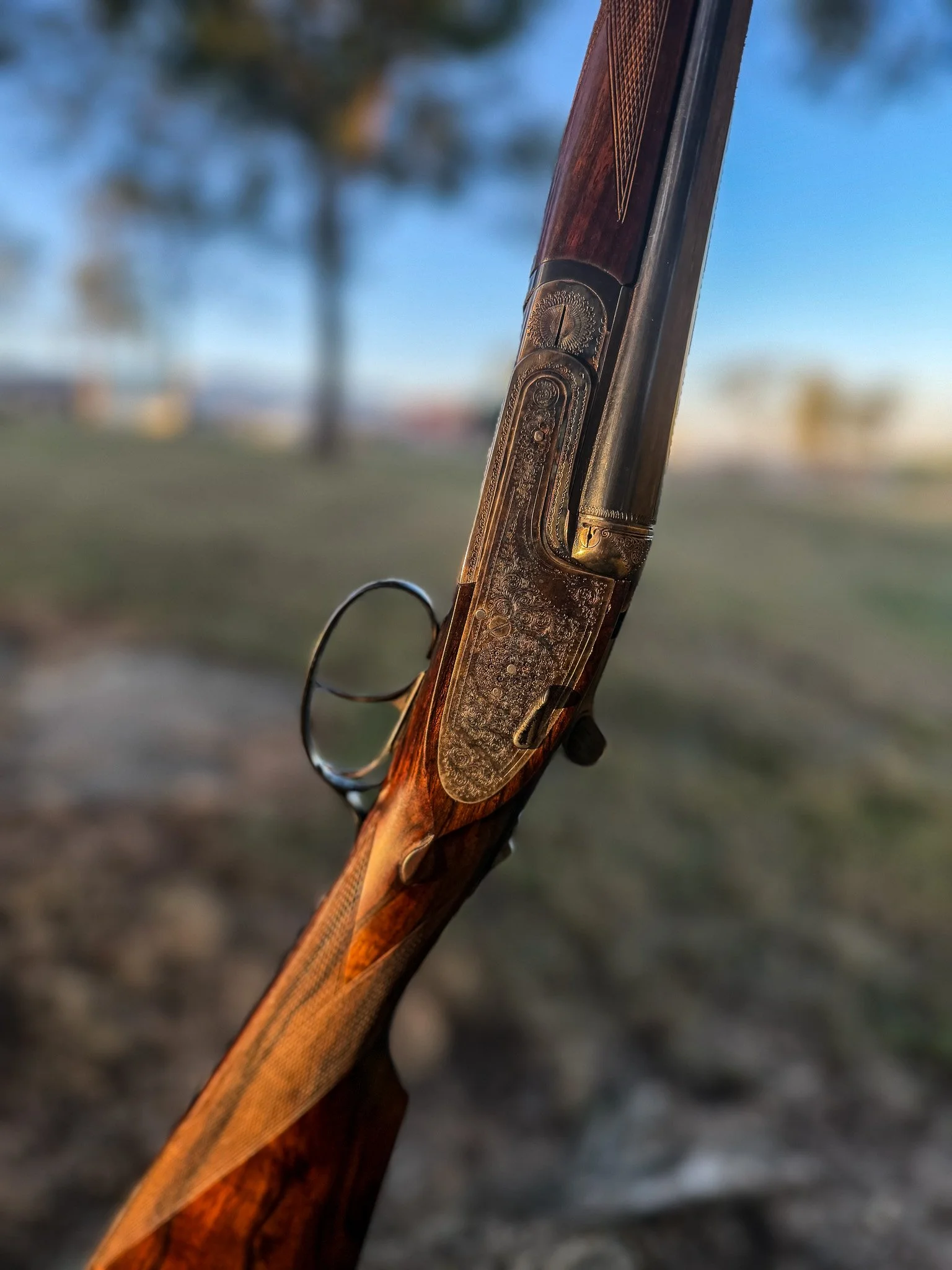
A case-hardened, five-pin sidelock with light-relief, intricate engraving throughout the recevier.
All of that history was sitting in my hands when I first shouldered the gun—and the opportunity was too good to pass up. It came naturally to the shoulder, it was beautiful, and it possessed features I had yet to know intimately: articulated double triggers, an English stock, a splinter fore-end, and automatic ejectors. Better still, the price was staggeringly low.
“I’ll take it.”
We returned home from the gun show with just enough daylight left to throw a few clays. One after another, they turned to powder. I could hardly believe it.
“The Spanish lady can dance!” I exclaimed.
I’m writing this on my way home from the first hunt of my 2026 season: Sharp-tailed grouse on the Montana prairie. Despite being elbows-deep in work and graduate school, I felt compelled to get my five-month-old puppy, Amos, onto the prairie as soon as possible. I brought Penelope along, too. Why not?
There is still much more hunting to be done with her, but in only a few days Penelope helped me take several limits of grouse. I’ve already begun to identify what I like—and what I don’t. In that sense, the purchase is serving its purpose: with every hunt, I’m getting closer to understanding exactly what I want when the day comes to order a gun built for me.
Penelope, however, was clearly built for a much larger man. Her length of pull measures 15½ inches, which is exceptionally long by almost any shotgun standard. Most mass-produced guns fall somewhere between 14 and 14½ inches, while many vintage American shotguns are shorter still. Montana was warm, and I hunted without a jacket, so the extra length never caused much trouble. I’ll be curious to see what happens later in the season, though, when the temperature falls and the layers begin to accumulate. That long stock may shoulder just as naturally—or it may begin catching on my coat when a covey rises.
The 27-inch barrels are unusual. I suspect they were chosen to balance the gun’s exceptionally long stock; rather than pairing its 15½-inch length of pull with 28- or 30-inch barrels, the original maker may have shortened them slightly to keep the gun from feeling too long or ponderous. So far, I haven’t developed a strong preference among 26-, 27-, and 28-inch barrels for an upland gun. I’ve taken birds successfully with all three, so when the time comes to commission my own gun, I’ll likely defer to the maker on whichever length best balances the finished piece.
Before hitting the road, I patterned Penelope with a handful of loads. Both Federal 1-ounce field loads of No. 6 lead and Fiocchi Golden Pheasant No. 6s performed well, Federal Prairie Storms performed horribly (I think those only do well in very open chokes). The barrels are fixed at light modified and improved modified. These are tighter than the chokes I typically carry afield, but seem to be well suited to the open prairie and its wild-flushing grouse. When the dogs pinned birds more closely, I simply allowed myself an extra moment before pulling the trigger.
Federal 1-ounce No. 6 field loads patterned exceptionally well through Penelope before I left for Montana. Patterning is incumbent upon every wingshooter—not only for greater effectiveness in the field, but also for the ethical pursuit of the birds we hunt.
I’m curious to see how those tighter chokes perform on roosters later this year and, perhaps more tellingly, on quail. Still, as long as I exercise a little patience when a bird rises close over a point, I don’t expect them to cause much trouble.
The English stock is beautiful, though it has taken some getting used to. At this point, I’m fairly confident that I prefer a Prince of Wales grip. Afield, I was largely indifferent to the splinter fore-end. At home, however, sustained clay shooting quickly heated the barrels beyond what was comfortable to hold without gloves. For that practical reason (and because it better suits my eye)I’ve concluded that I prefer a semi-beavertail fore-end.
The triggers are exceptionally crisp. After shooting Penelope and then switching to my CZ Sharp-Tail and Benelli M2, I realized just how refined they are. The gun’s sidelock action may contribute to that quality, although I’m sure there are boxlocks with triggers every bit as good—and certainly better than those on the factory guns I’ve hunted with. Whatever the reason, Penelope’s crisp, positive trigger pulls have established another benchmark I’ll carry into the design of my future gun.
Lastly, the ejectors: that’s a hard pass.
They’re convenient at the shooting park, but afield they become a nuisance. After every pair of shots, I find myself stopping to search the grass several feet behind me for wherever the spent hulls landed. I try to leave the prairie as I found it. Well, perhaps with a bird or two fewer, but never with discarded hulls or other trash left behind. When the time comes to commission my gun, extractors will be one preference on which I remain firm.
Penelope is a bespoke gun, so this is not a review in the conventional sense. You cannot walk into a gun shop, pull the same model from the rack, and expect it to fit, handle, or shoot exactly as mine does. In fact, much of what I’ve learned from her has come from the ways in which she was built for someone else. Her long stock, tight chokes, splinter fore-end, and ejectors have given me a far better understanding of what I will—and will not—ask for when I eventually commission a gun of my own.
None of that should be mistaken for dissatisfaction. I love this gun, and I intend to hunt with her for years to come. She is handmade, beautifully fitted, mechanically refined, and available to me at a fraction of what a comparable English gun might have cost. Most importantly, Penelope has already proven herself where it matters: carried across miles of Montana prairie with a young dog working out front, she is an absolute grouse-killing machine.
That may be the real lesson here. A used Spanish shotgun might not carry the familiar name (or the price) of a celebrated English or Italian gun, but the hands that built it may have possessed every bit as much skill. If you encounter one tucked into the corner of a gun rack, don’t dismiss it because its maker has faded into history. Shoulder it. Look closely at the details. You may find, as I did, that the Spanish lady can dance.