A Bird Dog in the Age of Artificial Intelligence
The truck is washed, the guns are cleaned, and the dogs have been bathed. Everything is back in its place after our first hunt of the season. For a few days, anyway.
Soon enough I'll go through the ritual again. I'll make a list, lay out clothes and gear, charge dog collars, rotate tires, and convince myself that this time I've remembered everything. Next up is a trip to the Iowa border for Aldo's NAVHDA Gun Dog Test, followed shortly by a journey north into Wisconsin in pursuit of woodcock and ruffed grouse.
Wisconsin will bring its own collection of firsts. My first true Northwoods hunt. Aldo's first exposure to woodcock. Another long list of lessons for Amos, who seems to discover something new every time he leaves the truck.
Until we depart, however, I’m glued to my desk. I’m lost in a screen from 8-5 working with artificial intelligence. I spend my days meeting with technology providers to understand emerging agentic-AI systems and how they might impact the financial services industry. By five o’clock, my brain is fried, but there’s still more to be done. I spread the textbooks out on my desk for grad school, pull out the highlighter, and do my best to comprehend what neural networks and computer vision are. I write an essay (or fifteen) on ethical frameworks as they apply to artificial intelligence. I lament at this self-imposed torture.
These things, my dogs and me on the prairie, and me at my desk, are worlds apart. One consists of prairie grass and noses into the wind. The other, algorithms and rapidly evolving technology. One requires patience over the span of seasons. The other moves so quickly that those working in its field struggle to keep pace. A dichotomy.
Between meetings and textbooks, I’m lost in thought, trying to understand machine intelligence, and wondering about intelligence itself. I think about how Aldo and Amos learn. How I learn. I wonder what separates information from wisdom. How is character formed? Where does curiosity come from? Why do some lessons take years while others only take seconds? Perhaps, most critical of my line of inquiry: can the most important things we learn in life ever be automated?
I’ve admitted this before, but I feel compelled to continue to share my own ignorance when it comes to raising and training a versatile hunting dog. When I brought Aldo home, I had no idea what to do. My place in life dictated that all training would need to be in-house, for better or worse. Books and YouTube videos got us through our first year together, but in retrospect, I know so much of my training was ill-timed and poorly executed. Despite my indiscretions, Aldo forgave me, and we developed a bond of the likes I did not know could exist between man and dog.
After Aldo’s first season, we stumbled into the local chapter of the North American Versatile Hunting Dog Association (NAVHDA). I wasn’t sure what to expect but I was eager to learn more, and to help Aldo learn more, too. I knew the silo I had been operating in was likely insufficient. Being surrounded by a group of people who seemed to care just as much as I did about training Aldo and had a wealth of knowledge I lacked about training versatile hunting dogs, shed light on so many things, not just about Aldo, but about Aldo’s handler as well. The mentors I found through NAVHDA helped me recognize that so much of what we strive to teach our dogs isn’t just in the task itself, but in how the task is taught: how the handler administers cues and corrections.
I mention this because years later, buried under textbooks of convolutional neural networks and K-means clustering algorithms, as I’ve started to recognize a similar lesson. Aldo was able to learn through his inexperienced handler, but far less efficiently than from one that had already learned hard lessons about dogs and their training. Machines aren’t so different. How a system is trained, and who, or what, is doing the training matters just as much as the raw ability to learn. To be clear, this is not to compare a dog to a machine but simply illustrate a connection I’ve drawn across these two worlds.
Aldo was about a year old when I began working on cleaning up his retrieve. In his first season, he had already retrieved pheasants, quail, rabbits, Sharp-tailed grouse, and Hungarian partridge, but without consistency. It’s not uncommon in dogs, especially not in young dogs, but after seeing NAVHDA Versatile Champions in the field, and realizing what was possible, I was determined to refine that lack of consistency.
I started with too much pressure. Aldo has never been particularly motivated by food, but by that point he was collar conditioned, and I assumed the e-collar was the right tool for the job. After a few weeks, I began to wonder if the pressure was too much for the dog or the situation. Perhaps it was a sledgehammer for a tiny finishing nail. I put the collar up, clipped on the check cord, and tried something much simpler. An ear rub. With each successful retrieve, I rubbed Aldo’s ears and patted him on the head. Within a few days, retrieves were consistent.
Most dog handlers know that reward is critical to training a dog. That really isn’t much of a revelation, it’s page one of nearly every training book, article, and video Aldo and I worked through that first year. What I was still learning was that a reward isn’t a single thing that I have or don’t have. It must be the right reward, calibrated to the dog in front of me, not the dog in the book. Once found, then the harder question becomes how that one reward, delivered at a single moment, can teach a dog to do everything I’m asking of it that led up to that moment. Turns out, machine learning has a formula for that exact situation (well, not quite exact, as I doubt ChatGPT is trying to retrieve a chukar at the bottom of the canyon anytime soon).
Q(s,a)=R(s,a)+max(Q(ns,aa))
This is reinforcement learning, one of the many ways that the artificial intelligence we interact with today was built. The value of an action isn’t just the reward achieved immediately, it’s the reward, plus the best value in whatever comes next. Do this enough times, across enough states and actions, and a pattern emerges. It becomes a strategy for what to do in any given situation to maximize reward over time. This, in the context of machine learning, is called a “policy.” An artificial agent isn’t just chasing its next treat, it’s building a policy, a whole way of behaving, out of nothing but a well-placed reward and enough repetition.
Aldo’s retrieve isn’t a single action. It’s a chain of actions. Receive a cue to execute the retrieve, find the bird, pick it up, hold it, carry it back, and deliver to hand. And then there’s the ear rub at the very end. Each step of the chain had to become worth something because of where it ultimately led to. The ear rub travels backwards through a sequence until the whole chain has weight, not just the final link. There’s no ear rub for finding the bird but not picking it up. There’s no ear rub for picking up the bird but not bringing it to hand. Get the reward right, and it’s not just a better retrieve, it’s a policy that the dog has learned, on his own, what to do at every step of the way to earn the ear rub.
A foundational figure in machine learning, Tom Mitchell, defined machine learning in 1997: a program whose performance at a task improves with experience. He wasn’t writing about dogs like Aldo but the definition holds either way.
Not all the parallels, from Aldo and Amos to AI, are as easily explained as the underlying algorithm of a trained retrieve. And now I’m thinking of a field of prairie grass in South Dakota, watching my friend, Scott, move expeditiously towards a staunch point Aldo is holding. There’s a flush, a shot, a retrieve. A rooster in the bag. But no one ever showed Aldo a picture of a rooster and said, “this is what you’re looking for” and gave him a label of the rooster’s scent and told him to memorize it. He was simply let loose from the tailgate, season after season, into cover that held birds sometimes and didn’t hold most times, and he was left to sort out the rest. That ability, to learn from time afield, from thicket to thicket and scent to scent, with no labeled answers and no immediate confirmation of right or wrong, is another kind of learning. In machine learning, it’s called “unsupervised learning” Apparently, it’s also how a versatile hunting dog gets made.
Over thousands of interactions with different data points—scent concentration, scent gradient direction, humidity, wind speed, time of day, cover density—Aldo has sorted his experience into two rough categories: conditions that reliably produced a bird, and conditions that did not. It would be ignorant to simplify the complexity of biology, of a dog’s cognition and intuition, into a tidy algorithm, but there is a parallel. It’s like he’s applied dimensionality reduction to the field. A linear statistical technique like Principal Component Analysis, which takes enormous amounts of data and compresses them down to a handful of dimensions that carry the meaningful signal. Bird, or no bird.
I see these parallels, AI to Aldo and Amos, when I’m daydreaming at my desk, trying to wrap my mind around some concept. But daydreaming is where the parallels end, too. There is no policy, no agentic architecture, no machine learning formula that can explain, create, or foster something as biological and metaphysical as the bond between a man and his dog.
My wife and I have been married for ten years now, and Aldo has been a part of our family since he was eight weeks old. Despite living and hunting alongside my wife for four years, there’s a distinct difference in how he responds to her commands versus mine.
I’ll give you an example. She’ll call for him from the kitchen. He’ll stand up, look at her, and, if I’m in the room, turn to look at me, as if checking whether her command actually bears weight. I’ll say his name, or some nonsensical phrase I’m fairly sure he doesn’t understand literally, and the whole interaction lands somewhere between frustrating for my wife and secretly hilarious for me. With my apparent consent granted, he’ll happily trot off to the kitchen to find out what she wanted in the first place. I couldn’t have trained that kind of loyalty if I tried.
That’s at home. In the field, the stakes are higher (or so we bird hunters think), and that bond manifests differently. It’s not Aldo checking with me before he moves. It’s me checking with him.
I’ve lost count of how many times I’ve watched Aldo veer left, tracking something unseen, refusing every bit of my encouragement that we are, in fact, not going left, only to watch, to my own disbelief, a Sharp-tailed grouse launch from a sparse patch of grass I wouldn’t have guessed could hold anything. Or the number of times I’ve begrudgingly followed him anyway, gun hanging low, expecting nothing, only to flush a covey of Bobwhite quail myself, the birds he’d been trying to pinpoint the whole time, and my shot opportunity lost due to my own mistrust.
In machine learning, a model earns a human’s confidence because someone can check the answers the machine produces against the data that machine never saw. It can be proof, after the fact, that something has been learned and was not just simply memorized and regurgitated. I have no such mechanism with Aldo. There’s no answer key for “known bird locations” that I can consult before deciding whether or not to follow him. I only find out if he was right, that there is a bird, if I trust him first.
What I do have is four years of memories with him afield. Most of it isn’t written down anywhere, but in my own recollection, I think back to the decisions I’ve made, follow or call him off, and I can feel the weight of them. The times I’ve doubted him and lost an opportunity at a bird and the times I’ve trusted him and had a shot. There’s no spreadsheet to reference but somewhere in my own cortex I’ve managed to identify a pattern based on his behavior, not in where the birds are, but when to trust my dog. I built that model of trust in him the same way Aldo built his model of locating birds: by getting it wrong enough times to eventually get it right.
I call them the A-Team: Aldo, Amos, and my wife, Alexis. I have them to thank for most of what I’ve learned about patience, loyalty, and being wrong gracefully. Lately, though, I’ve felt drawn to a different A-Team. Not because of anything Aldo or Amos did, but because of everything I’ve been doing at my desk. Studying, adopting, building and working with artificial intelligence. I’m spending time in between meetings and textbooks wondering what is the relationship, exactly, between humanity and AI? What might it cost us, this breakneck paced for optimization and efficiency? What happens if we get everything we ask for?
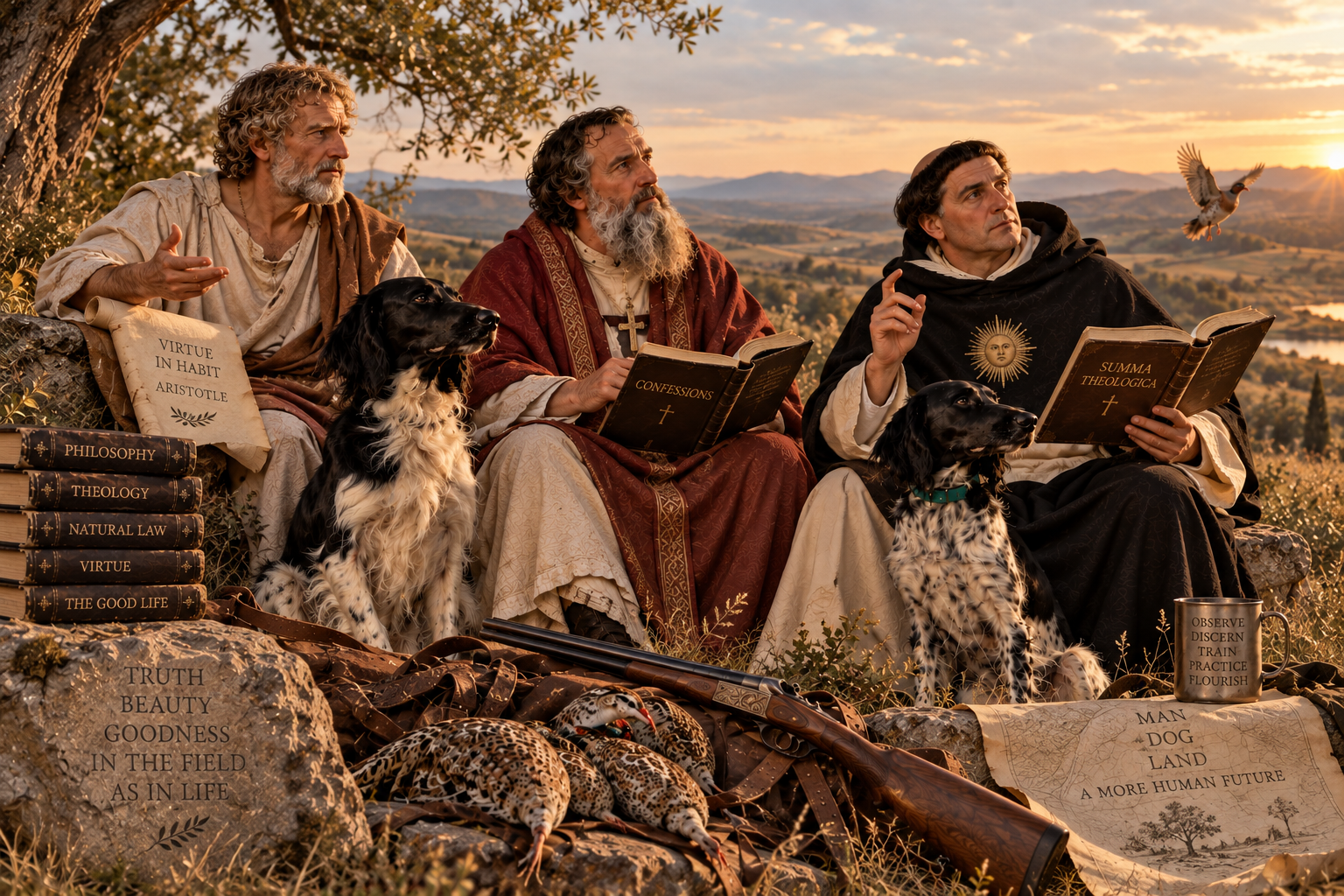
I don’t have those answers, but I keep wondering, and that’s what’s led me to look further back to this other A-Team: Aristotle. Augustine. Aquinas. Three men who never met a bird dog (as far as I know), or anticipated ChatGPT in everyone’s pocket, but who spent their lives asking really big questions.
On Aristotle
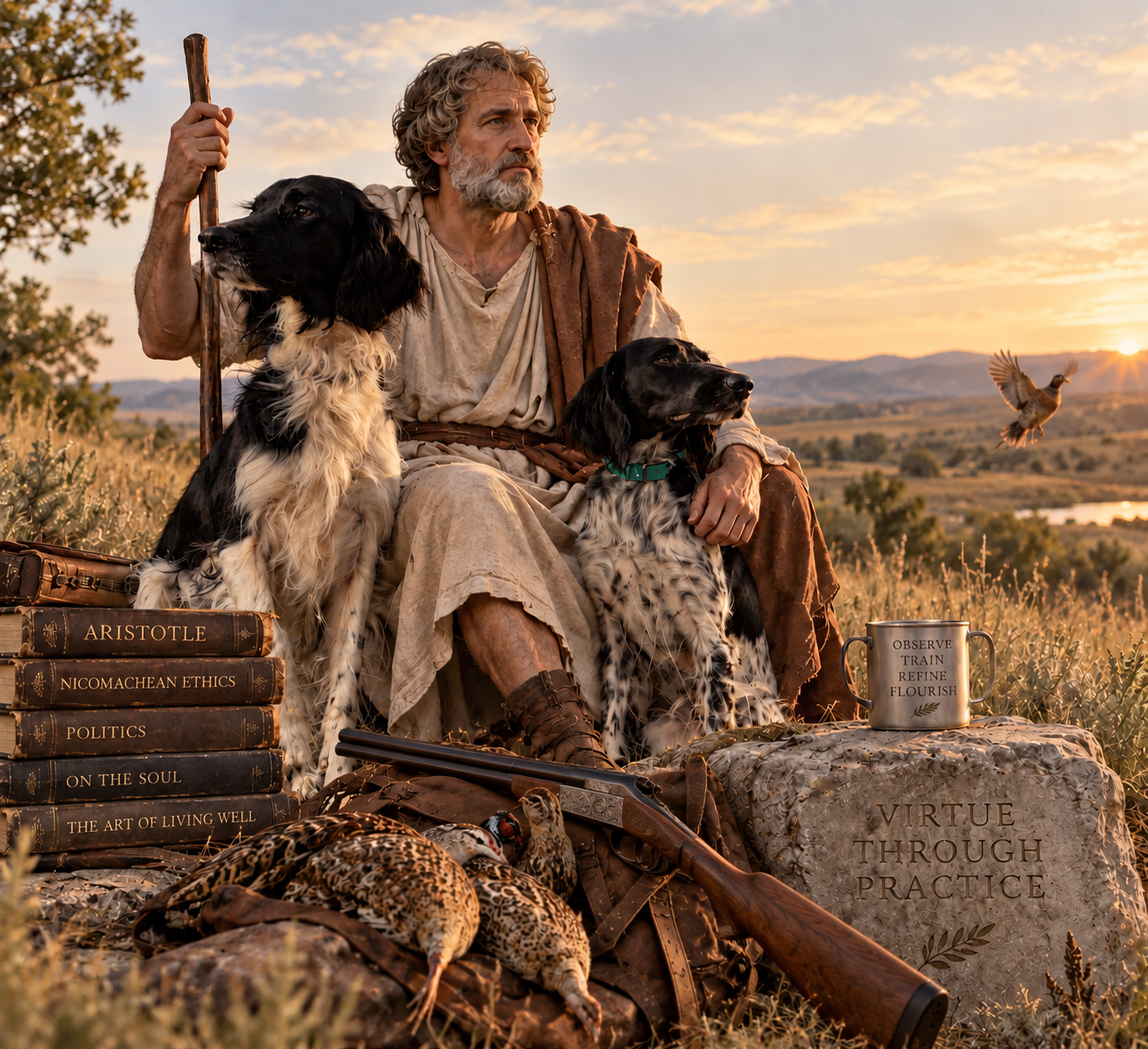
Aristotle spent a great deal of his life asking something deceptively simple: what is a thing for? Not how does it work, what can it do, but what end is it naturally directed towards. Its telos. An acorn’s telos is to become an oak. For a human, Aristotle argued, the telos is eudaimonia which is usually translated as happiness, although it means something closer to flourishing, or living well.
He believed that achieving eudaimonia was not something that could be felt, but something a person would do. Not a passing emotional state, not a single day, not a single achievement, but an entire life characterized by activity. This, then, is where Aristotle introduces virtue, or arete. It is many traits—courage, generosity, patience, justice—each a stable disposition to feel, choose, and act well, even when no one is watching. And eudaimonia, in turn, is simply what a life looks like when virtue is actually put to use, consistently, across everything that life contains. It can’t be instilled all at once, the same way a habit becomes a character, one repetition at a time.
Habituation isn’t the whole of it, though. Aristotle believed that every virtue sits between two extremes, one of excess and one of deficiency. Courage, for example, sits between cowardice and recklessness. But the right response to any given moment isn’t a fixed point; it shifts with the handler, the dog, the wind, the cover, the bird. Finding it requires judgement, which Aristotle called phronesis. Practical wisdom. Not simply knowledge of what’s good in the abstract, but the capacity to perceive, in a particular moment, what the good actually requires, and how to act on it. That practical wisdom is only learned by doing it, repeatedly, in situations that never quite repeat, until something like judgement finally takes shape.
I’ve already written about that to some extent. Trying to decide if Aldo veers left to call him off or to follow. There’s no codified rule on what to do in every situation, and every field is different, requiring fresh judgement each time. Wrong before right, over and over, is the shape that Aristotle called phronesis. A handler, gradually, becomes capable of judging the dog, and the moment in the field, well.
An AI model can be shaped by repetition—reward, correction, reinforcement, and policy built out of enough feedback and trial— but nothing about that process produces phronesis, because phronesis isn’t a rule that gets more accurate with more training data. It is judgement exercised by something capable of choosing otherwise, in a moment that has never occurred before. A model cannot perceive the dog, the field, the situation, and feel the half second of doubt before deciding whether or not to trust something it can’t verify. It can only execute what the training data has made most probable. Risk is mitigated, no true choice is made, and nothing, in the end, is formed.
I suppose Aristotle can tell me how a person, or a dog handler and his bond with his dog, gets built in a manner more nuanced than machine learning. One repetition at a time until judgement finally takes shape. But, candidly, I am still restless. Not about Aldo or Amos, but about the time when I’m not in the field with those dogs. About whether the life I’m building at my desk and the life I’m living in the field can be reconciled, or whether I’m just alternating between two lives that don’t agree with each other. And so, for that, I turn to the next member of this historic A-Team: Augustine.
On Augustine
Aristotle believed a flourishing life was built through habituation and judged well through phronesis. Virtue upon virtue, repetition upon repetition, until a person becomes, gradually, a certain kind of self. But what happens once the self is built? Is it possible, then, to be content? Or would a person, eudaimonia or not, still be searching?
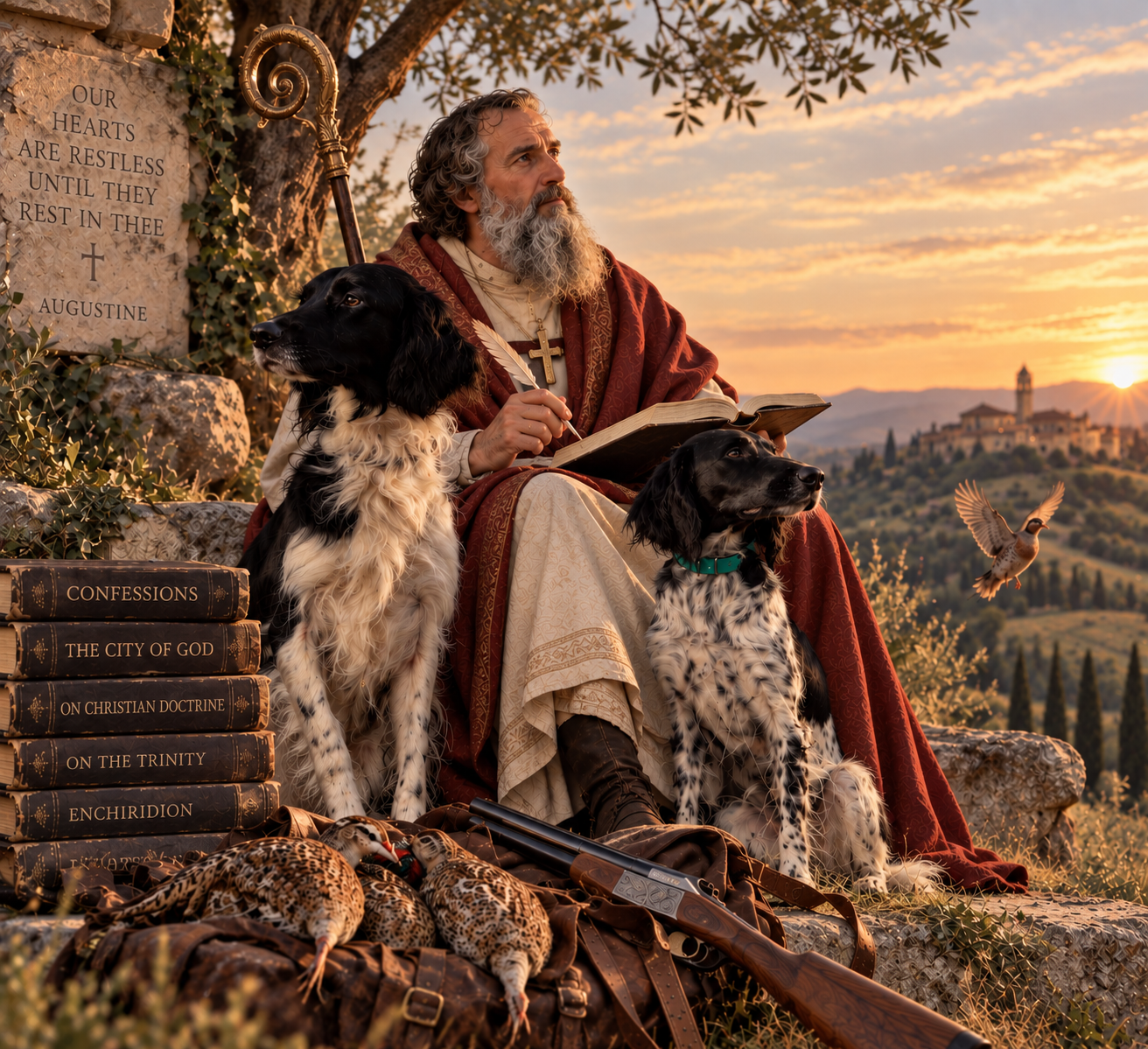
Augustine, I think, would say that a person would still be searching. Still restless. Not because Aristotle was wrong, but because he thought such a feeling of restlessness went deeper than any virtue could reach. “You have made us for yourself, O Lord,” Augustine wrote, “and our hearts are restless until they rest in you.” The restlessness isn’t a flaw in the self still being formed, but evidence of what the self was made for in the first place. Something with no finite achievement. No matter however well earned, nothing could, on its own, satisfy a person.
That’s not to say that achievements, or something finite, are a problem. Health, achievement, knowledge, even a life lived virtuously, in the Aristotelian sense, are not wrong to pursue. The trouble, though, according to Augustine, is pursuing and valuing them out of their proper order, asking a finite good to do the job only an infinite one can do. Ordo amoris. Not whether you love a thing, but whether you love it as much as it deserves, no more, and nothing above what is owed to God alone.
Augustine also distinguished things meant to be enjoyed, frui, from things meant to be used, uti. Knowledge, achievement, loved ones, none of these qualify as frui in the strict sense. Everything short of God is uti. People and things can be loved, even deeply, but always in reference to something beyond themselves, never as the resting place. That is reserved for God alone.
That’s an uncomfortable truth to accept in my own life. School and my career are easy enough. I don’t love having a job, and I certainly don’t love going to school. I have a job, and I’m seeking higher education in my career field, for the means to live the kind of life I’d like to have. It’s a very honestly ordered uti, at least. I’ve never mistaken a spreadsheet as the purpose of my life.
The dogs… that’s a harder truth to grapple with. I want to tell you that my time afield with them is the one place my loves are finally in order, the frui to my career’s uti. I’ve often felt that a day afield with my dogs is the whole point to being alive, but that’s a disordered way to see life and its purpose. Augustine would never allow such a claim. The real question is what of my life is uti and which is frui.
None of this is frui. Not the career, not grad school, not the dogs, not even my wife…however unromantic that is to admit in writing. By Augustine’s accounting, frui belongs to God alone. Everything else, at best, is uti. Again, the career and school are an easy case. They don’t ask for my love, and I don’t love them. But the dogs, being afield with them and with my wife, those are things that I do love, more than anything else in my life. So the test, then, isn’t whether or not those things—my dogs, my time with them, my wife and my time with her—move me, because they do, but it’s what I choose to do with that movement, and how I order it in the rest of my life and my search for meaning and purpose.
On those cool autumn mornings, when there’s a light breeze on my face, and a soft sway in the prairie, and I watch those dogs search, I feel something that can only be called gratitude. For the landscape. For the dogs. For being here. That’s not the test, though. The test is what the gratitude does next. Whether it stops at that field, or keeps moving, past the dogs, past me, to whoever thought a world like this was worth making in the first place.
That’s the closest I am right now to answering that question: whether my life at the desk and my life afield are two lives in conflict, or one life, rightly or wrongly ordered. I don’t think they really are two lives. Only one life, and one long argument with myself about what in it deserves to be loved, how much, and toward what end. Augustine hasn’t resolved that argument for me. But he is making sure that I keep having it.
On Aquinas
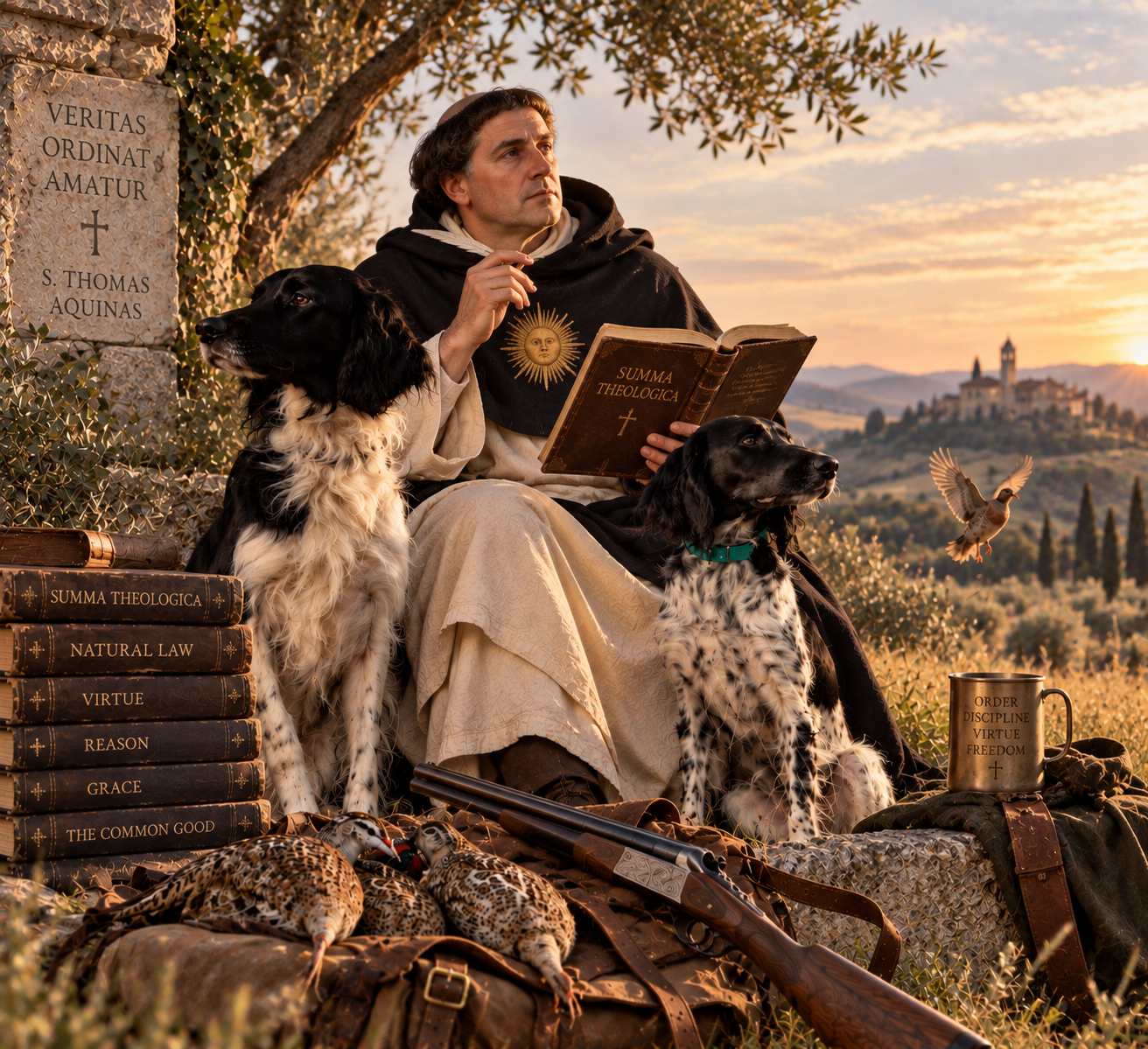
Beyond uti and frui, Augustine cannot tell me whether the work itself is any good. Rightly used doesn’t mean rightly aimed. A man can order his loves perfectly and still spend a lifetime building something worthless, or worse. I don’t think artificial intelligence is worthless. I’ve spent enough of my life on it to hope otherwise. But hope isn’t the same as knowing, and “I don’t love it, so at least I haven’t sinned by loving it wrongly” is a low bar to clear for an entire career.
I need to visit with the third and final member of this historic A-Team to think through this further. And so, I turn to St. Thomas Aquinas, who inherited the ideas of Aristotle and Augustine, but did not choose between them. Instead, he kept Aristotle’s architecture of virtue built through habituation, judged through phronesis, aimed at flourishing achieved through reason. He also kept Augustine’s insistence that no natural flourishing, however well built, is the final end, and that belongs to God alone. Aquinas found a way to apply both at once, to one particular act, on one particular day: is this specific thing I’m doing actually good?
An act’s goodness, according to Aquinas, depends on three things together: the object, what you are doing; the end, why you are doing it; and the circumstances, the situation surrounding what you’re doing.
In bird hunting context, this is a clear framework to apply. Aldo points a covey of Hungarian partridges on the side of a canyon in Wyoming. I approach, the birds flush, and I kill a pair. The object is that I, with Aldo’s help, have taken life (this is kosher in Aquinas’ book, he argued that animals exist, in part, for human use, provided that use serves a real good and isn’t done for cruelty’s sake). So now the question is of intention and circumstances. Why am I doing this? I’m not killing these birds for the sake of killing, but for the dog work it led to, for the meal these birds will provide, and for the few hours spent inside a created order I don’t get to participate in as frequently as I would like. As for the circumstances, this has been done during a legal season, among a healthy partridge population, with fair chase wild birds that have every chance of outsmarting Aldo and me. Object, intention, circumstances, all together, the act holds up as “good.”
Before reading Aquinas, I had already rationalized my behavior, my pastime, in this manner and while I have never taken life lightly, I have always felt at peace with the pursuit afield. Reading Aquinas, then, has only emboldened me in my justification for such actions. But what I’ve been grasping at most recently is not whether training and hunting with dogs like Aldo and Amos is good. It’s the other part of my life. My profession.
The object is simple enough to name, although not nearly as simple to do. Building and shaping the governance, rules, frameworks, and review processes that will determine how artificial intelligence gets introduced and overseen in a business environment that’s tied to the financial services industry.
The intention, I admit, is not nearly as noble as I wish I could present. I’m doing this work because artificial intelligence is where the workforce, at least the kind of work I’ve been a part of for the last decade, is heading, and I’d like to still have a place in it. But underneath that practical reason is that I believe I’m reasonably well suited for working in the governance of this technology because of everywhere else my life has taken me. I’ve spent years thinking about risks and consequences, both in a combat zone and in corporate roles. Those experiences have given me the willingness and confidence to ask what happens if this is wrong before someone else may ask how fast can this go. It’s not a grand intention, but it is the intention.
Finally, the circumstances. Investments. Retirements. Funds that hard-working Americans have socked away with the dream of waking up on a Monday and not having to go to work. The dream for a family to be able to send a kid to college, or help a child with the downpayment on their first home. The weight of that isn’t lost on me, and decisions around the use of AI in this capacity cannot be made lightly.
Aquinas is asking me to evaluate the act itself, examined plainly, to determine if it does what it claims to do, and serves a real good. Object, intention, circumstances, all together, not intention alone. I have to accept the circumstances here too, and not just the parts of this career I can explain away as a practical necessity. What I do, the decisions I make and those I champion in the boardroom, must be prudent. Not because I am virtuous, but because interacting with this technology, using this technology, by Aquinas’s standards, demands that I act as though real people, and real consequences, are standing on the other side of every recommendation I make.
So, then, is this career good? I can’t give it a grand yes. It’s not the kind of yes that turns a job into a calling, but the object, intention, circumstances, examined plainly, together, holds up.
I’m not done asking questions about it. I doubt I ever will be. Aristotle would probably tell me that’s the point, phronesis isn’t a question you answer once and file away. Augustine would say the restlessness itself is proof I haven’t arrived anywhere final, and that I’m not supposed to, not yet. Aquinas would likely remind me that today’s answer only covers today’s act; tomorrow’s board meeting gets asked the same three questions all over again.
I don’t know what artificial intelligence will make possible in the years ahead. After a year spent studying it, governing it, and writing about it, I’m not sure anyone fully does. I know a model can be trained. I know it can be rewarded, corrected, optimized, deployed, and trusted, provisionally, the way I’ve learned to trust Aldo in a field I can’t fully see into either. What I don’t think it can ever do, is stand near a river in New Mexico, feel the ache of gratitude from watching a versatile hunting dog do what it was bred to do, and wonder, unprompted, whether the whole scene was built by someone worth thanking.
I’ll keep bringing those questions to Aldo and Amos, to Alexis, to Aristotle and Augustine and Aquinas, and, more than any of them, to God, who I suspect has been patient with my restlessness a great deal longer than any dog has been patient with my training mistakes. I don’t expect a final answer this side of the tailgate.