The Stars Offer No Opinion
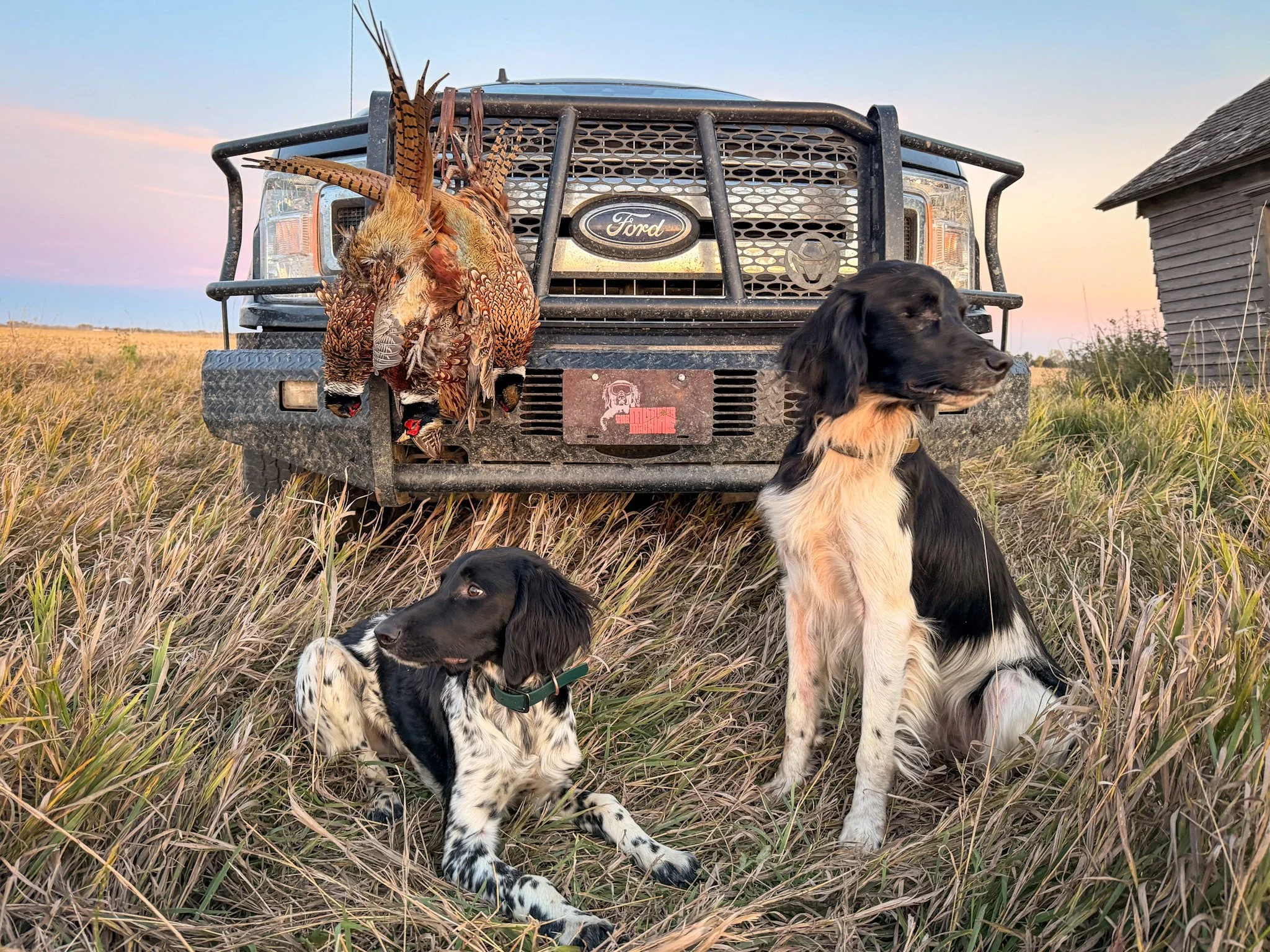
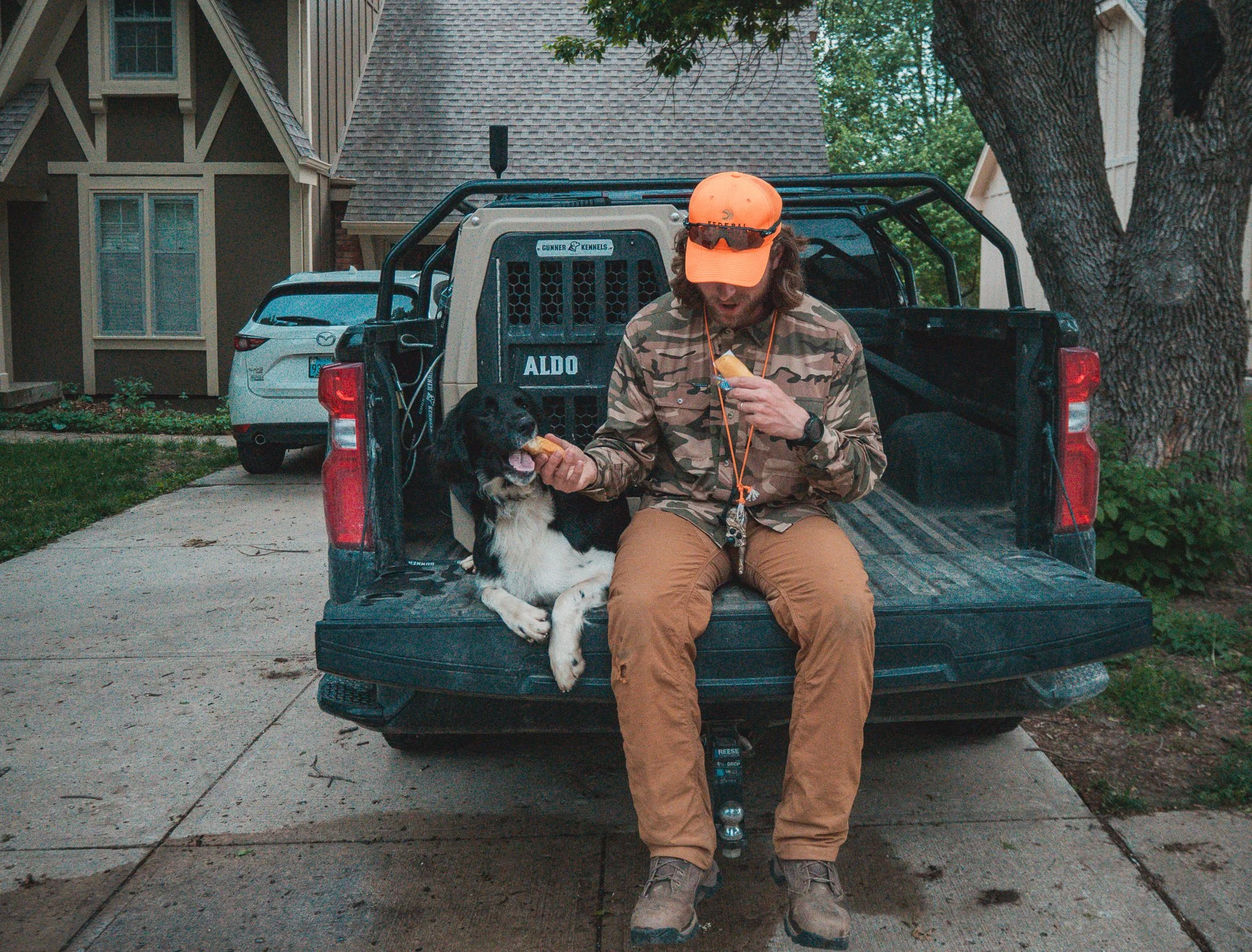
Amos and Aldo pose with the Munster Machine and a hard-day’s work of roosters.
A hundred feet downwind, the generator hums in the grass, powering the Starlink that connects my laptop to the rest of my life, and the rest of my life has accumulated while I spent five days following two dogs through South Dakota.
The temperature has fallen with the sun. After several afternoons near seventy degrees, it is finally cool enough to sit outside without sweating and warm enough that my fingers do not stiffen over the keyboard. An essay for school waits on the screen. So do emails and the other obligations that continued in my absence.
At my feet, Aldo and Amos work on bones I bought while passing through town. They hold them between their front paws and chew with the concentration of animals who have nothing left to prove. The collars Alexis made before Wisconsin are dirty now, having survived South Dakota better than the rest of us. Both dogs are tired. So am I, though only one of us seems interested in deciding what the week meant.
Between pauses in my schoolwork and work correspondence, the word redemption keeps coming to mind.
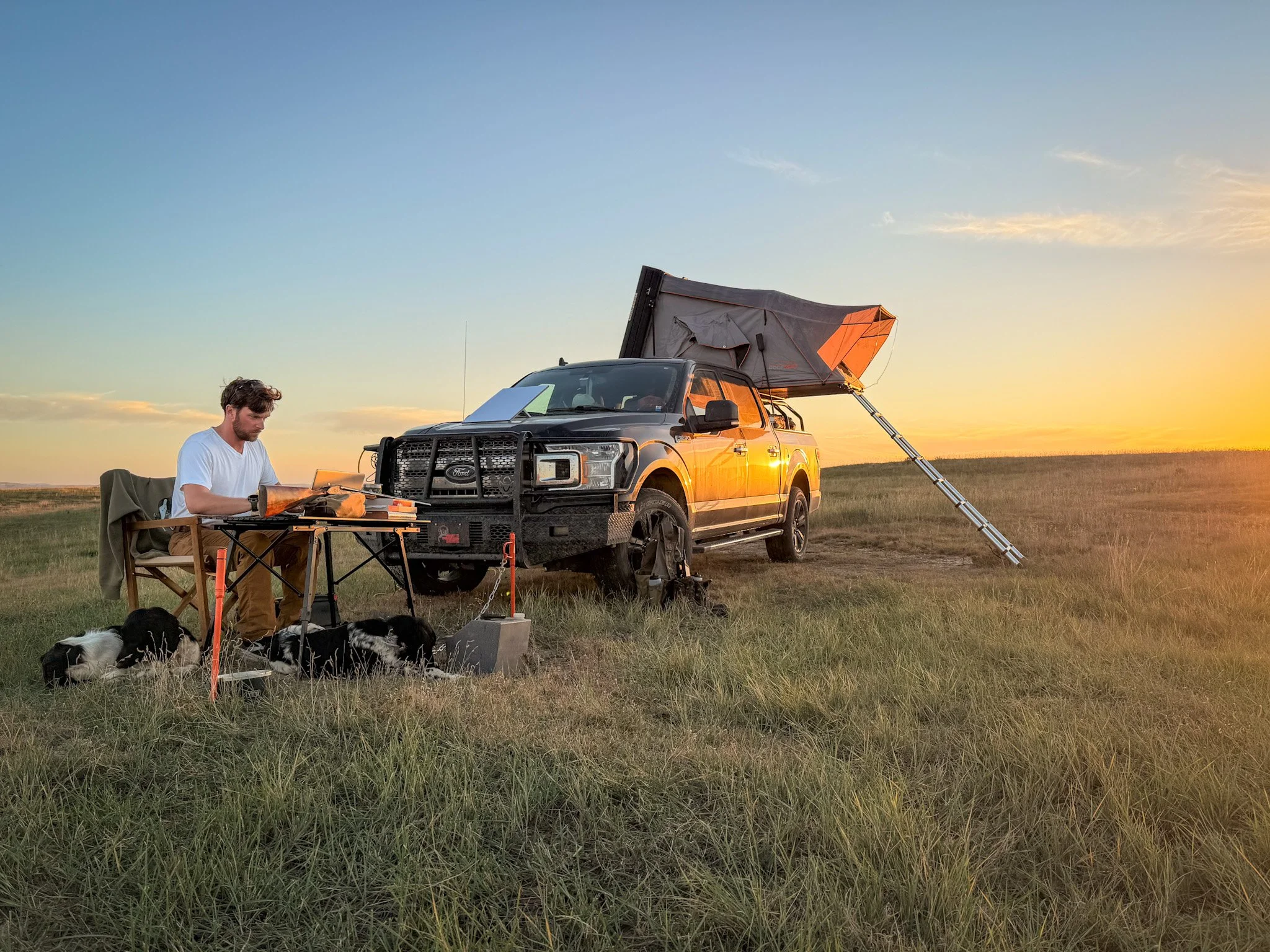
Little Office on the Prairie.
Last month in Montana, Aldo found sharp-tailed grouse but did not handle them with the steadiness I expected after a spring and summer spent working on exactly that. Two weeks ago in Wisconsin, the woods swallowed him so completely that I could not tell what he was doing. We came home without a bird of our own and without the complete memory I had wanted: Aldo searching, pointing, and retrieving a bird we had found together.
South Dakota gave me that memory day after day. I watched Aldo work the wind, trail pheasants, point roosters, and carry them back. Even when the grass or reeds rose high enough to hide him, they did so only briefly. His work remained visible to me. We hunted together again.
Redemption is an appealing word for it, but I am less certain it is an accurate one.
Not every field produced a point, or even a rooster. Some birds ran ahead of us. Others flushed wild, with no dog or hunter close enough to claim responsibility. That happens. But enough roosters held for Aldo that, day after day, I watched the same sequence unfold. The shortened cast. The turned head. The rigid body. I move closer, trying to see what he sees. Then the flush, the shot, the mark, and the retrieve. The whole conversation restored.
This, then, is the redemption I mean: the point, the shot, the mark, the retrieve. Or part of it. This week, Aldo was giving me back a conversation I believed I had lost, and Amos was beginning to speak it for the first time.
On his first morning in Montana, Amos had not searched so much as frolicked. A songbird could carry him hundreds of yards away from any recognizable purpose. I did not mind. It was to be expected. Still, I had the good fortune to watch several days and several contacts with sharp-tailed grouse begin to organize his attention. By the end of the trip, his nose appeared to be looking for something, but the rest of him had not yet learned how.
He did not cast from left to right across the wind. He did not remain mostly in front of me or return with any consistency after a distraction. He moved through bird country, and he was beginning to use his nose, but the search itself was not yet methodical.
Wisconsin did little to clarify what was developing. The woods concealed Amos just as easily as they concealed Aldo, and what searching I could see remained tight. He produced a woodcock at the edge of an elderberry swamp, but I could not yet watch the way he moved and say that he understood how to find another one.
In South Dakota, the pattern became visible. Amos began casting to my left, crossing in front of me, and working back toward my right. His nose and the wind appeared to govern where he went. Butterflies and songbirds still interrupted him, but they no longer carried him hundreds of yards away. He might chase one for twenty or thirty yards before turning back into the wind and resuming his search.
The puppy had not disappeared, but recess was growing shorter.
On our third day in South Dakota, I caught a glimpse of a flash point. Amos stopped for a split second and raised his right paw. Then he crept forward, and three hens erupted from the grass a few feet ahead of him. He spent the next ten minutes searching for birds that, by then, might as well have been in another county.
Progress.
On the fourth day, Amos bounded through the grass ahead of me until something stopped him. His torso turned. His head and tail locked into line. His right paw lifted.
A point.
I took two steps. Amos did not move. I followed the invisible line extending from the tip of his nose into the grass and took another step. A rooster rose. I raised Penelope and fired. The bird fell back into the grass, and Amos promptly secured his prize.
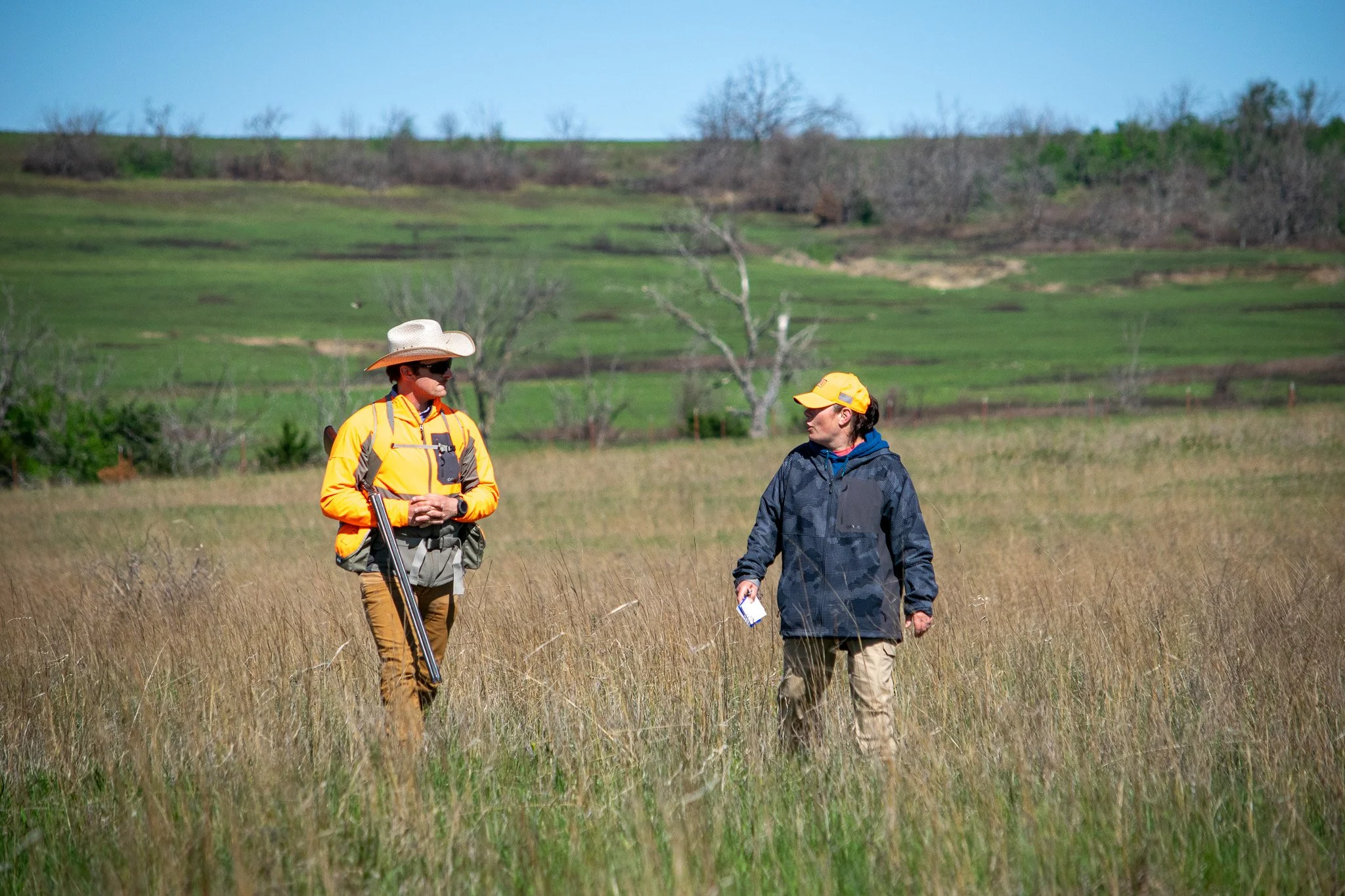
“THAT WAS A POINT!” I shouted at my hunting partner, Ian Moody.
I had shot a pointed rooster over Amos. I still cannot quite believe it.
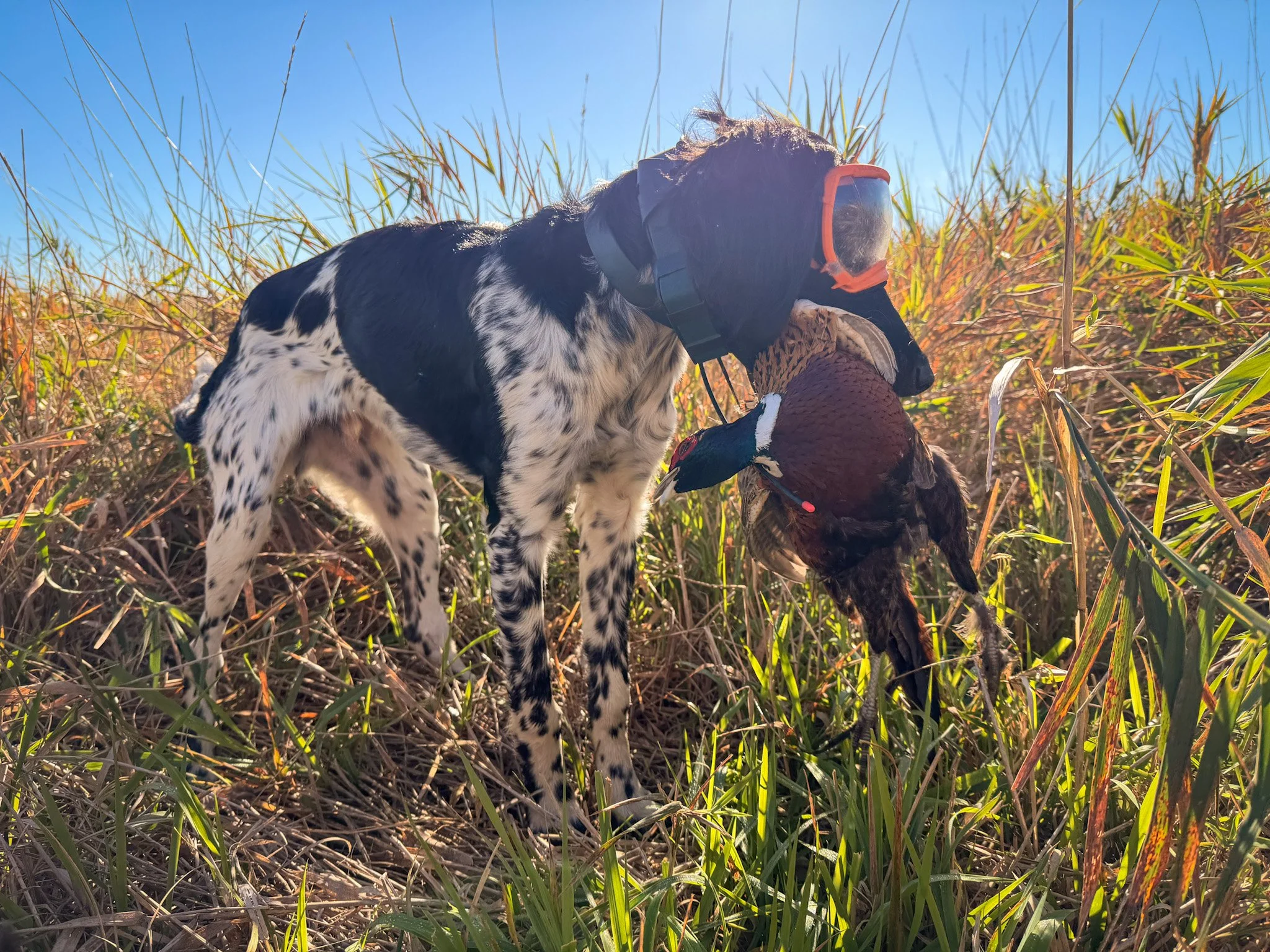
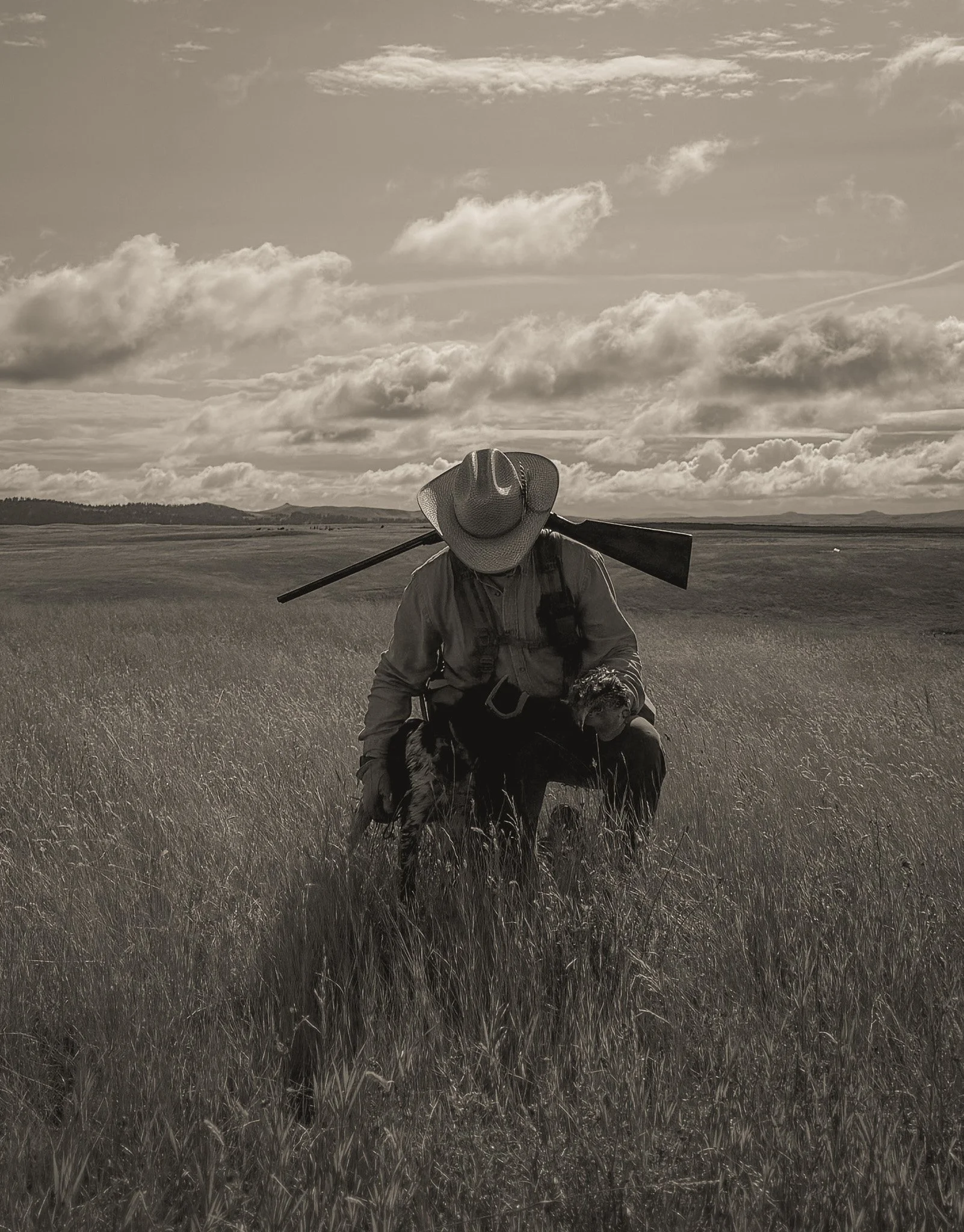
Amos with his first pointed bird — a South Dakota rooster.
On our last day hunting together, Ian was following Duke, his NAVHDA Versatile Champion, as Duke worked scent through the grass. Amos cast across their direction of travel and slammed on the brakes. His head snapped toward the line Duke had been following. Then he turned and followed it himself.
I was too far behind, and the grass was too tall, to see whether Amos eventually pointed. Forty yards later, a hen pheasant erupted ahead of the dogs.
Ian turned to me. “It’s just my opinion, but I’d say the switch has flipped.”
“Huh?”
“Amos. He’s not chasing tweety birds as much. He’s working across the wind, and he knows. He knows what these birds smell like and to follow that trail.”
I smiled.
Amos turned back into the wind.
On the fifth morning, Ian and Duke turned south toward Kansas City while Aldo, Amos, and I continued west.
I had a date with a Wyoming pronghorn in a few days, but my South Dakota license was still valid. I headed toward a piece of grassland where I had camped en route to Montana a few years earlier. I had encountered several sharp-tails along the entrance road then, and we had time for one more walk now.
I also had a theory I wanted to test.
In Montana, Aldo had bumped sharp-tails. In South Dakota, he had pointed rooster after rooster. Perhaps the difference was not the dog but the bird.
Thirty minutes into our walk, Aldo disproved the theory.
His body went rigid. He crept toward the edge of the next draw, then stopped. And this is where I screwed up.
I wasn’t ready. In fact, I wasn’t expecting to need to be ready. After Montana, I had nearly convinced myself that Aldo simply did not know how to stop and point a sharp-tail. Even with him standing motionless ahead of me, I approached more out of obligation than anticipation.
As I drew closer, Aldo took two more steps.
Creeping.
A sharp-tail erupted from a patch of snowberry halfway up the slope nearest us. It came from exactly the sort of place I should have expected to find one.
The bird flew. I watched it go. Aldo had pointed it, and I had failed to believe him.
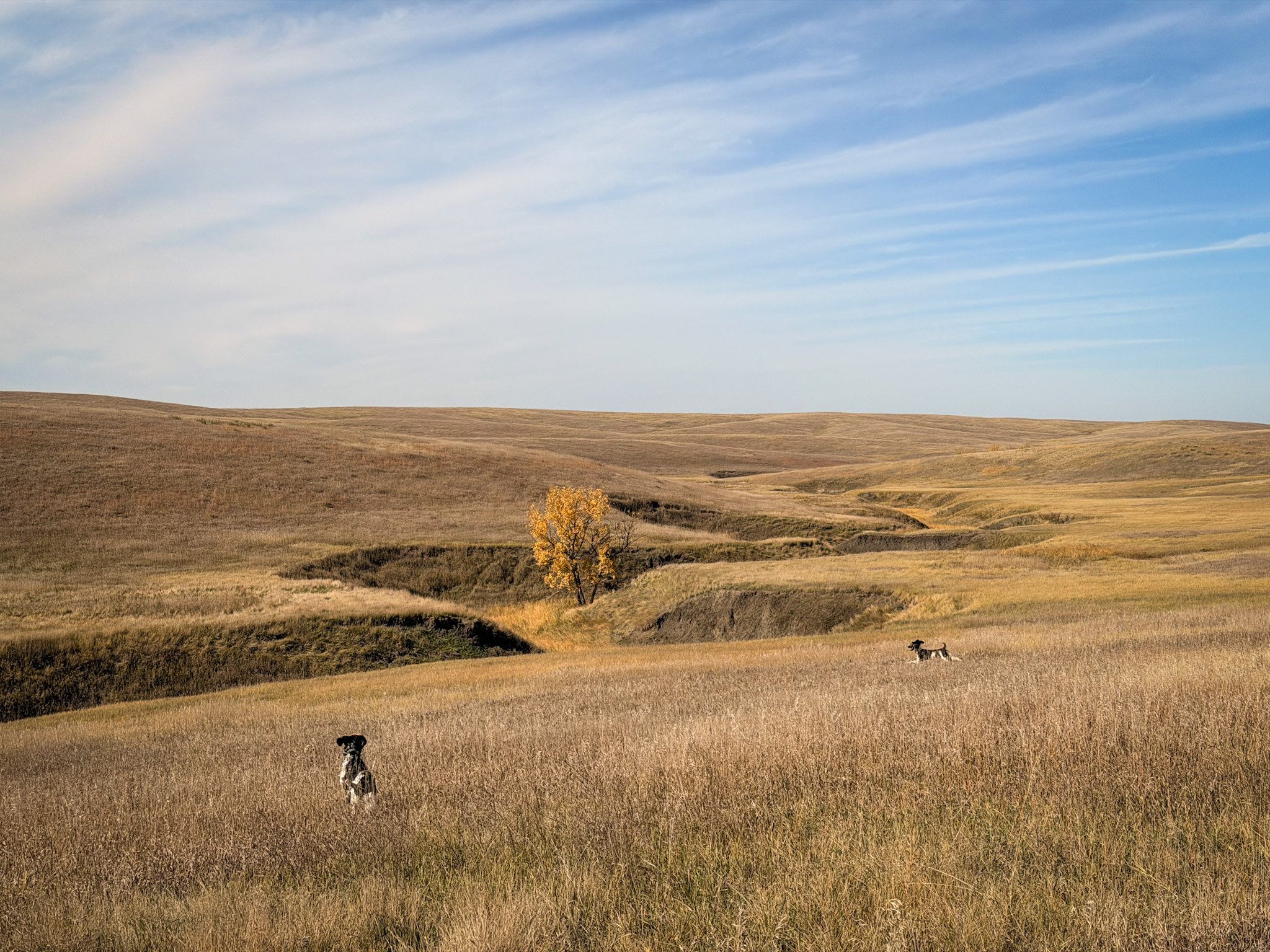
Amos, left, and Aldo, right, in search of grouse in South Dakota.
The point was not perfect. A better trainer might have had the remote in hand, ready to correct those final steps. But the bird may have moved after Aldo first stopped. Pheasants had done that all week, running through the grass while he tried to stay connected to them. Maybe the sharp-tails in Montana had done the same.
I thought of Poke, standing like a monument while sharp-tails rose twenty or forty yards beyond her nose. That is the picture we train toward: the dog motionless, the handler walking past, the bird holding somewhere ahead. It is beautiful when it works.
But birds do not always honor the picture.
They run. Scent moves. Distance grows. At some point, the dog must choose between remaining perfectly still and trying to locate the bird again. I knew which choice looked better. After a week of following Aldo through pheasant country, I was less certain which choice always produced the better hunt.
The sharp-tail disappeared over the grass. Aldo watched it go, then turned back toward me.
I had come there to test a theory about my dog. What I had tested was my trust in him. I had written before that experience with dogs had taught me to look longer before deciding what I was seeing. Apparently, I was still learning the lesson. Aldo had pointed it, though not without creeping, and I had failed to believe him.
Perhaps the bird had moved after he first stopped. Perhaps Aldo’s final steps were not the same impatient pressure I had seen in Montana but an attempt to remain connected to a sharp-tail moving through the snowberry. I could make an argument either way.
What I knew was that Aldo had found the bird, pointed it, and told me where it was.
I had approached expecting him to be wrong.
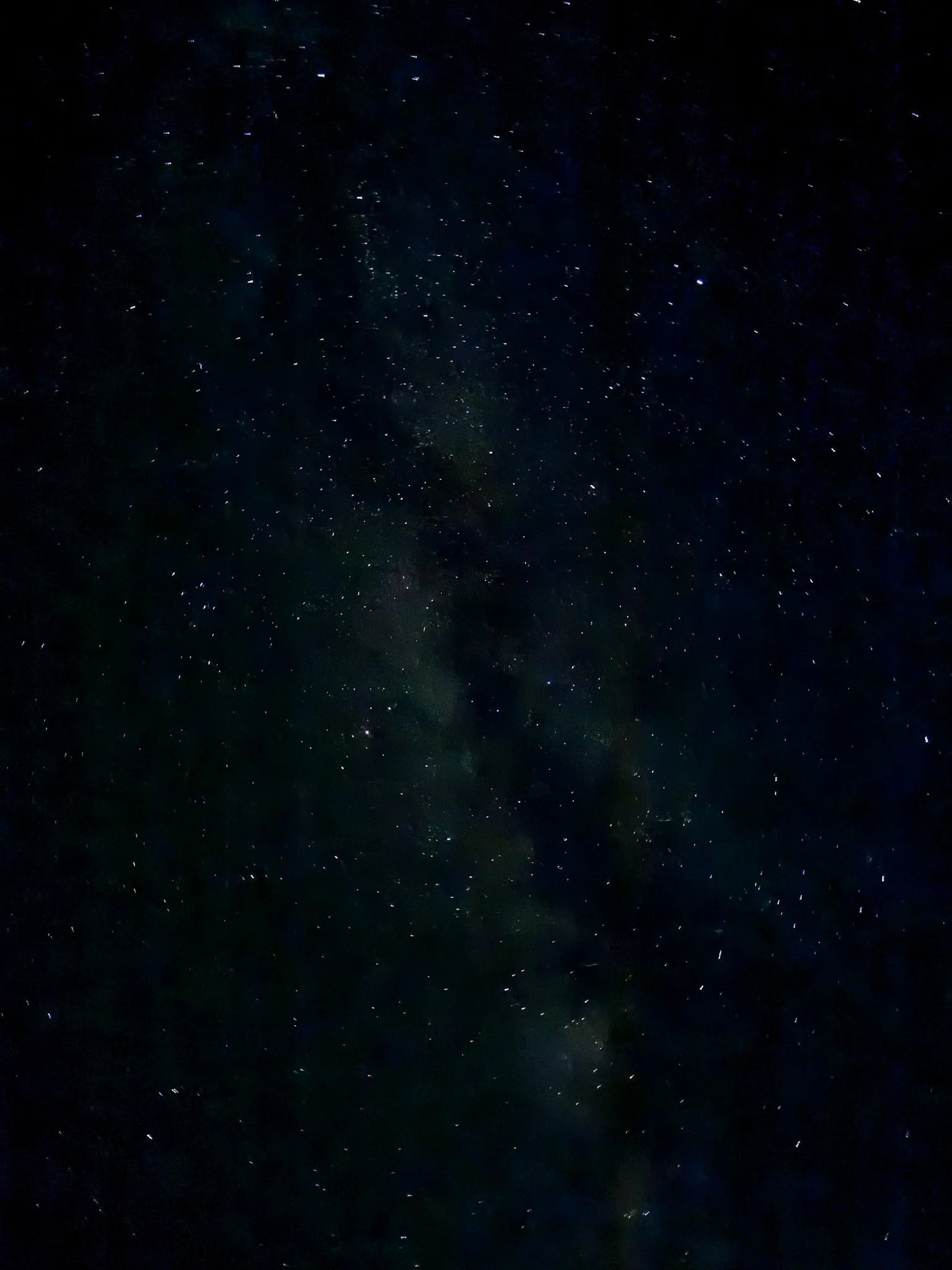
My schoolwork is finished, the work emails have all been read, and the dogs are sound asleep in their kennels. I close the laptop and shut off the generator. The sudden silence feels enormous as I sit beneath the stars eating white-cheddar Cheez-Its from the box. A guilty pleasure.
All week, I have tried to make sense of the dogs. Whether South Dakota redeems what happened in Montana and Wisconsin. Whether Amos’s switch has flipped. Whether Aldo’s creeping is a failure of steadiness or an attempt to remain connected to a moving bird. Whether I have trained them well, handled them poorly, or expected the wrong things at the wrong times.
The stars offer no opinion.
They are simply there, scattered across something too vast for me to comprehend and ordered in ways I cannot see. The questions consuming me begin to feel smaller beneath them. Not unimportant, exactly, but returned to their proper scale.
Tomorrow, we will continue west toward Wyoming. There will be another field, another wind, and, if we are fortunate, another bird to complicate whatever I decide tonight.
For now, I eat my Cheez-Its and look up.
Read More Stories About Aldo and Amos