The Dog’s Apprentice
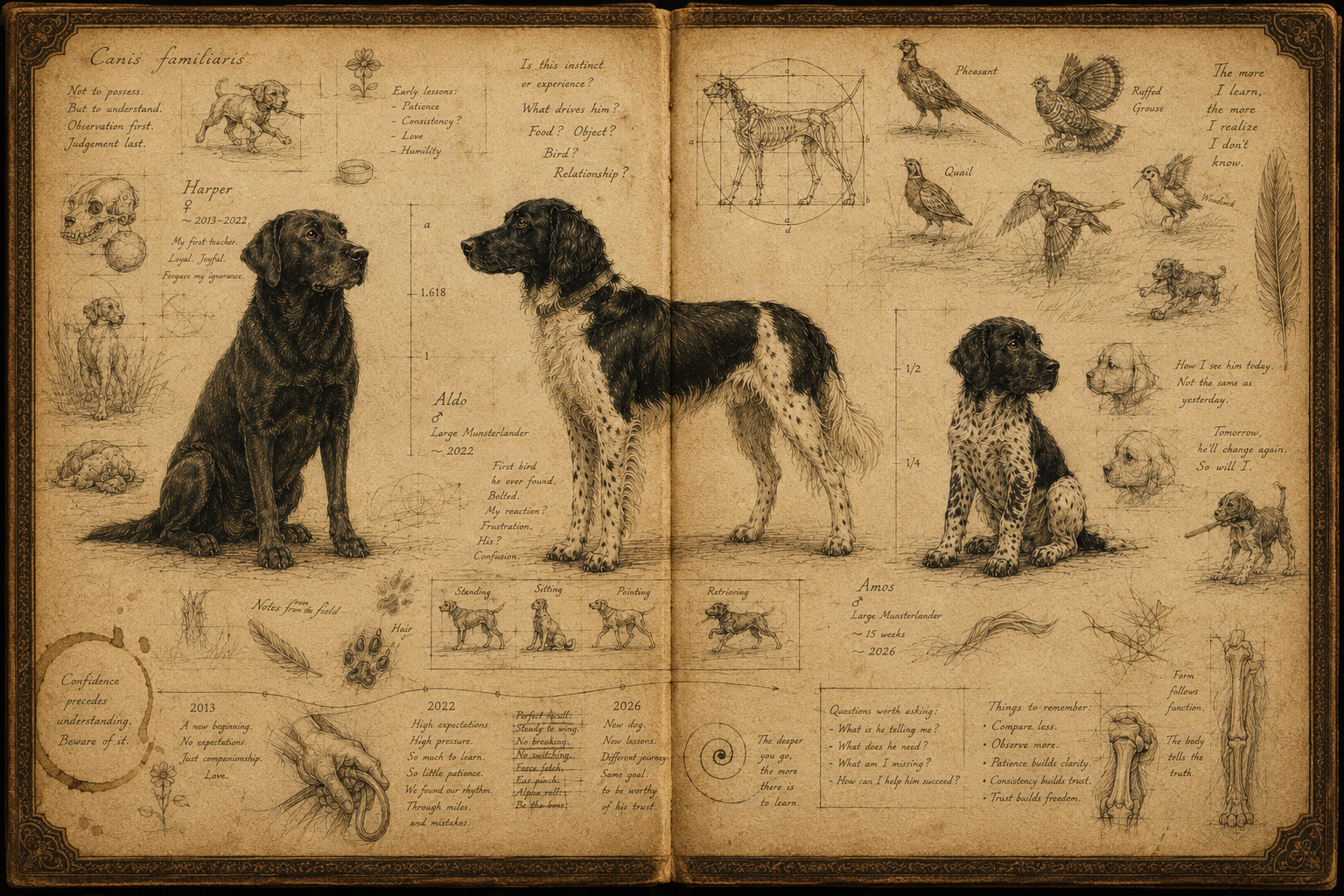
Studying. Approaching fourteen years at the time of this writing, I suspect my apprenticeship in dogs will be a lifelong one.
Amos is nearly four months old now. He’s been here, running and jumping and nipping and tripping for nearly fifty days. I’m starting to get to know him, and he’s starting to get to know me, but I know there’s plenty more work to be done on both fronts.
He’s curious and confident and he seems to mitigate stress well. Food is a core motivator, while the bumper and the tennis ball are interesting, but only sometimes. He roughhouses and likes to chew on toys. Rather fond of socks (especially if they’re dirty). Barks sometimes, the loudest right around breakfast and supper time. Independent enough to explore the backyard, but still keys off me as much as Aldo.
I’m reserved about it, but deep down, I feel promise—I see potential—when I watch him. It’s a completely different ballgame this go around. A completely different dog.
I’m different, too, so it would be naive to ignore that component of the equation. This marks Year 13 for me with a dog, going into Year 5 of raising, training, and hunting with a versatile hunting dog. Personal and professional life considerations aside, my experience—and expectations—of a dog are vastly different. They’ve evolved.
I fumbled my way through much of my responsibilities with my first dog, Harper. Eventually house trained. Recalled, sometimes. She did not—would not—hunt, nor did I expect her to when I picked her out of a cardboard box in a dimly lit mechanic garage. She was a faithful companion, jumping into my arms when I returned home from deploying overseas. In time, I had forgotten the trials of raising a puppy with no prior experience, and when timing with the rest of life was right, I got Aldo.
Aldo was my first versatile hunting dog. A Large Munsterlander, complete with pedigree and proud German heritage. Through a fire hose, I drank. When he didn’t fetch at two months, I was concerned. When he got ahold of his first dead bird and bolted, I lamented. Hours and miles, I sweat and walked, trying to enforce strict standards and expectations in a way that my drill sergeants and music teachers once did to me. I read books, watched videos, talked to trainers, and joined NAVHDA. Questioning each step, and each misstep. Unaware of what to expect but thinking that anything less than perfection was failure, and that fell somewhere between my own shortcomings and the dog’s genetic disposition.
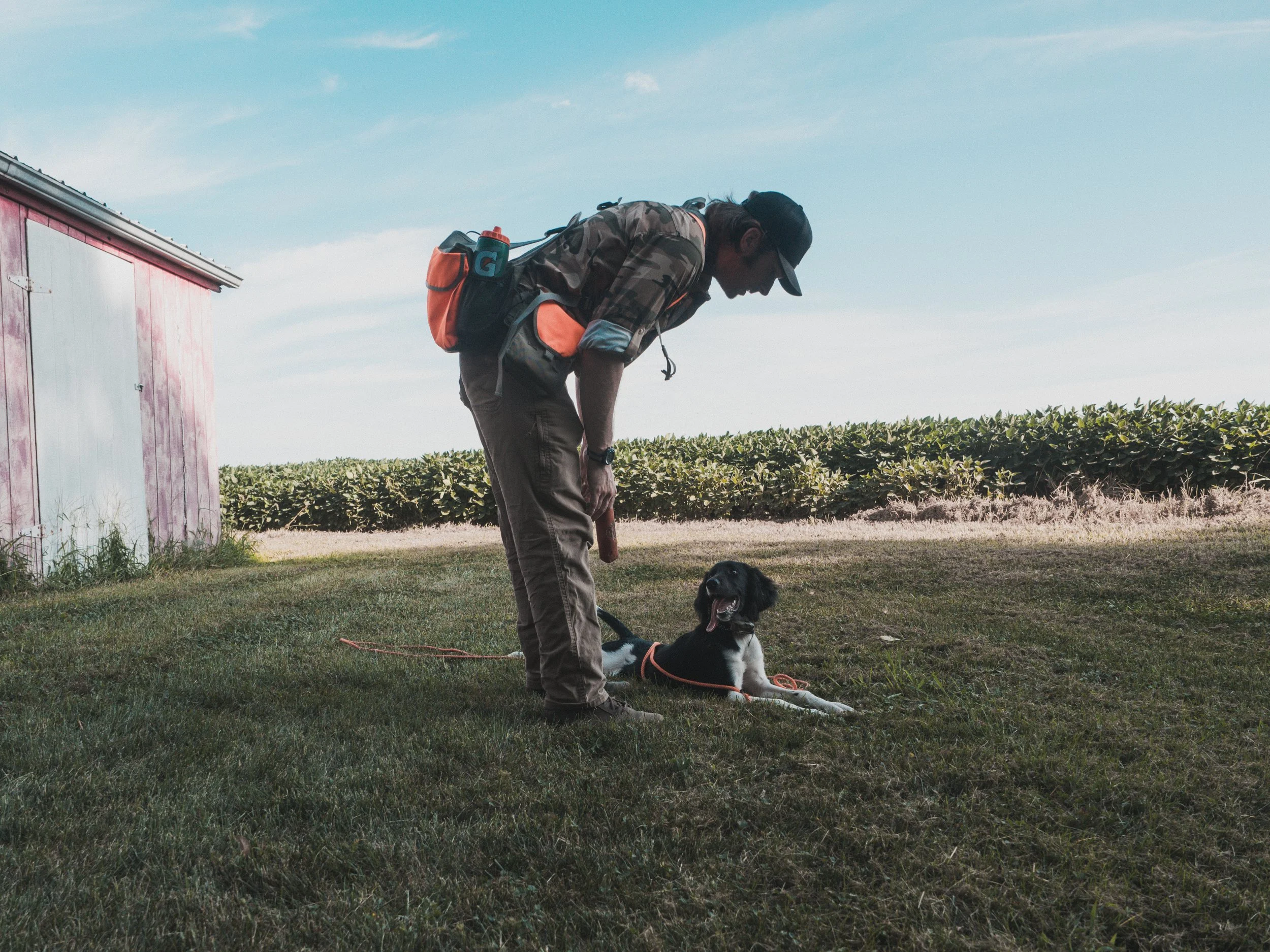
Perplexed, circa 2022. I remember this day, vividly. I was frustrated. Aldo wouldn’t retrieve consistently. His tongue hanging out the side of his face tells me now that the session should have been ended sooner—but I didn’t understand that then.
In time, Aldo and I found our rhythm. We hunted and we hunted some more. We continue to hunt and Aldo’s drive for the pursuit is like a train, thundering on the tracks, the gauge in the red. He yells at me, and anyone else that’s with us, when a bird is missed. Sometimes he won’t eat and he can be restless. Stressed but motivated by the next horizon, the next point, the next retrieve. His titles and scores will likely reach their apex at the NAVHDA Gun Dog Test, but I know that he will always return to my side when I call, and if there’s a bird in that field, he’ll find it.
And now, there’s Amos. The third chapter of my story, ACT III of my education in dogs, the next semester in my apprenticeship. Amos is not a better dog, and he is not a worse dog, but he is a different dog—because they’re all different. I see that now. Some things that came naturally for Harper did not for Aldo, just as some that came easily for Aldo will surely challenge me with Amos. The inverse is just as true.
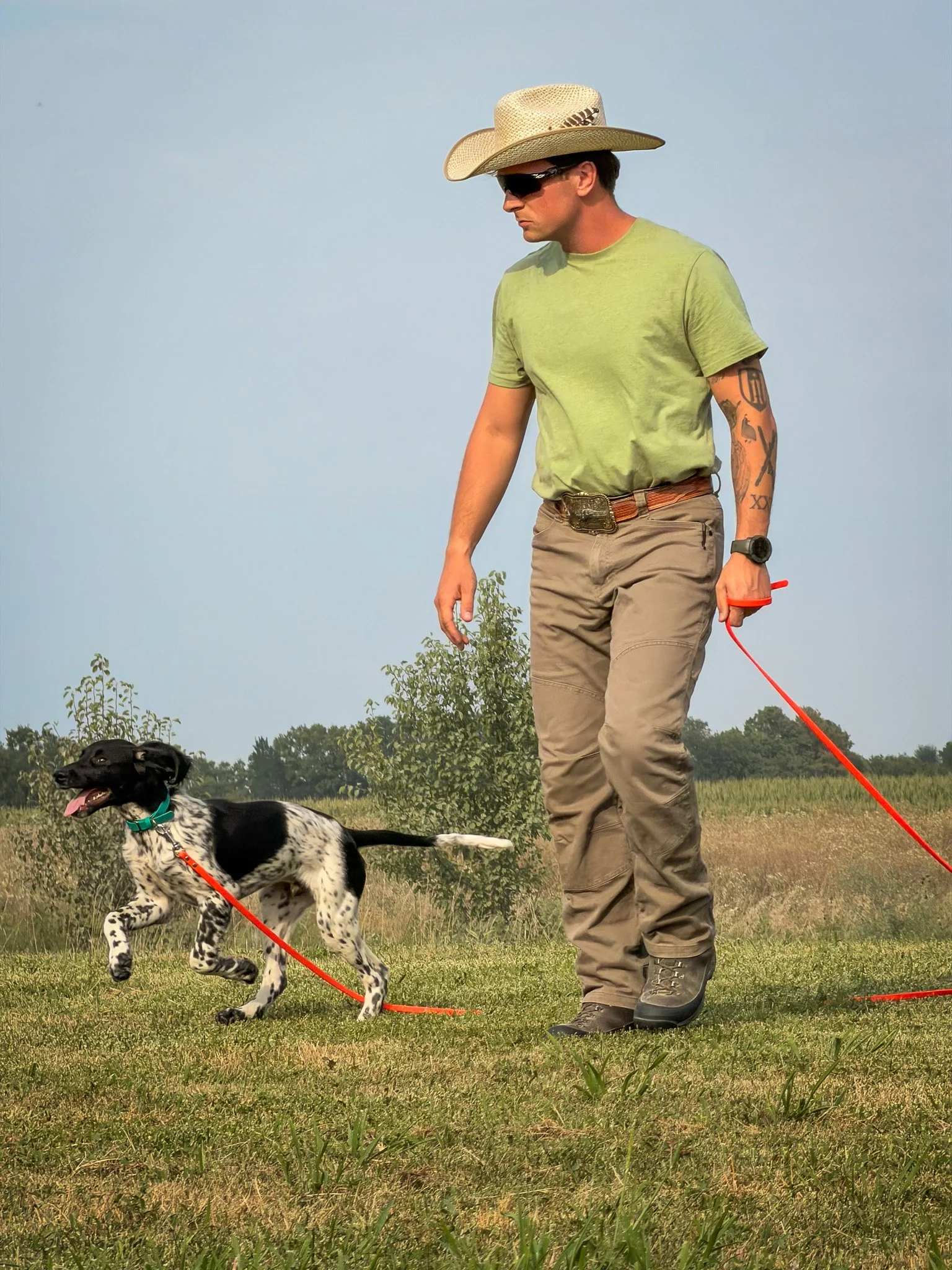
Working Amos on a check cord. A tool I misunderstood when Aldo was this age, and now one I greatly value.
When Harper was a puppy, I didn't know enough to realize how much I didn't know. Ignorance is bliss. By the time Aldo came along, I knew enough to think every problem had a solution if I could just find the right book, the right video, or the right trainer. Amos has arrived at a different point in my education. I still have questions—more than ever, in fact—but they're different questions.
Now, with an entire shelf of my personal library full of titles like Training Bird Dogs with Ronnie Smith Kennels, Speed Train Your Own Gun Dog, and How Dogs Love Us, I find myself less concerned with choosing the perfect method—or the perfect age to apply it—and more interested in watching Amos. I still ask many of the same questions: What's the right way to teach this? When's the right time to teach it? But those questions now follow a far more important one: what kind of dog is standing before me?
I'm using my eyes more than ever. Watching. Watching how quickly Amos recovers after something startles him. How food consistently outranks a tennis ball, except on the occasional afternoon when it doesn't. How he'll disappear around the corner of the house, confident enough to explore on his own, only to pop back a few moments later to make sure I'm still there. How he solves problems instead of creating them. How he decides when to engage and when to walk away.
None of those observations tell me how to train Amos. Together, they begin to tell me who he is.
I don't think I watched Harper this way because I didn't know what there was to see. I don't think I watched Aldo this way because I was too busy trying to shape him into the dog I thought he should become. Amos has arrived at a different point in my education. Experience hasn't taught me to see more quickly. It's taught me to look longer before deciding what I'm seeing.
Before dogs, there was a rigorous classical music education, followed by a career for Uncle Sam. Both taught me that the devil is in the details, that fundamentals can never be neglected, and that disciplined repetition compounds over time. Practice produces proficiency. Rehearsals become performances. Drills become instinct.
With Aldo, I applied what I knew, evolving from the laissez-faire approach I had taken with Harper. I expected an exceptional versatile hunting dog to emerge through structure, consistency, and enough repetition. To an extent, I still believe that to be true. Training matters. Standards matter. Repetition matters.
But dogs aren't violin virtuosos, nor are they combat soldiers. They don't all respond to the same instruction in the same way or on the same timeline. Every dog brings a different temperament, a different set of instincts, and a different way of learning. The fundamentals don't change; the application does.
It took years—and getting to know Amos—for that distinction to become clear. My focus with Aldo was on the performer and the performance, not the individual. I wasn't asking, Who is this dog? I was asking, How do I make him into the dog I had already imagined?
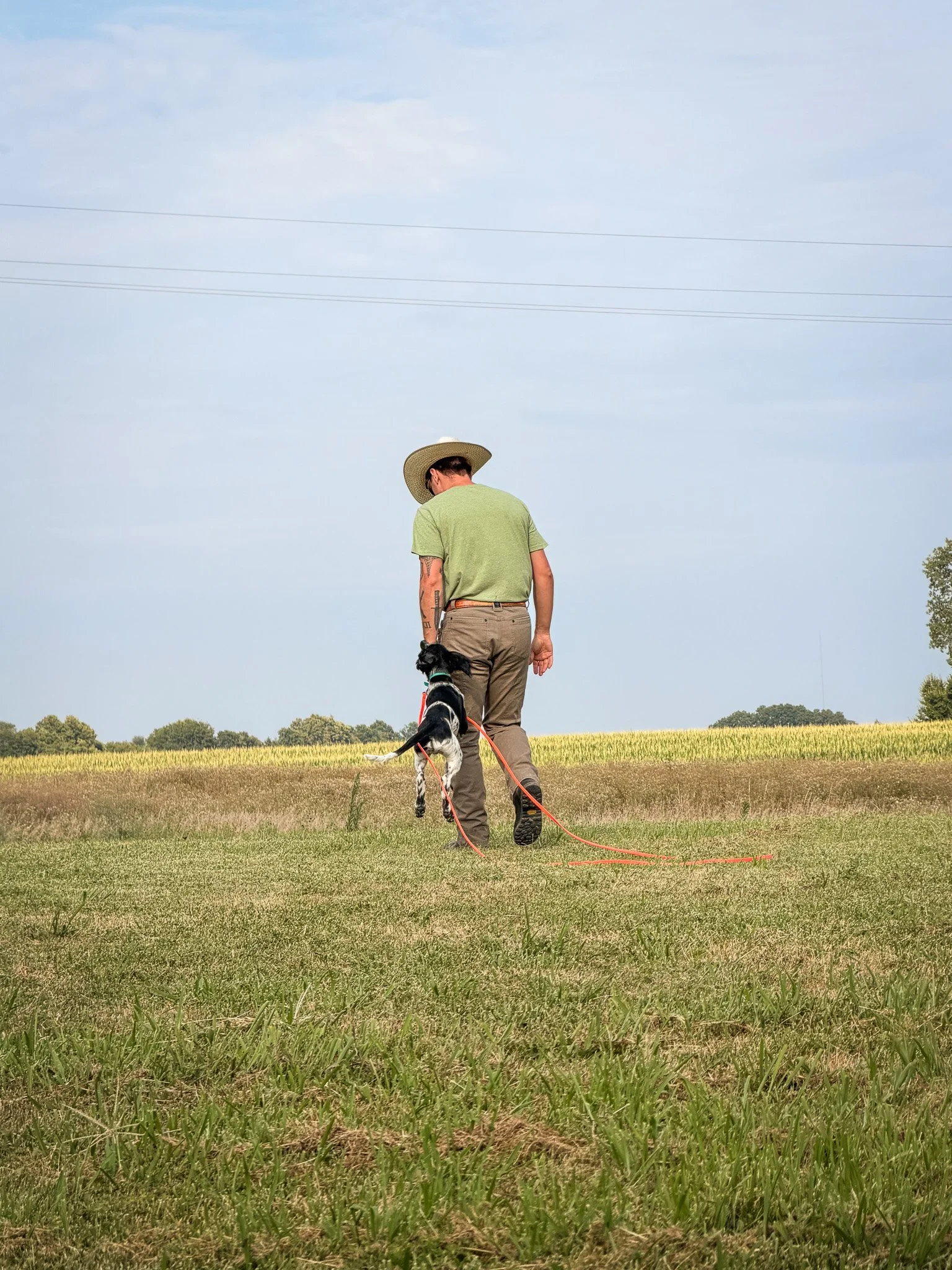
Amos getting air.
Looking back, I had the order backwards. I thought understanding would follow training. Instead, training only began to make sense once I understood the dog standing in front of me.
Somewhere between Harper, Aldo, and Amos, my temperament changed, too. The standards haven't softened. I still believe in repetition, consistency, accountability, and that some lessons are too important to leave to chance. What has changed is the anxiety.
I no longer disappear into the depths of my own mind wondering if I introduced a retrieve a week too early, corrected a behavior a moment too late, or somehow ruined a promising dog because he chased a bird, ignored a bumper, or chewed on another sock. I've learned that good dogs—and good trainers—are more resilient than that. Progress isn't decided by a single training session any more than character is decided by a single mistake. It's measured in seasons, not afternoons.
Every new dog arrives carrying more than its own pedigree. It carries the accumulated lessons of every dog that came before it, filtered through a handler who has been changed just as much. Amos deserves to be judged on his own merits, not measured against Harper or Aldo, or any other dog in the field. The older I get, the more I realize that each new dog isn't another opportunity to prove what I know. It's another opportunity to discover what I don't.
Perhaps that's the greatest gift a dog can give us. Not another title, another retrieve, or another bird, but another way of seeing the world around us.
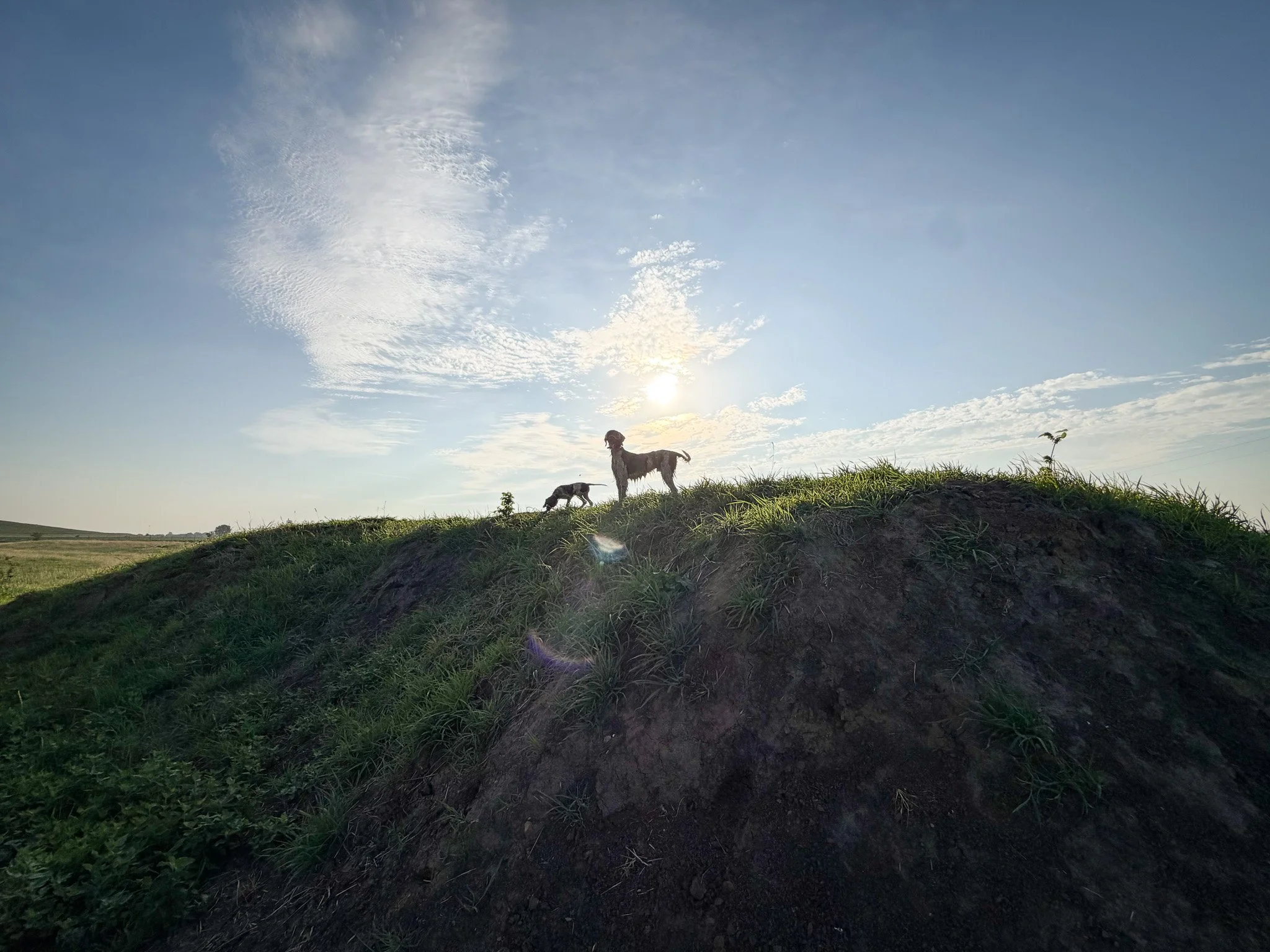
Scale. Amos, on the left, Aldo, on the right, the two of them fresh out of the pond.