The Sight of It All
The timber had opened around us. I could even swing a gun, which seemed a reliable indication that there would be nothing to shoot.
Most of the foliage still clung to the trees. An occasional breeze pulled loose one of the few burnt-orange leaves willing to fall. The colors had begun to turn, but we had arrived a week early, or so it seems. My calendar rarely aligns with nature’s.
The trees were older and taller than the books recommend for this kind of hunt, their canopy shading out the vegetation grouse and woodcock used below. I did not mind. For the first time that day, I could see Amos ahead of me. I did not need to locate him by the jangle of a bell while ducking and weaving through walls of aspen and piles of briars.
We were headed downhill toward an elderberry swamp, a distinct pocket of vegetation that a Northwoods regular would simply call cover. It was the kind of place that could hold a woodcock. I had seen the bird in magazine photographs and engraved on shotgun sideplates, but never with my own eyes.
Amos’s search tightened as we approached the change in vegetation. His body changed with it. First the tail, then the hips, then the neck, and finally the head. Nose down. I recognized the pattern. Aldo had been the first to teach it to me.
Now, when Aldo gets birdy, my body answers his. My thumb slides toward the safety. My pulse rises. My attention contracts around him.
In Amos, the pattern remained faint. More resemblance than declaration. At six months old, any number of woodland distractions worthy of a puppy’s attention could have produced it. Old scent. A mouse. Something else hidden beneath the leaves.
I watched. My thumb did not move.
A woodcock erupted a few feet in front of Amos.
It went almost straight up. Not vertically, perhaps, but close enough that the distinction felt pedantic. It climbed toward the canopy. I raised the battered 28-gauge, pushed off the safety, and fired.
The bird struck the forest floor a few yards short of the elderberry.
It lay atop burnt-orange maple leaves, waiting for Amos and me. I set down the gun and guided him toward the fall. When he reached the woodcock, he snatched it up. His eyes narrowed. He had the bird, but experience suggested that giving it to me was not necessarily part of his plan. Another game of keep-away, perhaps. Before he could establish the rules, I slipped an arm beneath his chest and held the puppy close.
We had found a woodcock.
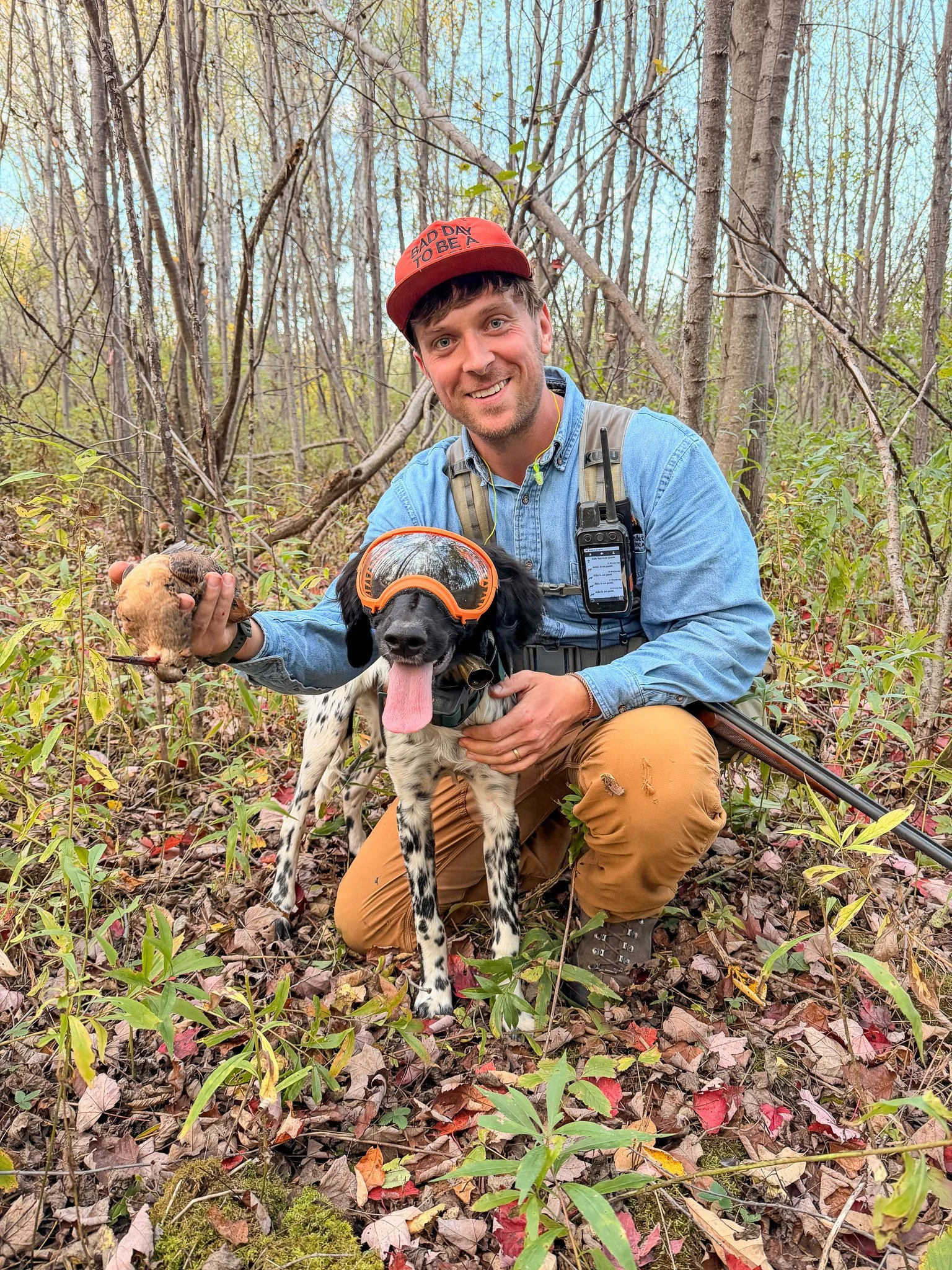
Amos and me with our first woodcock.
Amos’s part in the ruffed grouse was not as easily understood. We watched the bird walk from a logging road into the woods, and I led Amos to where I had last seen it disappear. His body changed again, that early and still-developing birdy behavior beginning to take shape. Beyond a screen of briars, the grouse flushed downhill toward a stand of young aspens. We followed it deeper into the timber.
The bird flushed again. This time, I was not afforded the open timber of the woodcock encounter. Trunks, limbs, and thickets blocked my view. I heard the flush and caught Amos in the corner of my eye, rigid near where the sound began.
We followed the bird farther into the woods. It flushed a third time.
Amos’s bell sounded to my right. A grouse erupted from the same direction. For a few feet, its path crossed an opening in the timber. I raised the gun, swung through the opening, and fired.
Amos had not pointed the grouse, and I could not say with certainty that he had produced any of the flushes. But in less than thirty minutes, one wild bird had given him three contacts. That was all I could ask of it.
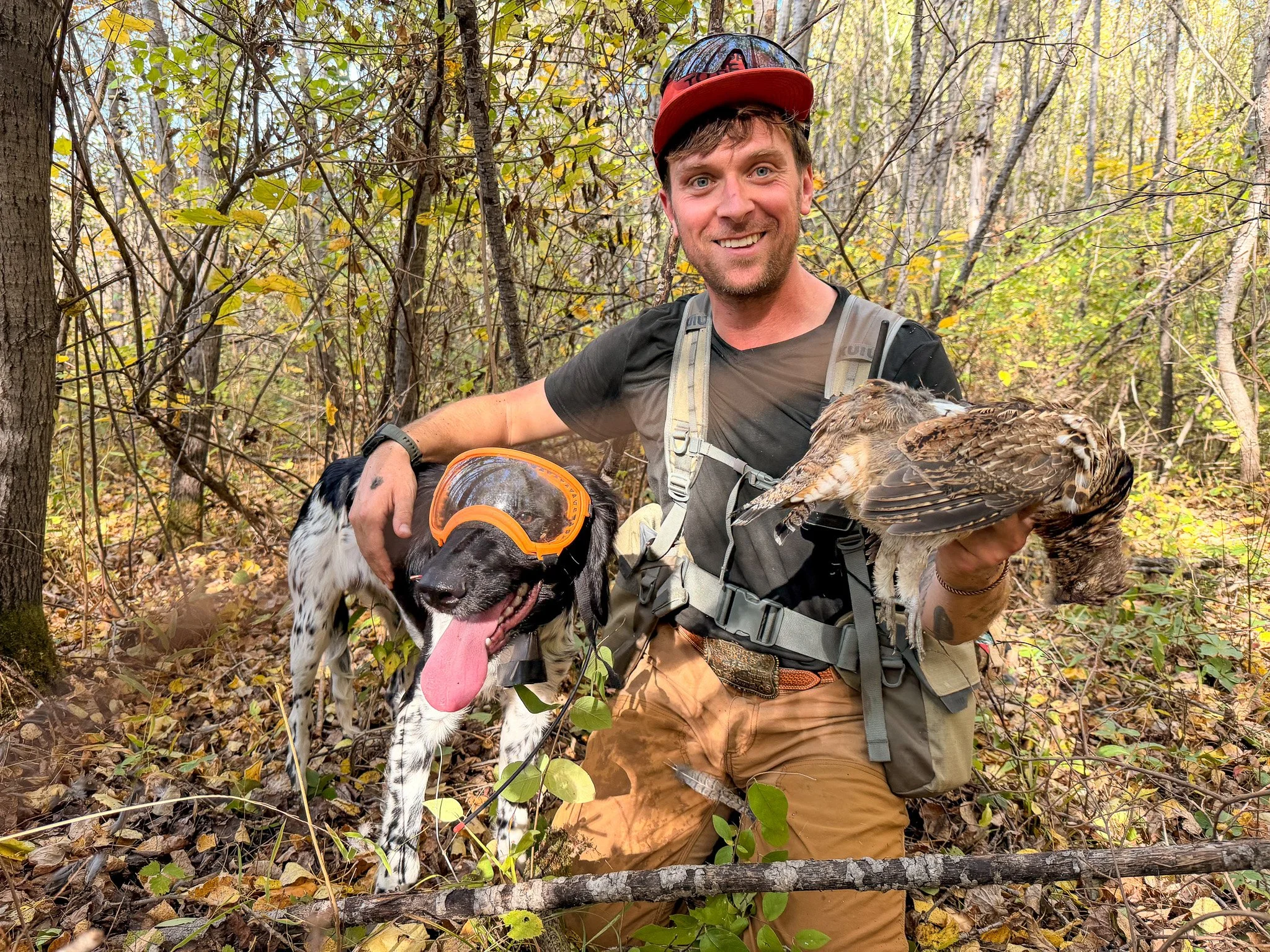
Amos and me with our first Ruffed grouse from the Northwoods.
Two woodcock and two ruffed grouse lay in the cooler. None of which belong to Aldo.
I knew that was an unfair way to account for the trip. Two of the birds did not belong to Amos, either, and I had no reason to believe Aldo measured his days by the cooler’s contents. Each time I released him, he entered the cover with purpose. Still, I could not shake the disappointment, or the suspicion that I had asked so much of him without giving him the experience I had hoped we would share.
Time and again, the Northwoods swallowed a dog I had learned to read from two hundred yards. What remained was the jangle of a bell, moving from my left, to somewhere ahead, then to my right. It gave me his approximate location. It could not show me what he was doing.
I could not see his head turn into scent or his search tighten around some unseen possibility. There was no rigid point to admire, no marked fall, no bird returned to hand. I had wanted a bird for him.
Or perhaps I had wanted one with him.
Aldo did not appear disappointed. He ate. He slept. When it was time to hunt again, he was ready. The raw skin on the tops of his front paws, bloodied tail, and sore lips from porcupine quills bothered me, but none appeared to lessen his desire to return to the woods.
Perhaps the miles had been enough for him. Perhaps he had found scent I never saw him encounter and followed birds that never flushed. Maybe the days in unfamiliar cover had given him something that could not be measured by a point, a retrieve, or the contents of a cooler. I cannot know.
What I know is that Aldo seemed content, and I was disappointed. For years, when I have tried to explain my love for bird dogs, I have told people that I love watching them work. I thought the important part of that sentence was the work: the search, the point, the retrieve, and the instincts that somehow allow a dog to find what I cannot.
Somewhere in Wisconsin, I began to wonder whether the more important word was watching.
With Aldo, hunting has become a conversation conducted through movement. I watch him search until his body changes. His head turns. His pace slows. His casts shorten. He becomes certain, and his certainty begins to direct me. My feet follow his. My thumb moves toward the safety. If everything unfolds as we hope, a bird rises, I shoot, and Aldo brings it back.
The Northwoods had not necessarily prevented Aldo from working. From the glimpses I caught, I knew he was hunting. But most of that work occurred without me. The woods had separated his search from my ability to witness it, and I had not understood until then how much watching him was part of hunting with him.
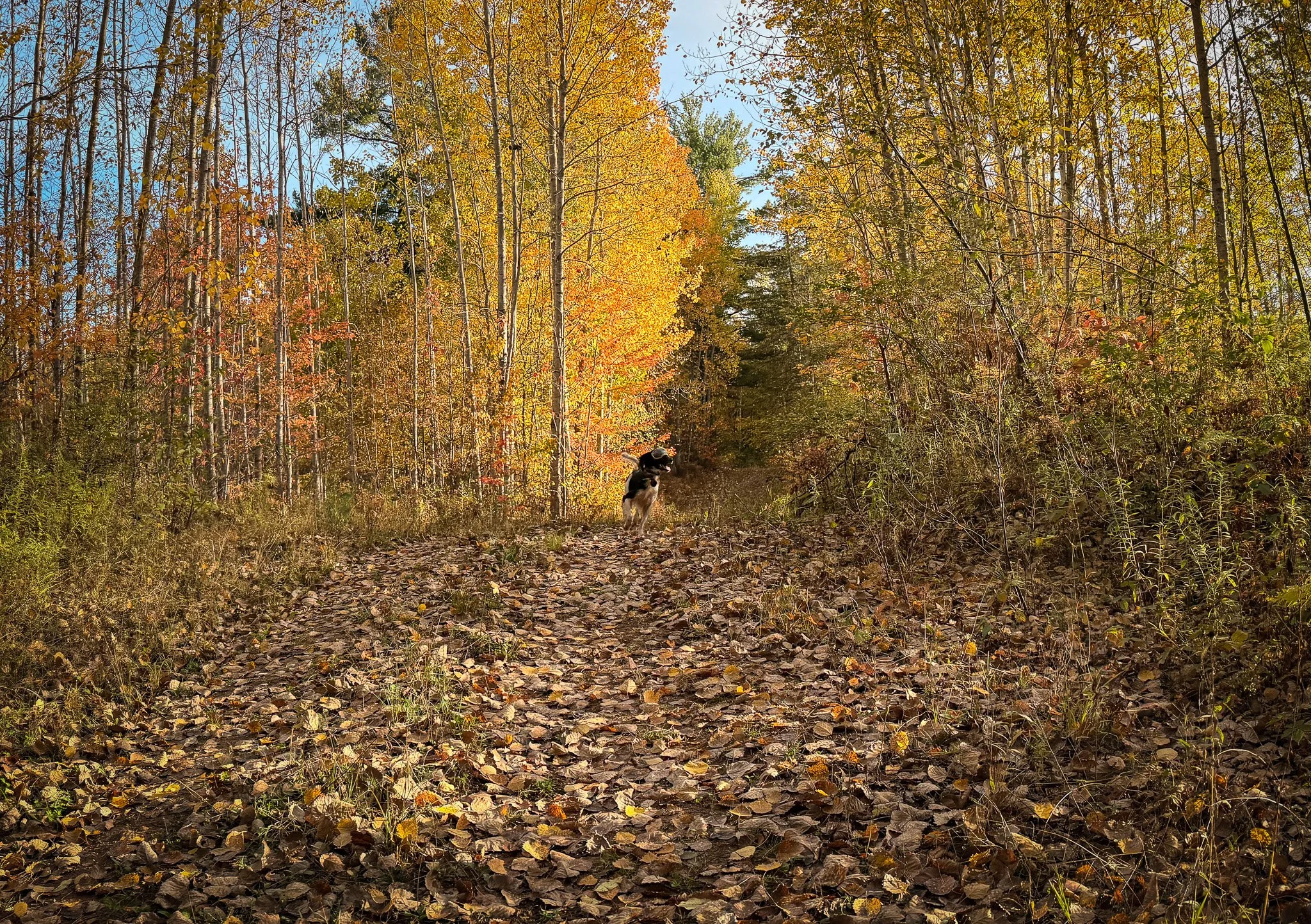
Aldo, checking in on the trail before cutting back into the timber.
On the prairie, Aldo can be two hundred yards away and remain available to me. I can see the country he chooses, the turns he makes, and the moment his interest begins to narrow. In chukar country, the exertion required still does not impede the view ahead of the route Aldo has chosen. But in the Northwoods, he could be only twenty yards away and feel absent.
I spent the drive home thinking about these things. How, for years, I have inadvertently found such value in the sight of it all. How a bell can feel deafening and isolating. The joy of encountering a new species of bird. The satisfaction of watching something begin to take shape in Amos. The disappointment of traveling all that way with Aldo and returning without one complete memory of hunting a bird with him.
There are moments from the trip I will remember for the rest of my life. But I am less certain that I want to repeat the experiences that produced them. I am glad we went. I still did not know if I enjoyed it.
That is difficult to admit.