Iron Sharpens Iron: Why NAVHDA and the Versatile Dog Community Matter
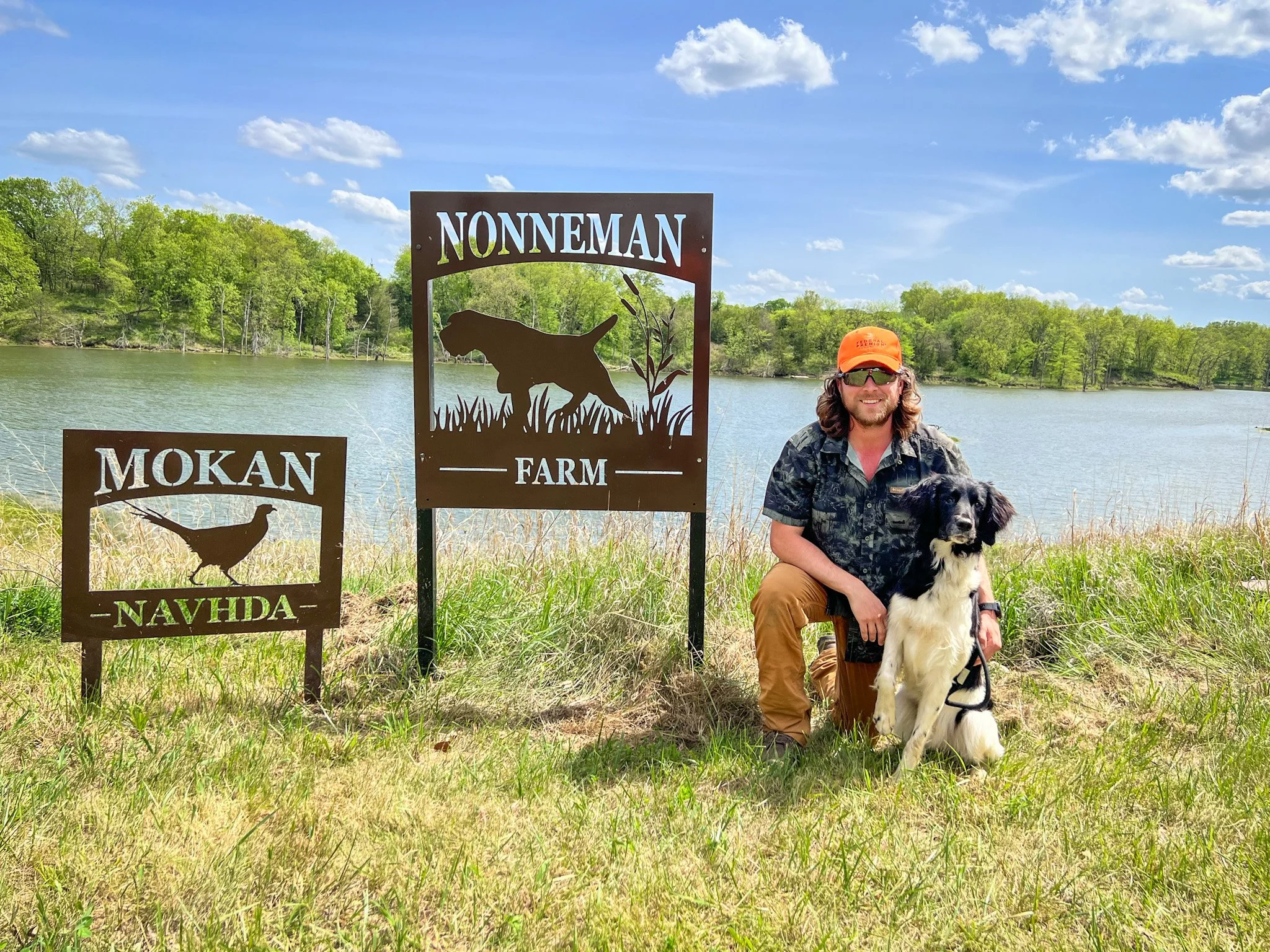
Aldo and I at our first NAVHDA test in 2023 hosted by the MOKAN chapter.
My generational cohort adapted to one technological milestone after another as it aged through childhood, adolescence, and young adulthood. There was a corded landline in our home’s kitchen when I was a kid. I’d dial Ryan’s mom, ask for her permission to speak with Ryan (if she answered), she’d hand the phone off to him (if he was home), and I’d ask if he could come over to play that Saturday afternoon. In junior high, cell towers began to crop up along with “can you hear my now?” billboards. I got to sit across the kitchen table from my dad as he waved the Sprint Mobile bill “FIFTY CENTS A TEXT, IAN. AND LOOK AT THESE ROAMING FEES! WHO ARE THESE PEOPLE?!” (girls, duh). By high school, we departed the communication Dark Ages (or perhaps, entered them), and Facebook lifted its policy for its users have an official college email address. My short-lived AOL Instant Messenger profile, Xanga page, and MySpace were all effectively dead overnight, the floodgates were opened to the emotional onslaught of likes and shares.
I first learned the term “influencer” as an adult, asking the perennial question of the deployed-soldier: “What are you going to do when you get back home, man?” One guy told me he planned to finish his tour, then go live in a van with a dog—and get paid for it. While sand trapped between my skin and body armor rubbed me raw, Instagram was well on its way to making things like a plate of macaroni and cheese not only sexy, but monetizing its sexiness (so sexy, in fact, that Forbes began championing influencers as a critical business strategy). When I returned to college, YouTube had transformed from a video catalog of grainy cats playing the piano to high-definition graduate physics lessons and everything else in between. One video could help you master quantum mechanics while the next compels you to question whether or not the moon was real.
In that ~thirty year span, communication innovation gripped my generation, impacting us at our most formative moments. We went from corded landlines in the kitchen to AI chatbots in our pockets. As we aged and communication became the currency of our social survival, the kitchen-table diplomacy our parents taught us became a dead language. We stopped calling Ryan’s mom. Instead, we found ourselves parsing the silence of an unreturned “like” as if it were a coded diplomat’s cable. By seventeen, we were suddenly tasked with managing the digital fallout of a “friend request” ignored, weighing the false power of a “confirm” button against the quiet guilt of a “delete.” It had become simpler, and more comfortable, to both sidestep confrontation and create it from a self-prescribed digital echo-chamber.
I said my goodbyes to Facebook and Instagram several years ago. The departure ended up being much more difficult than I anticipated. I’d catch myself staring at my unlocked home screen only to realize there was no actual purpose for digging my phone out of my pocket. Boredom was afoot, and my mind craved a digital cure. Or, perhaps it wasn’t boredom of finding something to look at or digest, but this uncanny nag that I needed to post something, for fear of being forgotten. The conditioned responses were not all that different from what I experienced walking to the fridge on auto-pilot, looking for a cold beer, post sobriety.
What I didn’t consider until a few months after leaving Instagram and Facebook was that I might occasionally “miss out” on something simply because I no longer interacted with those platforms every day. I didn’t feel particularly hurt that I had lost track of the latest trending meme, or that I didn’t know when so-and-so (whom I haven’t spoken to since fourth grade) got married. But maybe a buddy I deployed with tried to get back in touch with me at one point. Maybe there was a funeral I would have attended. There was probably a high school reunion. That kind of stuff. But life goes on, and as far as I can tell, my life is largely unimpacted. I still see and interact with what matters most—my wife, my dogs, my faith—every single day.
Yet, for all my talk of being “unimpacted,” there is a persistent irony in my disconnectedness. I’ve tried to slam the door on the digital noise, but the world still moves through those channels whether I like it or not. I remain a reluctant hostage to the fact that, every once in a while, the algorithm actually drops a grain of wheat among the chaff.
A perfect example was my introduction to the North American Versatile Hunting Dog Association. In the spring of 2023, my wife, still navigating the digital currents I had abandoned, saw a post in her feed for the local NAVHDA chapter’s annual kickoff meeting. She relayed the information, and with her strong encouragement, I put it on the calendar. I had no inkling of how impactful NAVHDA would end up being to me.
Aldo and I had just wrapped up our first hunting season together and we were both restless. I knew that Aldo’s education was surely lacking, I just didn’t quite know what we needed to work on, or how. We had found success on the high plains and in the marsh, but he was only my second dog and all training had been DIY to this point. I liked the idea of finding a group—a community - of like-minded bird chasing, dog training, adventure seeking enthusiasts, but I wasn’t convinced from a Facebook post alone. After all, what on earth does a club dedicated to a dog testing system have to do with real world hunting applications?
Like so many things in life, my limited exposure veiled the full story. From a distance, it’s easy to form conclusions about things you don’t truly understand and it’s even easier for those conclusions to be wrong. Pushed by a bit of Alexis’ persistence and the ever-present gloom of the "down months" between hunting seasons, I attended that first meeting and joined the chapter.
“It is impossible for a man to learn what he thinks he already knows.”
Our first training day felt chaotic (for context, a “training day” is a scheduled event where members of a NAVHDA chapter convene to train dogs together). Ducks were soaring across a pond by way of an oversized sling shot. Chukars gained flight from remote-controlled trampolines. Puppies ran down pigeons in the short grass. Dogs barked and people cajoled as shotguns discharged in the background. What kind of circus have I walked into? I don’t mean for that to sound disparaging, it was just a lot to take in for the new guy that didn’t know anyone.
Aldo and I gravitated toward a large field where dogs were working through the tall grass. While watching the first iteration, I observed as a dog went on point, its handler and the chapter’s training director approached, and then my mind was promptly melted. As if on command, an overpowered toaster launched a chukar partridge vertically into the air. Some birds soared toward the safety of the tree line; others were shot and retrieved by the dog. After watching a few rounds from the sidelines, I noticed a small group following behind the action. I sheepishly asked a bystander if it was kosher to follow along; they confirmed that, with the handler’s consent, I was welcome to walk behind them and observe the team at work.
As I walked with the next iterations, I learned that these chukar-filled tall-grass toasters were called “bird launchers.” They were about the size of a large shoe box, spring loaded, and controlled by a handheld remote. Depending on the handler’s preference, and where the individual dog was at in its training journey, the handler would hit the remote at a specific moment in time to train a certain behavior with the dog. Birds make a bird dog. Similar to the catalyst for clicking the remote was the decision to shoot at, or not shoot at, the bird in flight. The more seasoned dogs had assigned “gunners,” people that carried shotguns and walked with the handler and dog. The sole job of these gunners was to shoot the birds which allowed the handler to focus on the dog and the timing of various commands. This also increased the likelihood that a bird would be dropped in flight.
When Aldo and I were eventually invited to take a run ourselves, I wasn’t entirely sure what to expect. Aldo and I had only ever worked birds found on the open prairie during hunting season, but this looked like it could be fun and I wasn’t about to pass up a chance for him to stretch his legs.
“Oh, a Munsterlander! We don’t get very many of these,” the chapter’s training director, Ian Moody, commented. There was a hint of curiosity mixed with excitement in his voice.
“What do you want to focus today’s training on?” he asked.
“I don’t know—I’ve never done this before.”
“Okay, well let’s plant a couple of birds and we’ll see how he does,” looking down at Aldo.
“Sure, that sounds good. I don’t know how to do that. The bird planting, that is. Also, do I need a gun?” It was clear that I was out of my element but Ian didn’t seem to mind. He found someone to gun for me and someone else to plant birds for me.
As the birds were planted (the term used for placing a bird in a launcher) Ian asked a few more questions. “How’s his recall? Will he come back if you call him? I see he has an e-collar. Does he respond to that?”
Truthfully, I didn’t know what Aldo was going to do. New place, new people, new smells, birds stuffed in toasters—it was a coin toss at best so I reverted to the false confidence that’s gotten me through a few sticky situations in the past and nodded, “he’ll be fine. He’ll come back if I call.”
We set out and with a gallery in tow. There was Ian, the training director, along with his wife, Tara, a pair of gunners, and a handful of spectators. I suppose we made for a curious duo, Aldo with his goggles and me with my shoulder-length hair (I was still living out the rebellion to the army’s grooming standards that so many veterans embrace in the early years after their discharge). I later learned my suspicions were somewhat accurate. Most of the people there had never seen, or heard of, a Large Münsterländer, and they were all curious to see what “the new dog” was like.
“Do you want me to run the remote?” Ian asked.
“Sure? I’m not quite sure how to use it.”
“Not a problem. Let’s just see if he can find the bird and point it. If he does, we can launch the bird and see how he reacts.”
“Sounds good.”
I unclipped Aldo’s leash and rubbed his ears. He sat, waiting for the command. Out of the corner of my eye, I could tell this was well received, a dog that didn’t just tear off the moment the leash was unclasped. The self-induced social pressure was mounting. C’mon, buddy. Let’s show them what we can do.
I gave a firm, “okay!” and Aldo was off. Aldo cast left to right, then right to left, tearing through the tall grass fast enough that we couldn’t amble, but slow enough to show he was checking scent and searching for what he was bred to find. We approached where a launcher had been earlier in the day, I could tell from Aldo’s body language that something had peaked his interest.
“Oh, we had a launcher there earlier, do you think you can get him off of that? I’d like to keep him moving,” Ian asked me.
“Sure.” I whistled and called to Aldo, “this way!” Aldo turned and carried on, back to moving in the direction of where the launcher was. Okay, so far, so good, he’s responding to my commands and hunting.
And then the moment that so many bird hunters live for—the point. Aldo had located the launcher, catching the chukar’s scent through the vents in the box. A moment of pause.
“Okay… that’s a good point. I’m going to release the bird. Gunners, are you ready?” Ian waited for the confirmation from myself and the gunners before launching the chukar into the air.
It took flight and soared about twenty yards, Aldo watched, and then a shot rang out. Before the chukar could hit the dirt, Aldo was already on his way for the recovery. He disappeared from sight, the bird had fallen behind some dense vegetation on the edge of the field. Uh oh. The moment of silence was broken by a cheer—someone in the gallery behind me— “way to go, Aldo!” And there he was, bounding back to me with the bird in his mouth.
“Nice!” Ian exclaimed, as I reached out to take the bird from Aldo’s mouth.
Okay. This is pretty fun.
I still didn't fully grasp the mechanics of the day, how or why we might have worked the field differently, but I knew one thing: Aldo was back in his element. And from what I could see, everyone on the sidelines was just as happy to watch him work as I was. I couldn’t wait to tell Alexis about it when we got home that night. When I did, I let her smirk—I knew it was coming—and gloat for a moment, “see, I told you so. I knew you’d like that NAVHDA thing.”
A fellow MOKAN NAVHDA chapter member “guns” for me while I focus on refining Aldo’s steadiness. You’ll notice that I stomp around and make abrupt motions in Aldo’s direction. This is intentional; I want to see if I can startle him or break his concentration. I want him to remain rock steady until given a command to “fetch” a downed bird.
That first training day was three years ago. I’m no longer the new guy, cautiously observing the circus from the sidelines. These days, I spend more time setting up training scenarios and gunning for other handlers than I do running my own dog. I attend as many clinics as I can, not just to refine certain skills with Aldo, but to chase mastery of the ancient partnership between man and dog. The progression Aldo and I have made through the NAVHDA system is real, but the most striking discovery has been finding the version of social connection that for many years I thought had died with the kitchen landline.
I didn’t recognize the value of that connection at first. In fact, I was completely oblivious to it, consumed instead by a series of gates the NAVHDA testing system presented. I was fascinated by how every dog and handler still had room to grow, regardless of the seasons under their collar. But as Aldo and I chased our first perfect score, it dawned on me that the satisfaction wasn’t just in the points, but also in the company we kept. At the time, I was a project manager in GovTech SaaS, working entirely remote and drifting into a digital vacuum. I had deleted my social media and siloed my professional life; NAVHDA was the slow drip antidote to human connection, all under the guise of a plaque denoting a prize score.
More than a prize score, it was evidence of a life being lived in three dimensions again. While my professional life was tethered to a server, my real life was being reclaimed under the hot sun and heavy humidity of a training field. I hadn’t realized it at the time, but I was gravitating toward the one thing my remote-work, post-social-media existence had slowly stripped away: actual human presence. I wasn’t just watching another YouTube tutorial or scrolling through a static forum; I was standing next to people who genuinely wanted to see us succeed, receiving the kind of immediate, visceral feedback that you can only find when you’re sharing the same patch of dirt.
This wasn't just “socializing,” but a curriculum of the real world. That shared effort eventually clarified into three distinct realities that have nothing to do with digital vanity and everything to do with the physical world: the raw development of the dog, the health of the sport, and a depth of connection that keeps us human.
For the Dog
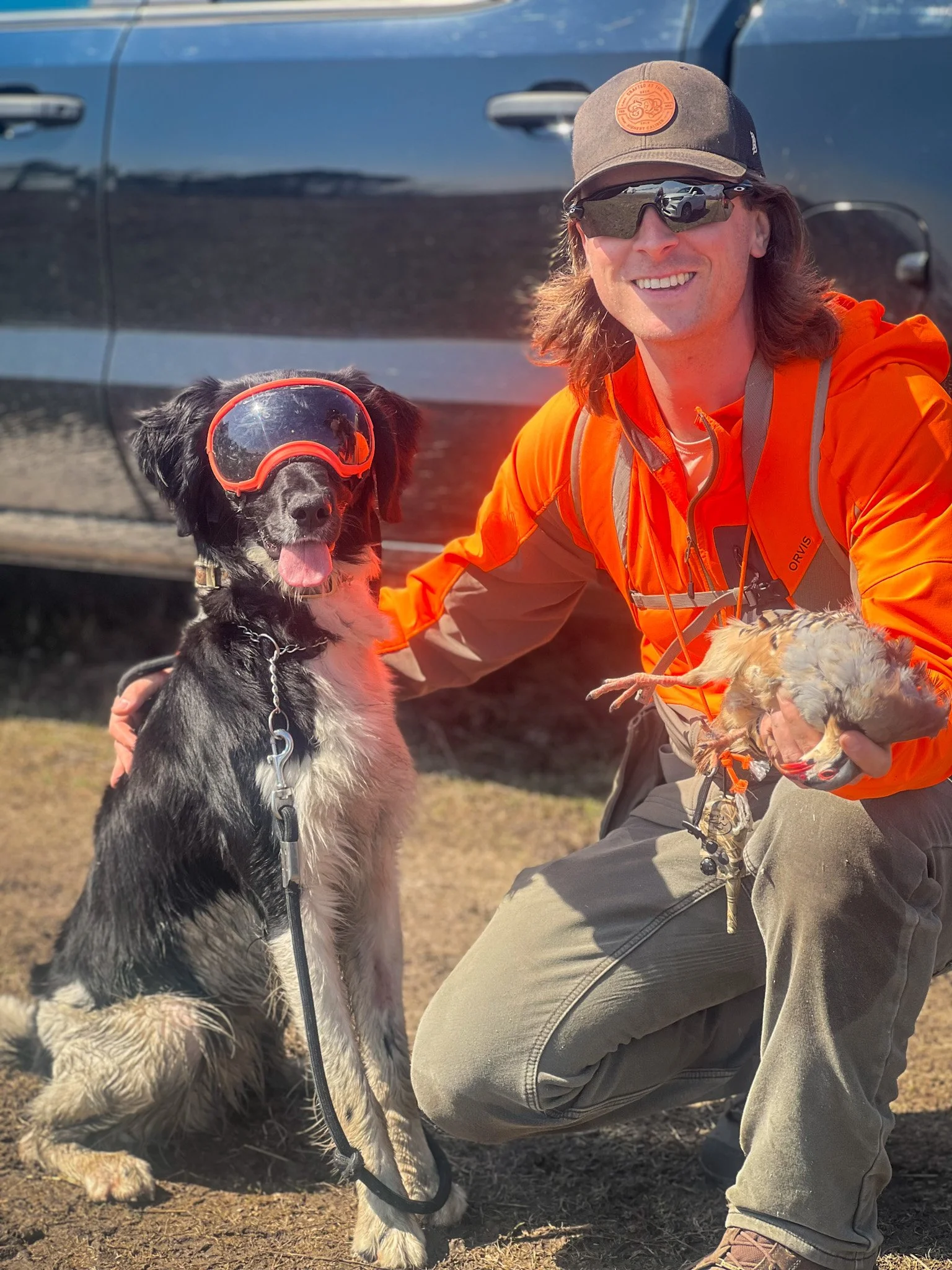
Aldo and me at our first NAVHDA training day. Our first training day opened my eyes to how many skills we could work together that would improve our real-world hunting experiences.
Aldo was my second dog, and up to this point, my training had been strictly DIY. This had less to do with being a purist and more to do with the options I thought I had on the table. I didn’t have a circle of experienced handlers to lean on, and I certainly didn't have the budget to ship my dogs off to a professional trainer for months at a time. I was essentially operating in a silo of "good enough," unaware that organizations like NAVHDA even existed, let alone that they offered a roadmap for someone like me. I was wrong to assume a testing system was just about vanity; I had failed to see that it was actually about structure, how NAVHDA testing can provide a guided training path that breaks learning down into fundamental building blocks.
As we got deeper into training and preparing for our first NAVHDA test, I was reminded of my time in the Army, where we obsessed over the basics. It was the simple, repetitive drills in the red Georgia dirt that eventually empowered my platoons to execute complex maneuvers under pressure in the Persian Gulf. I also thought back to all of those classical violin and piano lessons I had growing up; you don’t play the symphony until you’ve mastered the scales. The NAVHDA testing tiers are a classical form of education for the dog, a structure that builds upon itself. The "arbitrary" goal of a prize score is actually a mechanism that forces the handler and dog to learn a common language. These dividends are paid in full when the season finally opens. The result isn't just a dog that passes a test; it’s a dog that is more efficient, more capable, and a more synchronized partner when the stakes are real.
Beyond the mechanics of the test, there is a fundamental debt we owe these animals. A versatile hunting dog is a high-performance athlete with a genetic mandate to work; to own one and leave it dormant for nine months of the year is a disservice to its lineage. It is easy to let the "down months" between seasons dissolve into a sedentary routine where the dog’s mind atrophies along with its muscles. Participating in NAVHDA, with a consistent cadence of training days and organized events, can ensure the dog remains engaged, healthy, and fit year-round. It drives us, as handlers, to maximize the capabilities our dogs were bred to possess, transforming the "off-season" from a period of boredom into a continuous pursuit of mastery. We aren't just keeping them busy; we are honoring their nature.
For the Hunt
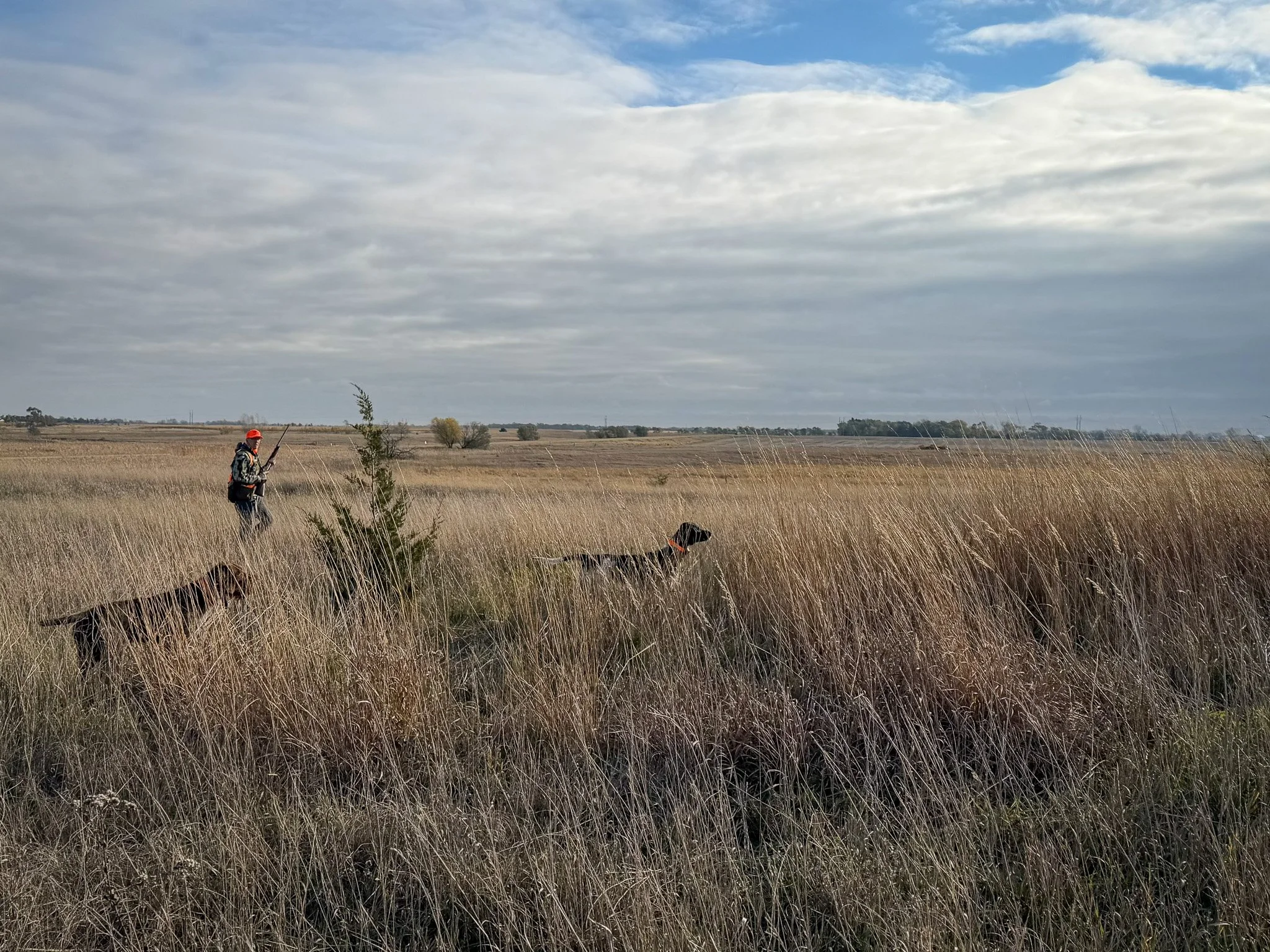
Duke on the left, a NAVHDA Versatile Champion, and Aldo on the right, both on point in South Dakota. A moment after I snapped this photo, we discovered that the dogs had worked together to locate, track, and point a pair of roosters.
There is a simple, cascading logic to this work: a good bird dog makes for a good hunt, and a good hunt makes for a good day. Add enough of those days together and you find yourself with a good life (now just imagine what could happen if you had a “great” dog…). By striving for excellence and honing Aldo’s skills to a standard, we aren't just chasing a score; we are engineering the kind of experiences afield that keep the spirit of the hunt alive. When the hunt is efficient, ethical, and—frankly—fun, it creates a gravity that pulls us back to the prairie season after season.
This cycle is the engine of the North American Model of Conservation. It isn't just a theoretical policy; wildlife conservation is fueled by the active, personal role of hunters whose dollars serve as the primary funding mechanism for our wild places. Every hunting license purchased and every excise tax paid on firearms and ammunition is a direct reinvestment into the wild things and wild places, providing the lifeblood for state natural resource and wildlife management agencies. NAVHDA can act as a catalyst for this stewardship by lowering the barrier to entry into hunting. It’s not uncommon for someone to discover hunting, and participate in it for the first time, after joining NAVHDA.
I was astounded to discover how many members are attracted to the organization simply because of the breed of their dog, only to find themselves captivated by the depth of the craft that comes with training a versatile hunting dog. It is more than just teaching commands; it is training a dog to do exactly what it was bred to do, and to do it efficiently. This creates an entirely new lens through which to interpret and appreciate hunting. Through digital media, the hunt is often reduced to a static image or a controversial headline; in the training field, it is revealed as a craft of patience and a multi-dimensional respect. It is a respect for the land we walk, the ancient circle of life, the sacred partnership between man and dog, and, ultimately, a profound respect for the game we pursue. By taking someone who just wanted a "smart pet" and turning them into an advocate for habitat and heritage, the organization recruits the next generation of stewards who will pay the bills for the wilderness.
For the Fellowship

My friend, (also named Ian), my NAVHDA chapter’s Training Director, posing with our dogs and our two-man daily limit of South Dakota roosters. Our friendship was made possible only because of NAVHDA. Ian’s dog, Duke, has achieved the pinnacle of the NAVHDA testing system by earning the title of Versatile Champion.
Ultimately, the structure of the test and the stewardship of the sport are held together by a third, more personal reality: the fellowship. Online, "community" is often an algorithm that rewards the echo chamber. We exist in spaces where we are encouraged to curate our successes and hide our failures, and where we frequently draw snap conclusions about others based on a single post or a perceived political lean. In that world, it is easy to disregard a person before you’ve even met them, effectively poisoning the well of potential friendship before the first word is spoken.
That self-curated insulation dissipates on the training field. When you step into that tall grass with chukar-filled toasters, your digital footprint and your LinkedIn job title vanish; it’s all about the dog, the work, all of which are championed by the community that’s standing right there in that same grass with you. I’ve found myself standing alongside people from a range of backgrounds, many of whom I suspect I might have scrolled past or "muted" in a different context. But that’s not the case here, in the physical world, where accountability, confrontation, and communication persist in a fashion that can’t be deleted, muted, or swiped left on. You have to stand there and simply be human.
This is the kind of humanity that has slowly eroded over the last thirty years. We traded the friction of a real neighborhood for the convenience of a digital one, and in the process, we lost the ability to simply exist with people who aren't exactly like us. NAVHDA provides a way back. By replacing the "silence of the unreturned like" with the visceral, honest feedback of a fellow handler, it provides more than just training advice. It provides a reminder that when we stop parsing the digital ghosts and start sharing a patch of dirt, the things that bring us together—like the love of a good dog—are far more powerful than the algorithms that drive us apart.
I joined NAVHDA simply to find a way to work my dog during the off-season. I didn't expect that a training group would become the primary medium through which I’d relearn the value of human connection.
Aldo and I have stayed because the benefits are tangible. The "work" is still the draw—it’s fun, it’s challenging, and it satisfies a genetic itch for both of us—but the environment in which that work happens has become just as vital. It turns out that the best antidote to a digital isolation isn’t more solitude; it’s a shared pursuit with people who are physically present.
I don’t think everyone needs a hunting dog, or the desire to hunt, but I do believe that we all need a "patch of dirt" where the curated version of ourselves isn't required. Whether it’s a NAVHDA training field, a rec league softball team, or a community garden, there is a profound, quiet relief in finding a space where you can let the phone stay in your pocket and simply be a human among humans. For Aldo and me, that space just happens to involve a check cord, some tall grass, and a few chukar-filled toasters.
“Though this be madness, yet there is method in’t.”