How I Write
The more I write, and the more I share what I write, the more I get the question, “is this AI?”
Candidly, I don’t quite know how that makes me feel. The initial response is negative. You think I don’t know how to write? And then, deeper, You think I don’t think like this, have these thoughts and questions and ideas, of my own volition? And, at its deepest, You don’t think I’m capable of crafting that, do you?
I have to remind myself that every lucky beaver nickel has two sides.
Flip that coin and then I’m digging myself out of that negative thought loop: Hm, I guess this must seem really polished. Which, I think, then means the question was actually a compliment.
But the question keeps coming up—is this AI?
The short answer is no, but it became frequent enough that I felt compelled to provide a long answer.
Why I Write
I write because I’m selfish.
I experience something, I think about it, I create a note in my phone or on a notecard, and I debate whether or not I want to explore it further. I debate if I even want to entertain the idea of writing about it. It sits for days. Weeks. Even years. I think and I think and I think. I come back to the idea and I write a sentence. Maybe a paragraph or two. I sit back, read it, and move on to a different idea. I move on to a completely different article. I work on that for a bit, close the laptop, and more time passes. I do some more thinking.
The whole thing is rather Byzantine by the time I click the publish button on Gun Dog Yoga, or submit to an editor for a print publication. I suspect much of the inefficiency is caused by my own self-critique, but I also recognize that helps me organize, process, and ultimately, understand life as I’ve lived it. Cognitive offloading. That’s what a psychologist might understand all of this to be. A mechanism to decompress and clear my mind. That same psychologist might also recognize the markers of the generation effect, where putting ideas into one’s own words can strengthen understanding, memory, and develop critical thinking.
In that sense, I’m writing because I’m selfish. I’m writing because it helps me make sense of the world.
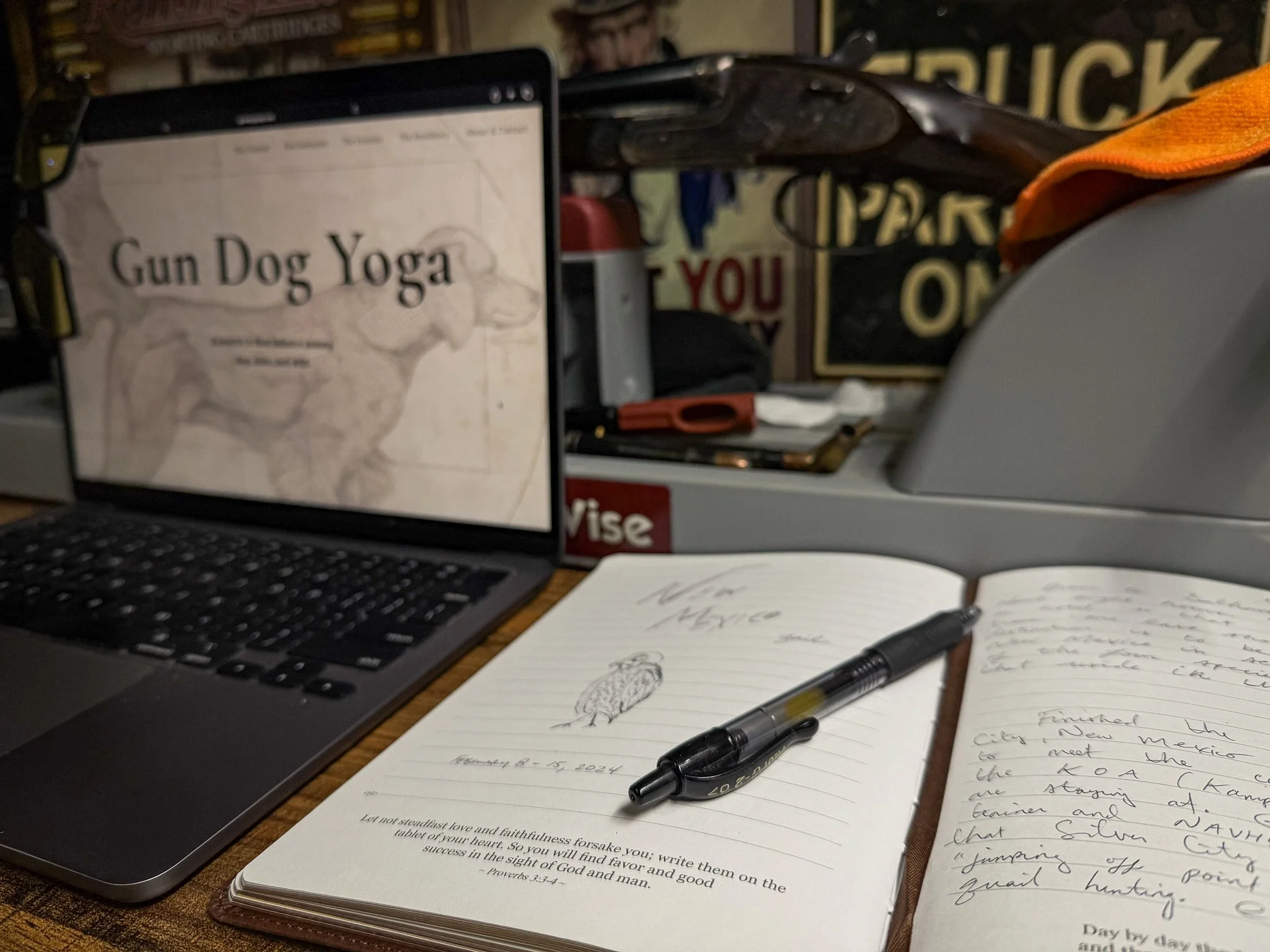
I like to use a computer to do it. I have short notes—things to prompt a thought process—scrawled across an assemblage of journals and 3×5 notecards but the “work” really happens on the computer, where I can see an idea shape into a sentence or into a paragraph. I can see those “blocks” and move them, pieces to a puzzle that, when I begin, has a murky box, the picture opaque. But, as I write, and delete, and then write and reshape, move one sentence up, a paragraph down, the puzzle pieces take shape, and the picture on the box steadily becomes more clear.
Where AI Fits
I did some consulting for an AI company a while back. The organization not only wanted to develop a niche AI tool, but leverage AI along the way. Live by the sword, die by the sword, kinda thing. They heavily relied on AI tools to generate communications and marketing content and I quickly became very familiar with the generic tools and prompts to help the business. I would gather up the technical notes from the upcoming software release that I was managing, compile the organization’s branding, and construct an efficient prompt for an LLM like Gemini.
“In 500 - 750 words, render a press release about the upcoming software release [insert technical specs about the software, the changes and their benefits]. Reference the company’s website [website link] and attached branding documentation [attached file], to include the company’s mission and vision, so that the article is consistent with the organization’s voice.”
Hit enter, words stream, and news release complete.
I share that vignette because I want to be transparent that I know exactly how easy it is to generate convincing writing using AI. I've done it professionally, I understand why organizations choose to, and I have no ethical qualms about that. But, with Gun Dog Yoga, and with all of my own writing, such an approach would defeat the very thing that I value the most in all of my writing—the process. The thinking, questioning, revising, and second-guessing are all critical steps that make the published article possible.
I use AI much the way a writer might use a trusted editor. After I've wrestled with the ideas myself, I will occasionally share portions of a draft to check spelling and grammar, search for a stronger synonym, and explore different ways to structure a sentence. Sometimes I accept those suggestions, but often I don’t.
Despite the use of any tools, authorship must remain inseparable from responsibility. If I choose to publish something under my name, then every sentence, opinion, factual claim, and conclusion is ultimately my responsibility.
More importantly, the stories themselves are mine. They are born from lived experience, shaped by curiosity, and refined through reflection. They come from mornings spent behind bird dogs, miles walked across prairie and mountain, conversations with people I admire, books that have challenged me, music that has moved me, successes that have humbled me, and failures that have forced me to grow. Those experiences become thoughts, those thoughts become questions, and eventually, if they prove worthy, they become essays.
The quill gave way to the typewriter. The typewriter yielded to the computer. Today, the computer has begun its own metamorphosis into something capable of assisting with the written word. The tools have changed, but the source has not.
No machine has ever watched a young dog point its first wild rooster. It has never stood in the October prairie as the wind carried the scent of autumn across the grass. It has never heard the explosive flush of wings, the report of a side-by-side shotgun, or felt the indescribable mixture of relief, gratitude, pride, and joy that comes when man’s best friend places a bird gently into one’s hand.
Those moments cannot be prompted into existence. They must be lived. My hope is that the writing you find here reflects that distinction.
On Imagery
All photographs, unless otherwise noted, are my own. I use Adobe Lightroom to make minor adjustments that reflect my personal preferences for color, contrast, and composition, but the photographs themselves remain authentic representations of what I witnessed.
Non-photographic imagery, such as the Renaissance-inspired Vitruvian Dog branding, and the illustrations accompanying Eroded Frontier, were created with the assistance of AI tools. Those images exist to support the written work, not replace it.
I have tremendous admiration for illustrators and artists. If I had the opportunity and resources to collaborate with one, I gladly would. My hope is that one day the visual identity of Gun Dog Yoga will include original artwork created by human hands. Until then, I choose to use the tools available to me so that the words themselves can remain the focus.
—Ian Burrow, 16JUL2026