The Geography of Inheritance
A desert pilgrimage with Aldo: tracing the genesis of his name, the birthplace of the wilderness, and the history that shaped my own ideals
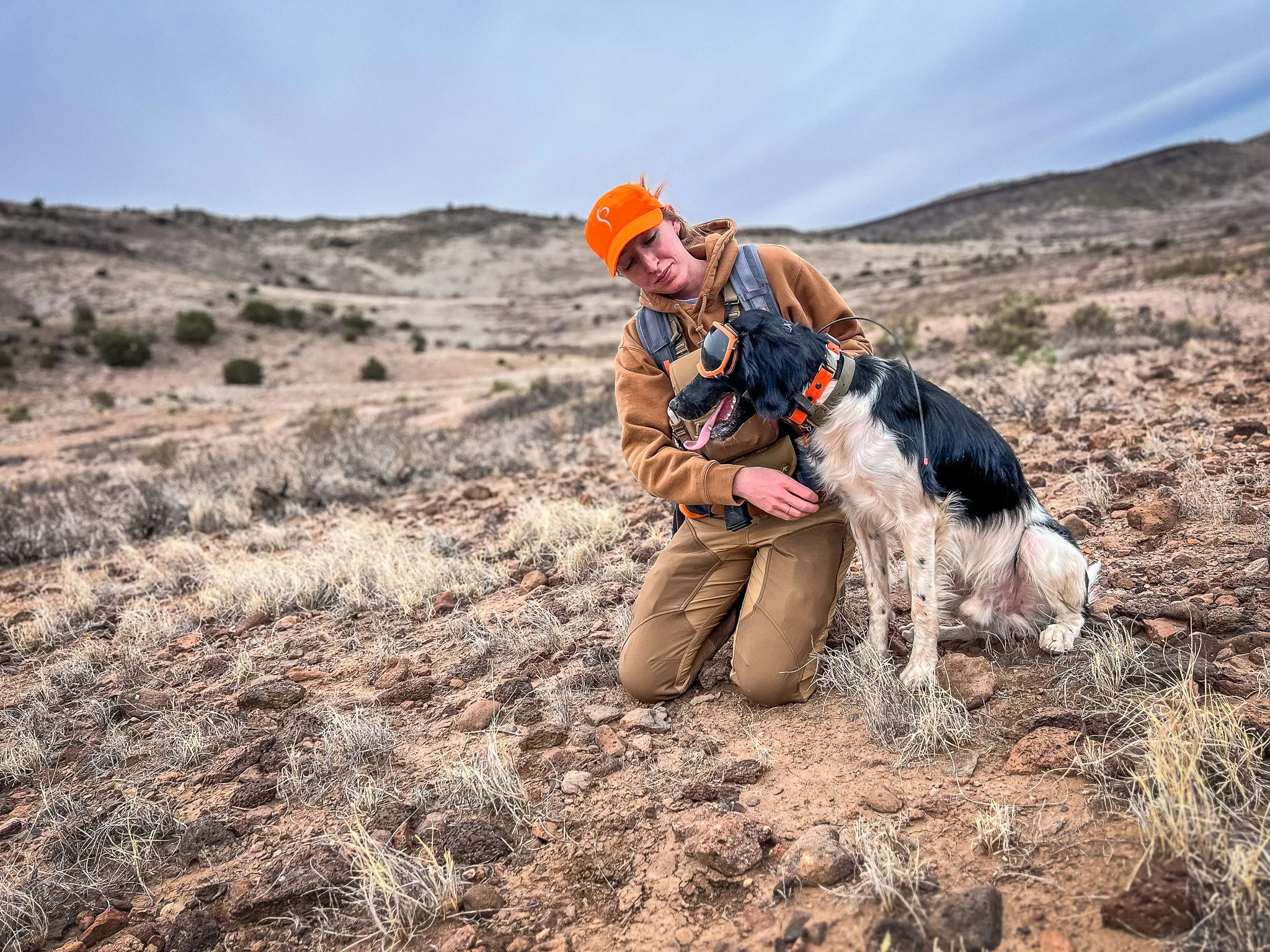
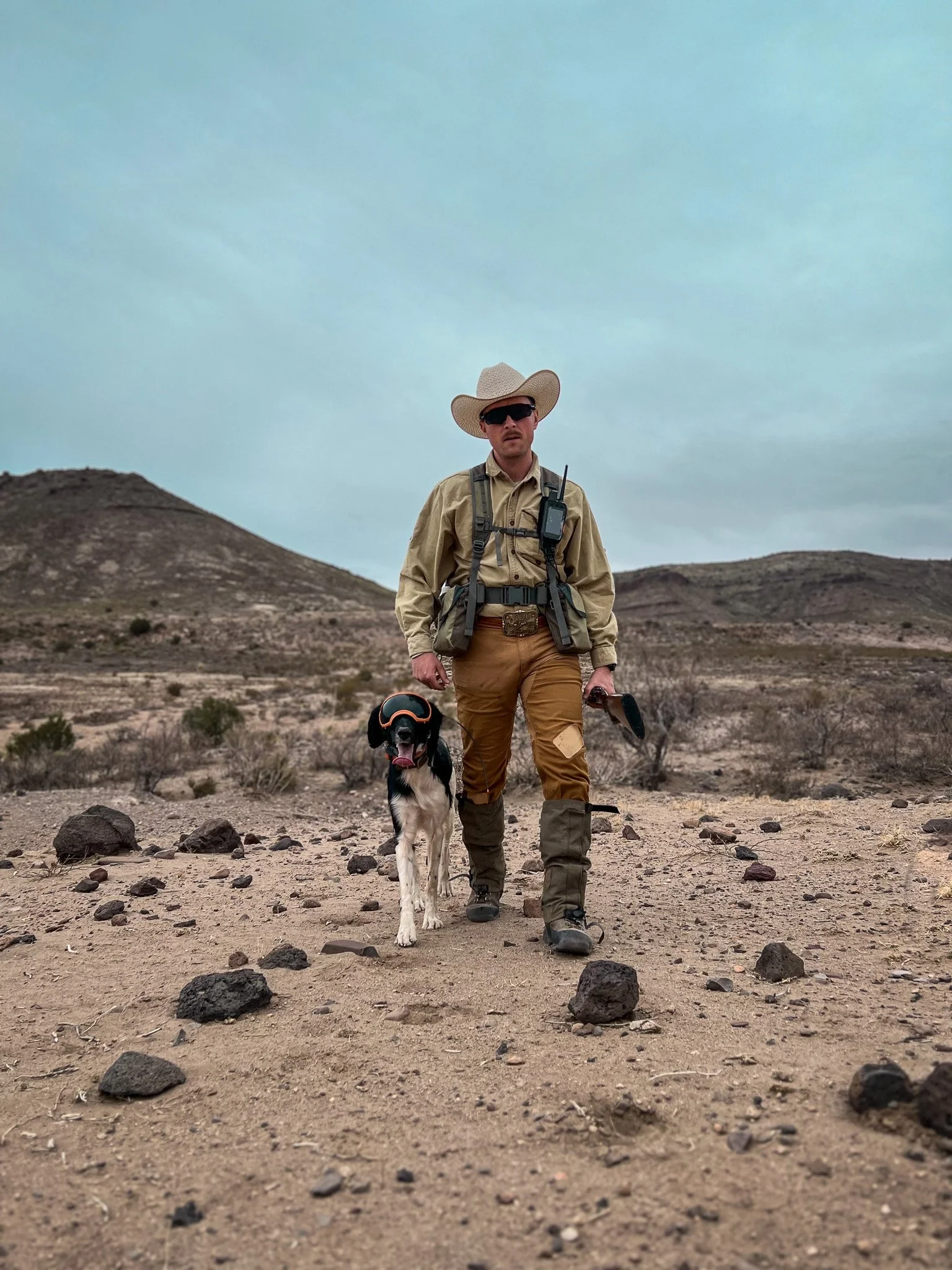
Along the Gila River, I walk towards Aldo, gun at the ready, as he stands steady, pointing a Gambel’s quail.
There is something venerable in the way Santa Fe greets the morning. The air is clear and crisp, the streets quiet beneath a fresh layer of snow. The city stirs slowly, unhurried by the demands of the day. In a few hours, shopkeepers will kindle piñon pine in their kiva fireplaces and the Plaza will come alive. For now, however, it belongs to the silence, interrupted only by the muffled crunch of my boots and the quiet footfalls of Aldo beside me.
Alexis was still asleep at La Fonda on the Plaza, the historic hotel overlooking the heart of Santa Fe where we were spending Valentine's Day weekend. The extra sleep was well deserved after a week spent crossing New Mexico in pursuit of the Land of Enchantment's four species of quail.
This trip follows a formula Alexis and I discovered several years ago in Wyoming. After a late-season elk hunt near Jackson Hole, she joined me for a few days of rest and sightseeing. Somewhere between snowmobile rides through the Tetons, evenings beside the Hotel Jackson fire, and the simple luxury of having nowhere to be, I realized we had stumbled upon the perfect vacation formula: hunt first, rest afterward. A few days spent embracing discomfort make a few days of comfort all the more enjoyable. Since then, we've repeated the formula whenever possible.
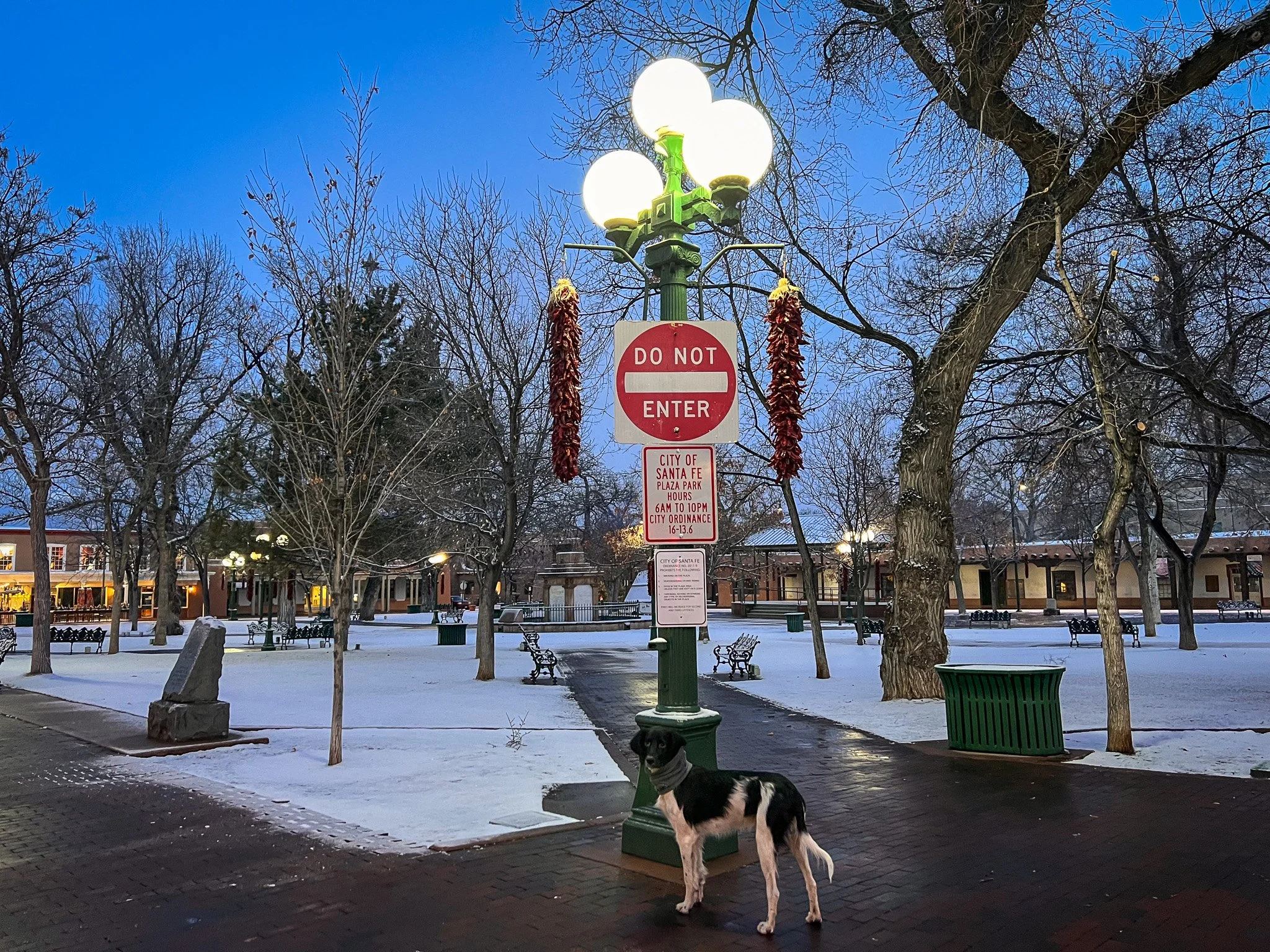
Chili-adorned lamp posts lit our early morning walk around the historic Plaza in downtown Santa Fe, New Mexico.
The glow of chili-adorned lampposts guides Aldo and me toward the Plaza. Buildings have come and gone. Flags have changed. Governments have risen and fallen. Yet the Plaza remains what it has always been: a gathering place. For more than four centuries, people have come here to trade, govern, celebrate, protest, and build community. Few places in America have witnessed so much change while remaining so fundamentally the same.
At the center of the Plaza stands what remains of the Soldiers' Monument. The obelisk that once crowned it is gone, and several of its inscriptions have been altered or removed. It strikes me as a fitting introduction to Santa Fe's history. Even here, in a city so deeply rooted in the past, the stories we choose to remember remain a matter of debate.
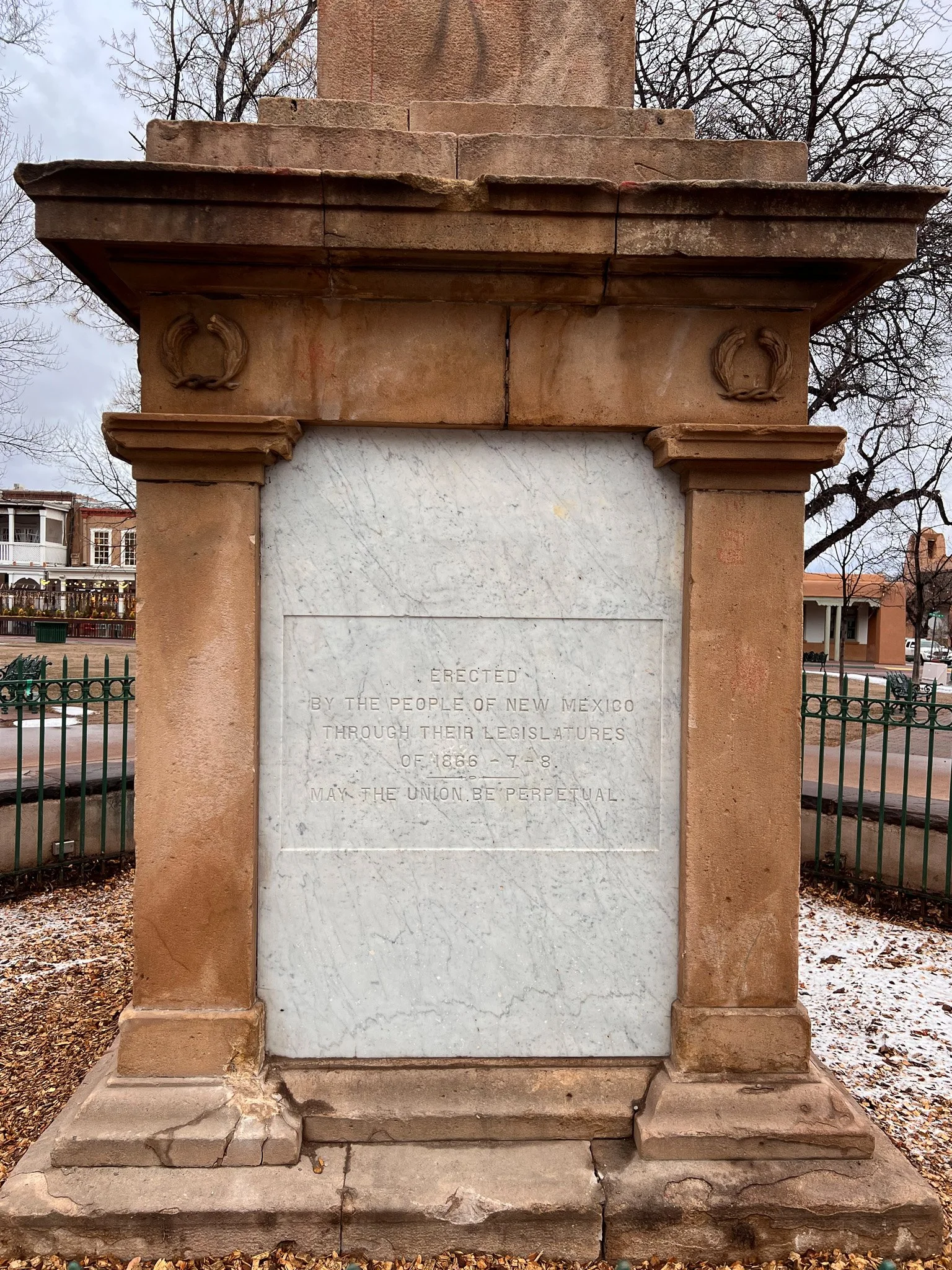
“May the Union Be Perpetual.” An ominous and powerful statement carved by those who had experienced the travesty and pain of our nation’s civil war.
On the east panel, the words “MAY THE UNION BE PERPETUAL” add a chill to the morning. Chosen by the territorial legislature in 1868, only three years after the Civil War, the phrase feels carved with both hope and fear. Hope that the bloodshed had ceased; fear that it might not.
For many of us, the Civil War survives only as a collection of names, dates, and battlefield maps recalled from high school textbooks. We know how the story ends. What we seldom consider is how terrifyingly uncertain that ending must have felt to those living it.
Most of us possess no meaningful frame of reference for a conflict that claimed more American lives than every war of the twentieth century combined. We can recite casualty figures, but numbers have a way of concealing human experience. It is difficult to imagine a nation where nearly every family knew loss and the future of the republic remained uncertain for years.
As I made my way around the monument, reading each face, Aldo methodically investigated the benches nearby. Scent, rather than inscription, formed the archive that held his attention—both of us reading a language the other could not.
The south and west faces memorialize four Civil War battles. The north face once reflected a view of the American frontier that many now reject, while revealing how those who erected the monument understood their world:
“TO THE HEROES WHO HAVE FALLEN IN THE VARIOUS BATTLES WITH SAVAGE INDIANS IN THE TERRITORY OF NEW MEXICO.”
The word "savage" has since been chiseled away. The monument now records two histories at once: the one its builders intended to preserve, and the one later generations sought to challenge.
Standing there that morning, I found myself less interested in judging the men who erected the monument than in understanding them. History becomes far less useful when viewed only through the lens of heroes and villains. The people who built Santa Fe, defended it, traded in it, and fought for it inhabited a world very different from my own. Their assumptions, fears, and aspirations were not always admirable, but they were undeniably human.
Aldo, meanwhile, had already moved on. Whatever secrets the benches had been willing to surrender that morning had apparently been exhausted. A slight tension on the leash pulled me from my thoughts and back into the present.
Ahead of us stood the Palace of the Governors, its adobe walls glowing softly in the rising morning light. The day before, Alexis and I had walked beneath the Palace's portal—the long covered porch that runs the length of the building—where Native artisans displayed their work much as they have for generations. Rugs and blankets stretched the length of the building, a colorful checkerboard covered in turquoise jewelry, silverwork, pottery, and paintings. Visitors drifted slowly from one display to the next, pausing to examine pieces whose traditions long predated the arrival of Spaniards, Americans, or even the Palace itself.
The artistry was undeniable, the jewelry stunning, but I found my attention repeatedly drawn to the tribal identification cards displayed beside each vendor. At first glance they resembled the driver's license in my wallet—a photograph, a name, a tribal affiliation. Yet they seemed to carry a far greater weight. They were reminders that the descendants of those who inhabited this land long before the arrival of Spaniards, Mexicans, or Americans were not figures confined to history books. They were here, seated beneath the Palace's portal, telling their own story.
Standing there beneath the Palace of the Governors, I remember feeling unexpectedly small. Not because of the age of the building, nor even the history it had witnessed, but because of the continuity it represented. The people seated beneath the portal belonged to communities that had endured conquest, displacement, disease, broken treaties, and relentless pressure to assimilate. Yet they remained. The monument in the Plaza preserved memory in stone. The Palace preserved it through people.
Aldo had apparently exhausted the historical value of the Palace and was ready to continue our tour of Santa Fe. One of the virtues of a good dog, I suppose, is his ability to keep a man from disappearing entirely into his own thoughts.
We cut our tracks down East Palace Avenue, passing a shopkeeper shoveling snow from the sidewalk in front of his store. A nod and a smile. A friendly comment about Aldo's scarf and calm disposition. Another nod and smile.
The Palace gradually disappeared behind us as we entered Cathedral Park beneath a canopy of towering trees. More benches for Aldo, another monument for me.
I began a slow circuit around the Pioneer Monument. A Spanish conquistador stood watch beside a Franciscan friar. Nearby, a pioneer family pressed forward alongside horses, sheep, and other livestock. Above them all sat La Conquistadora, the revered Madonna who has watched over Santa Fe since the early seventeenth century. Together, the figures tell a story not of a single person, but of a people arriving, settling, and attempting to build something that would endure.
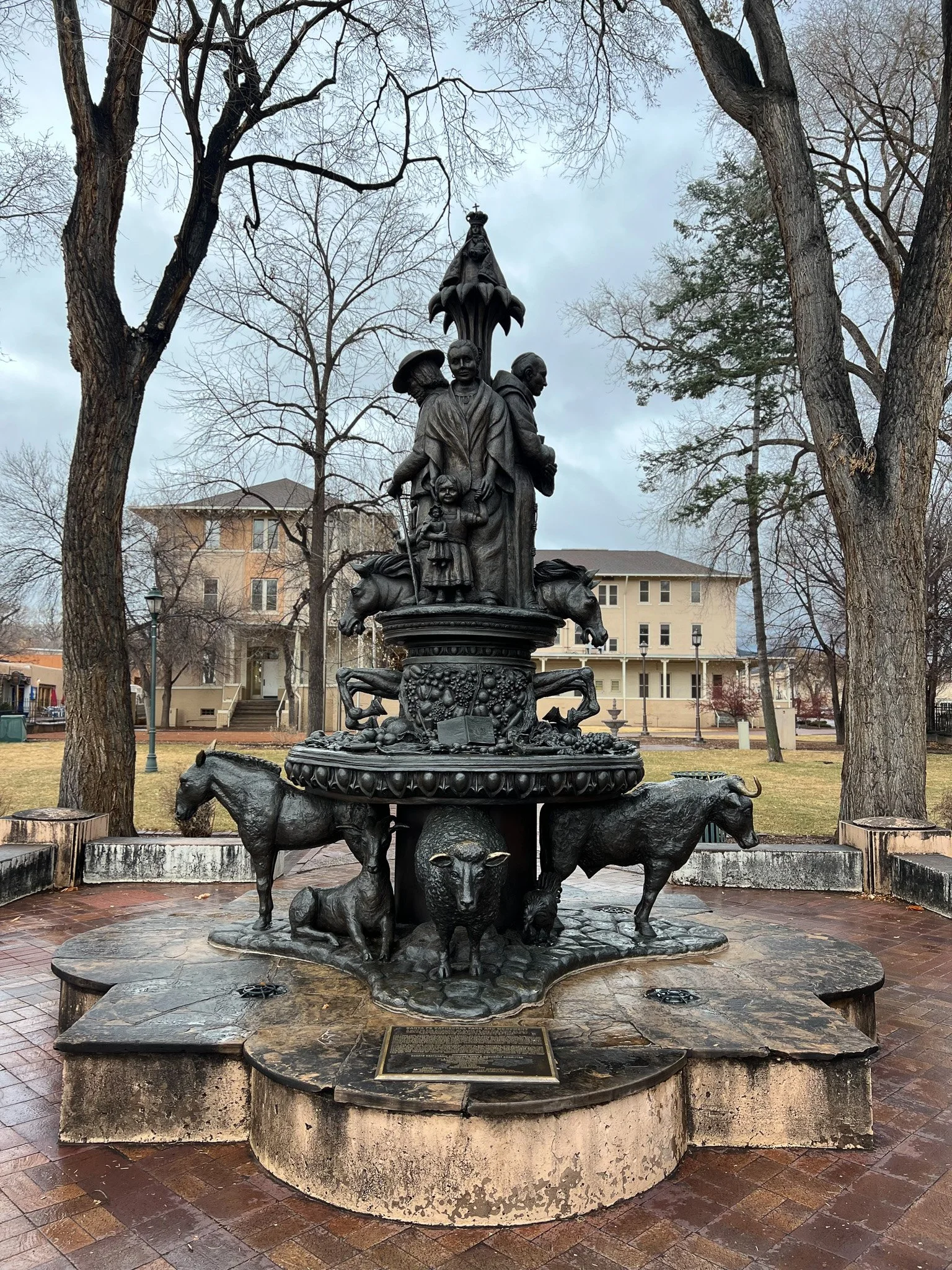
The Santa Fe Pioneer Monument stands to the north of The Cathedral Basilica of St. Francis of Assisi. “…to our forefathers continuing contributions to the history, culture and values of today’s America. May they serve as an inspiration to all who pass this way.”
The monument brought to mind Commerce of the Prairies by Josiah Gregg, a book I had read before this trip. Published in 1844, Gregg's account chronicles his travels along the Santa Fe Trail and offers a glimpse into a world that has largely disappeared. Reading it, I was struck by the immense planning, risk, and uncertainty that accompanied even the most routine journey.
My trip from Kansas to New Mexico had required little more than a full tank of gas, favorable weather, and a few podcasts. Gregg's travelers faced a different calculus entirely. Leave too early and spring rains turned the prairie into mud. Leave too late and winter threatened to close the trail before the journey was complete. Every river crossing introduced uncertainty. Every mile carried risk. Even arrival itself was never guaranteed.
I imagine arriving in Santa Fe must have brought a profound sense of relief. It is easy, now, to admire the destination with its blend of cultures, art, history, and modern luxuries. More difficult is imagining what it meant to see the city for the first time after months on the trail. I found myself admiring the grit such a journey required—and questioning whether I would have possessed the same courage as those enshrined before me. Modern life rarely asks such questions of us, and because it does not, we seldom discover the answer.
It was a thought I carried with me as Aldo and I turned back toward our own wagon—a Ford F-150 parked a few blocks away. Breakfast awaited at La Fonda's atrium dining room, where Alexis was undoubtedly enjoying a slower start to the morning than we had.
Our route back took an unexpected detour through Cathedral Park in search of a trash receptacle for one of Aldo's recent contributions to the city. As the hourly bells of the Cathedral Basilica of St. Francis of Assisi rang overhead, their deep tones drew my attention toward the cathedral grounds, where another figure stood waiting beneath the trees.
St. Francis of Assisi.
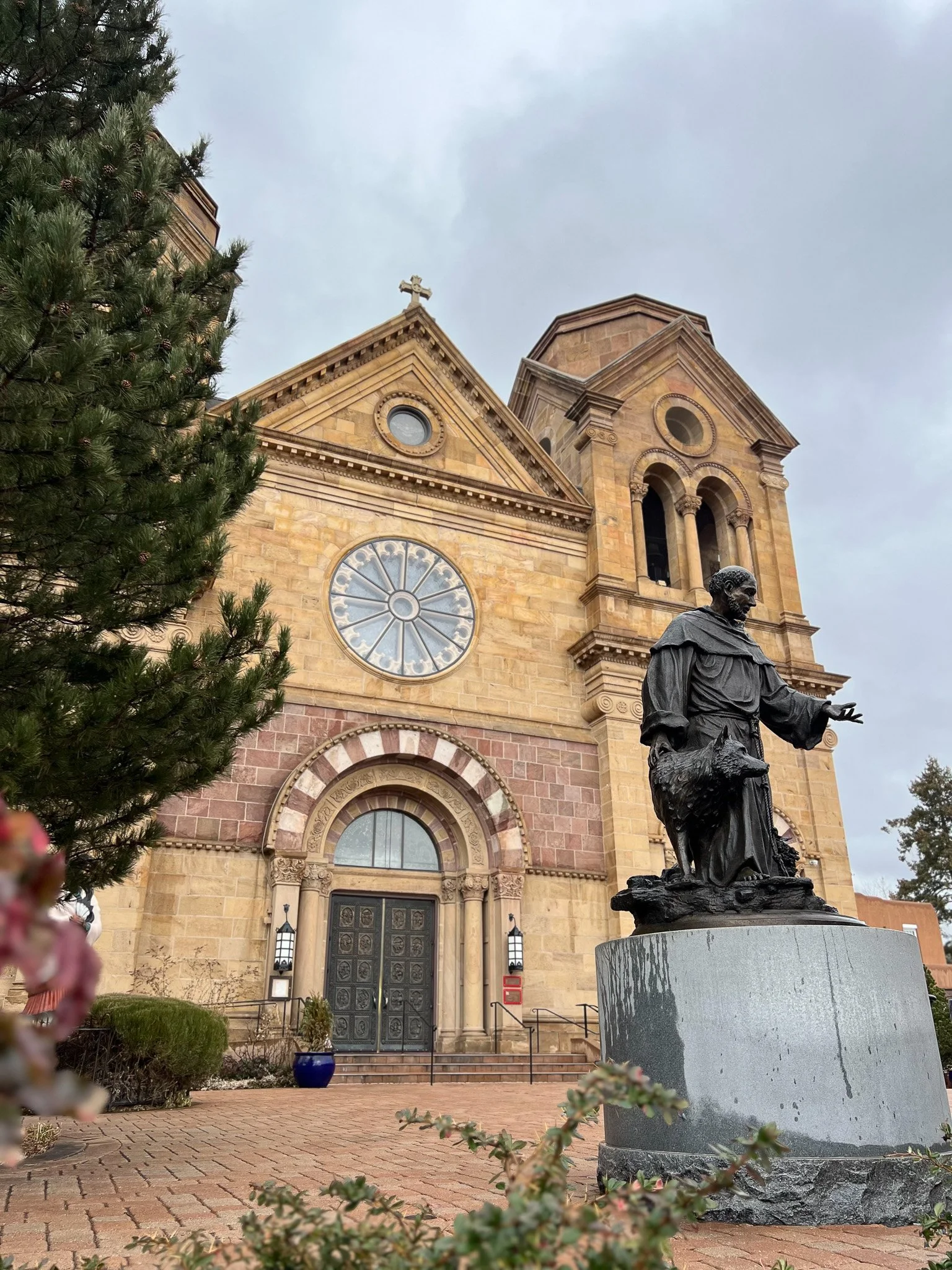
A statue of St. Francis of Assisi and Wolf of Gubbio stands in front of the The Cathedral Basilica of St. Francis of Assisi. The statue was sculpted by a Kansas City artist, Betty Sabo.
Unlike the monuments I had encountered that morning, St. Francis is not remembered for what he built, conquered, traded, or settled. He is remembered largely for how he regarded the world around him.
“All praise be yours, my Lord, through Sister Mother Earth, who sustains us and governs us, and who produces varied fruits with colored flowers and herbs.”
At Francis's feet stood the Wolf of Gubbio. At mine stood Aldo. The parallel was impossible to miss. For centuries, dogs and wolves have accompanied humanity through both wilderness and civilization. Standing there beneath the cathedral trees, it struck me that many of the questions that occupied Francis's world still occupy our own: What is our relationship to the natural world? What obligations do we owe the creatures that inhabit it alongside us?
The question felt especially relevant after the week Aldo and I had just spent wandering New Mexico's deserts, grasslands, and mountains. Hunting has a peculiar way of forcing a person to pay attention. To rainfall and drought. To grass and cover. To water, weather, predators, and prey. To the countless relationships that determine whether wildlife thrives or disappears. Relationships that, whether we acknowledge them or not, shape our own lives as surely as they shape the lives of the animals we pursue.
The bells had long since fallen silent. Aldo had already moved on. Whatever lesson St. Francis had for me that morning would have to travel with me. Alexis was waiting.
I found Alexis, rested and content, waiting for me at a table near the atrium's water feature. She looked entirely at peace with the morning—a welcome, grounding presence after the heavy historical ghosts I had been chasing through the snow.
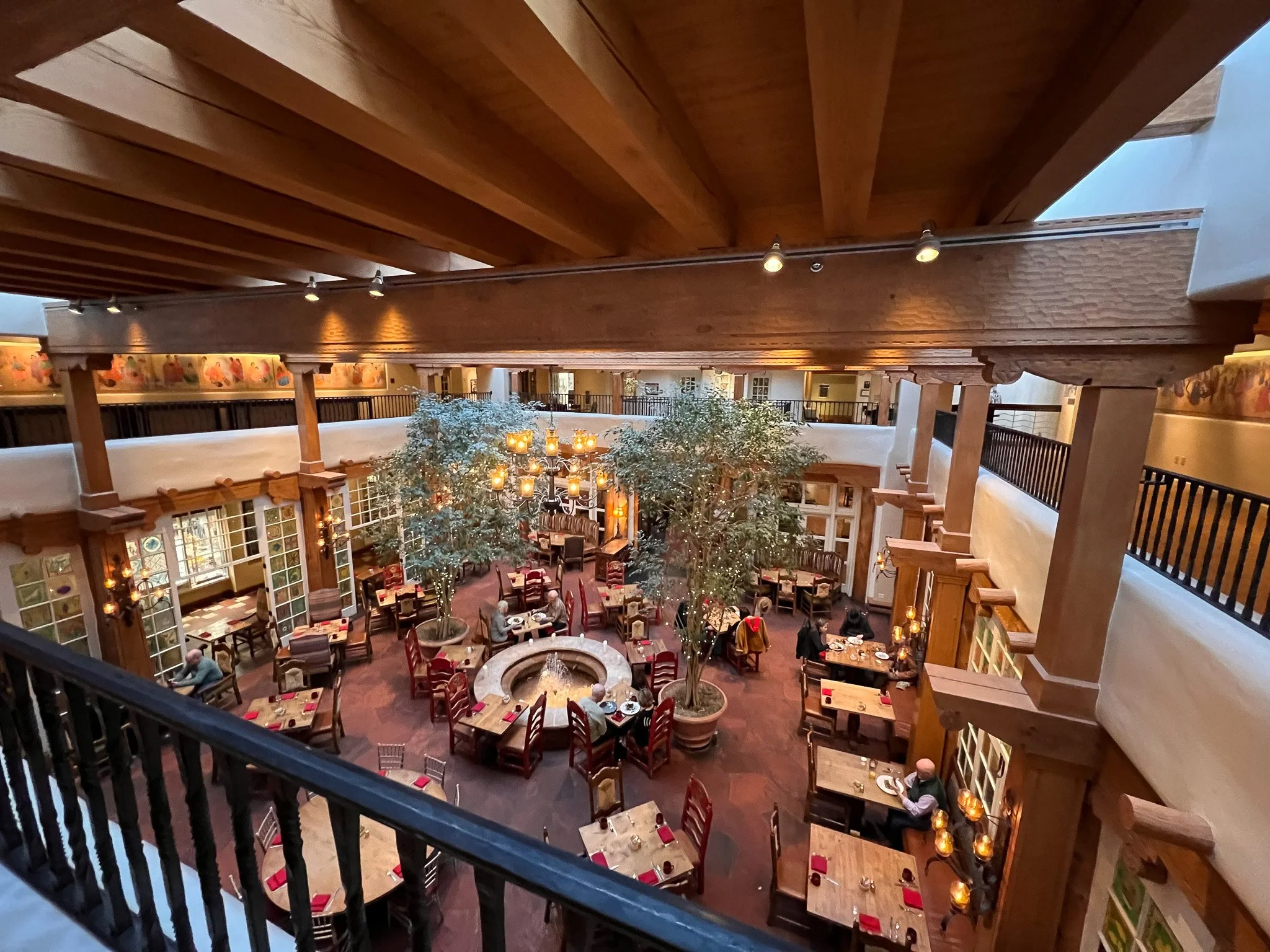
A view of the atrium in our hotel, La Plazuela At La Fonda. We ate breakfast here every morning before exploring Santa Fe.
“Red, green, or Christmas?” the waitress asked me, referring to my choice of chillies to be served with my huevos rancheros.
I had tried red two mornings ago and green yesterday, so Christmas was the only logical answer for this morning.
Aldo was resting in his kennel in the truck. La Fonda was pet-friendly—one of the many reasons we chose to stay there—but breakfast is often simpler without a counter-surfing bird dog monitoring the proceedings.
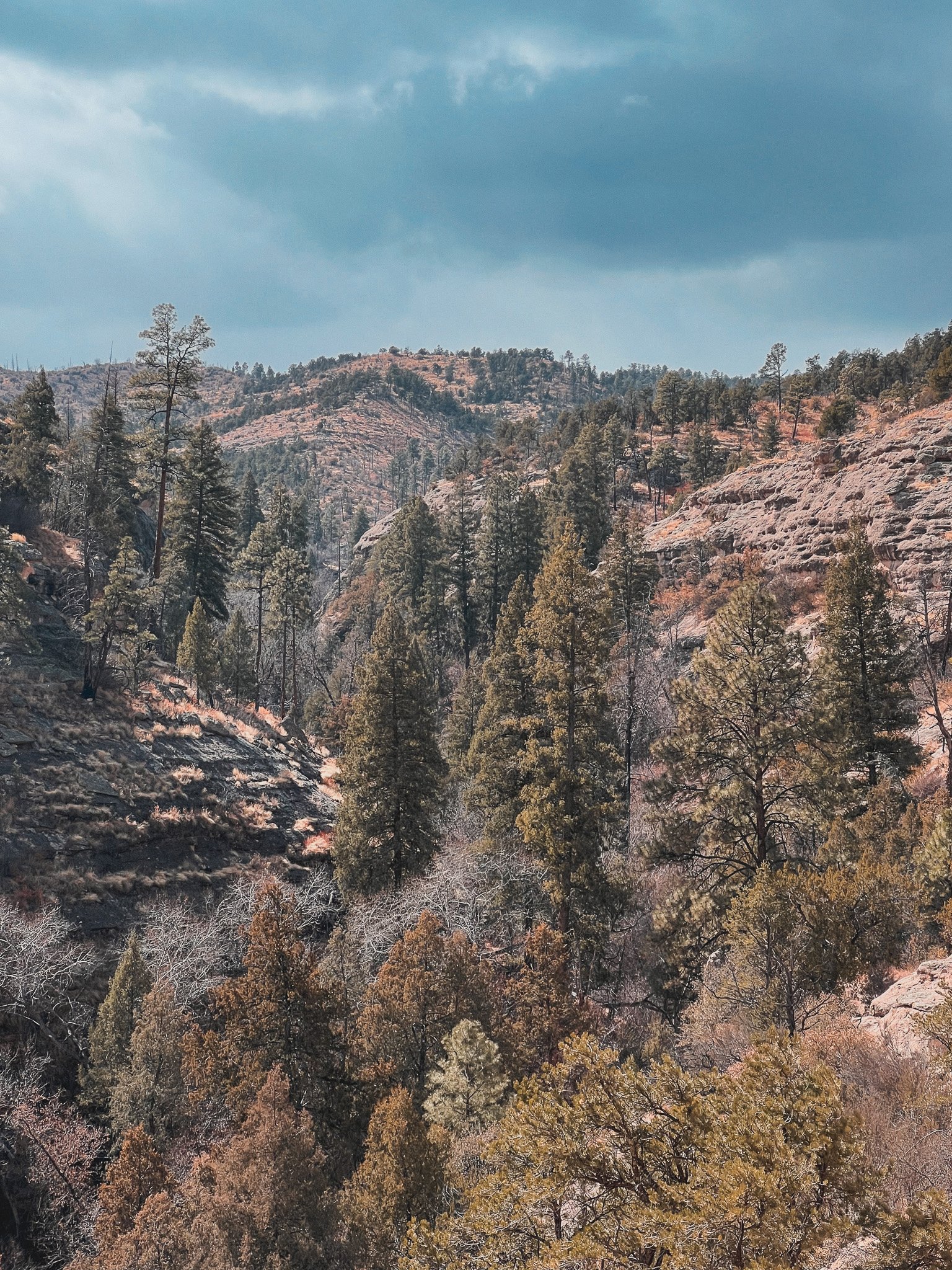
As I drank my coffee and waited for breakfast, my mind drifted beyond the Plaza and across the state. New Mexico's ecological diversity was staggering. In the span of a single week, Alexis, Aldo, and I had left a bitterly cold Kansas, crossed a stark desert, and climbed into the Gila Wilderness, where we watched the snow fall past the openings of the Gila Cliff Dwellings.
The quail hunting hadn't been the barrel-burner New Mexico is sometimes reputed to be, but I hadn't expected it to be. This was new country. My résumé was deep in the high prairies; these deserts—both low and high—were unfamiliar ground.
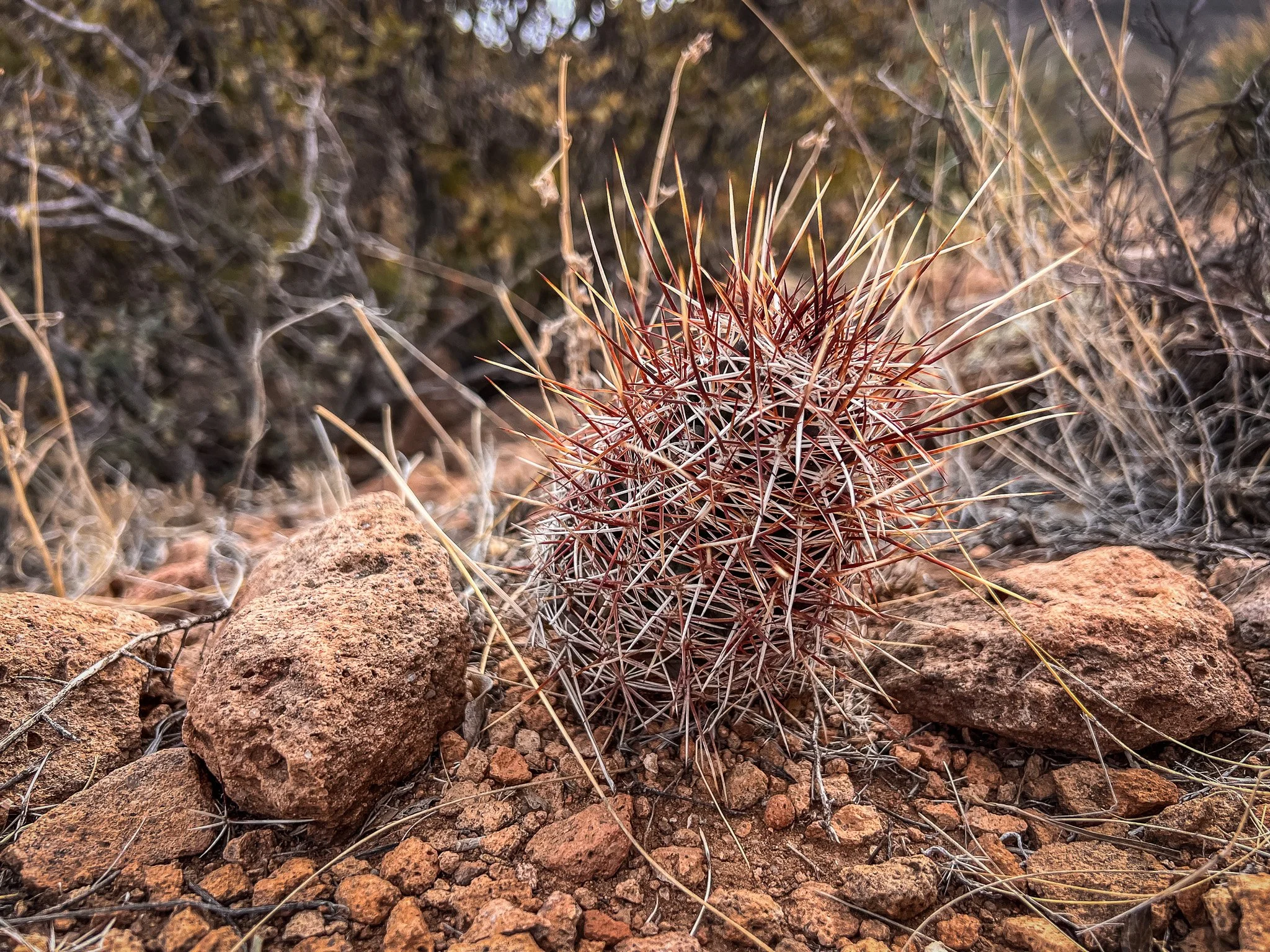
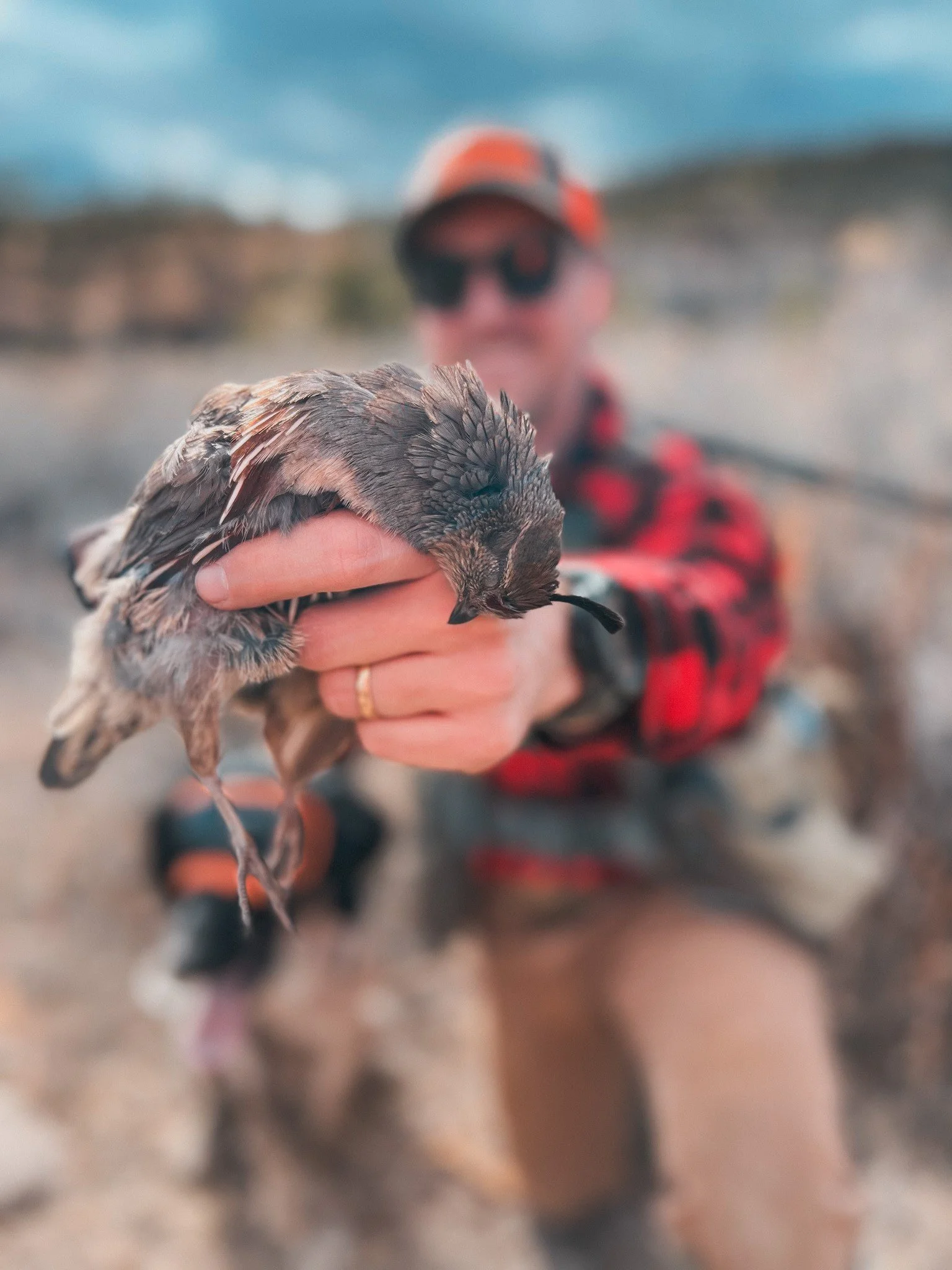
To find birds here, we had to learn the language of the Gila. It meant reading the slopes to find where the Mearns' quail sought the shade of evergreen oaks, or watching Aldo sort through the maddening, labyrinthine foot-scents of Gambel's quail running through the mesquite. We didn't measure the success of the day by the weight of the vest, but by the single, hard-earned point; the brief, brilliant flash of a topknot in the brush; and the quiet triumph of a clean retrieve from a thorny draw.
There were new birds to learn, new habitats to understand, and new questions to ask. I have long believed that we should never stop asking questions within God's creation; there is always more to learn.
A century ago, a young United States Forest Service officer, Aldo Leopold, looked out over this same landscape and asked questions. Why did some places teem with wildlife while others seemed barren? Why did predator populations matter? How did forests, rivers, grasslands, animals, and people influence one another?
Perhaps some of those answers seem obvious today, but they were not at the time when capitalizing on natural resources—timber, ore, grazing, and game—held center stage. Leopold came to understand that the natural world functioned not as a collection of independent parts, but as an interconnected whole. It was during his years in New Mexico and Arizona that he began the intellectual journey that would eventually lay the foundation for modern wildlife ecology and his enduring concept of a land ethic.
In 1921, Aldo Leopold penned Wilderness and Its Place in Forest Recreational Policy for the Journal of Forestry. In fewer than 2,000 words, he challenged a prevailing assumption of his era: that land derived its value from what could be taken from it.
To be sure, America was already beginning to recognize the importance of conservation through the establishment of national parks and forests. Yet Leopold believed something remained unaddressed. The Model T was changing America, figuratively and literally. Roads pushed farther into remote country. Wild places became increasingly accessible to a growing public. Many viewed this as an unqualified good. The more people who could visit nature, the more people would value it, but Leopold was not so certain.
In his view, wilderness itself possessed value. The absence of roads, buildings, and human convenience was not a deficiency to be corrected, but a resource to be protected. Some landscapes were valuable precisely because they remained wild.
“I mean a continuous stretch of country preserved in its natural state, open to lawful hunting and fishing, big enough to absorb a two weeks’ pack trip, and kept devoid of roads, artificial trails, cottages, or other works of man.”
A year later, Leopold submitted an administrative proposal, Report on Proposed Gila National Hunting Ground, that, in conjunction with his essay in the Journal of Forestry, would be the catalyst for the Gila Wilderness Area—the first place in the world designated to protect the wild from the machine, legally barring all roads and motorized transportation from crossing its boundary.
“Is everything OK?”
Our waitress checked in with us. I nodded and smiled, my mouth full of Christmas, my mind lost in the Gila. Alexis was mapping out our afternoon ahead—a return to the galleries and shops we’d promised to explore. I nodded along, grateful for the shift in pace, even as my thoughts remained briefly anchored in the history of this dirt.
It is a connection I first forged years before I ever read Leopold’s words. I was deployed to Southwest Asia, living inside a perimeter of Hesco barriers and concertina wire. When the days were long and sleep elusive, I often ran the base perimeter before sunrise, beneath cold desert stars. One morning, something clicked. There was nothing there. No grass. No trees. No running water. No birdsong. Beyond the wire stretched a landscape truly barren, stripped of everything that sustains the spirit.
I found myself aching for things I had never consciously valued before: the sound of wind through oak leaves, the sudden flash of a deer crossing a field, the simple comfort of green, growing things. It was the first time I understood that nature’s value was not limited to what it produced or provided. Some things matter simply because they exist.
Our first Gambel’s quail.
Years later, I would begrudgingly return to college and study political science with a focus on environmental policy. There, buried among coursework, case studies, and assigned readings, I would eventually encounter the work of Aldo Leopold. To my surprise, I found that he had spent a lifetime exploring questions remarkably similar to those that had first occurred to me while running laps around a dusty military outpost half a world away.
“Ready?” Alexis asked, poised to get up from her chair.
“Of course, dear,” I smiled. Not a clue what I was claiming to be ready for, but I’d let her lead the way out of the restaurant and I’d figure it out, eventually.
As I followed her back into the Santa Fe morning, the city now alive, I thought about Aldo, sleeping in his kennel in the truck, and our hunt this week. I hadn’t just come to New Mexico to check four species of quail off a hunter's bucket list, nor was it just a pleasant Valentine's getaway. For me, this trip was a quiet, necessary pilgrimage to bring my dog to the genesis of his name, and our shared passion.
Years after discovering his work in the classroom, I had named my first gun dog after Aldo Leopold. Bringing my dog here was a deliberate act of reverence. I wanted to watch a dog named Aldo trail birds through the very canyons that had catalyzed the American land ethic. I wanted us to walk, camp, and hunt in the birthplace of the world's first wilderness area—the landscape that helped shape how many Americans think about wild places.
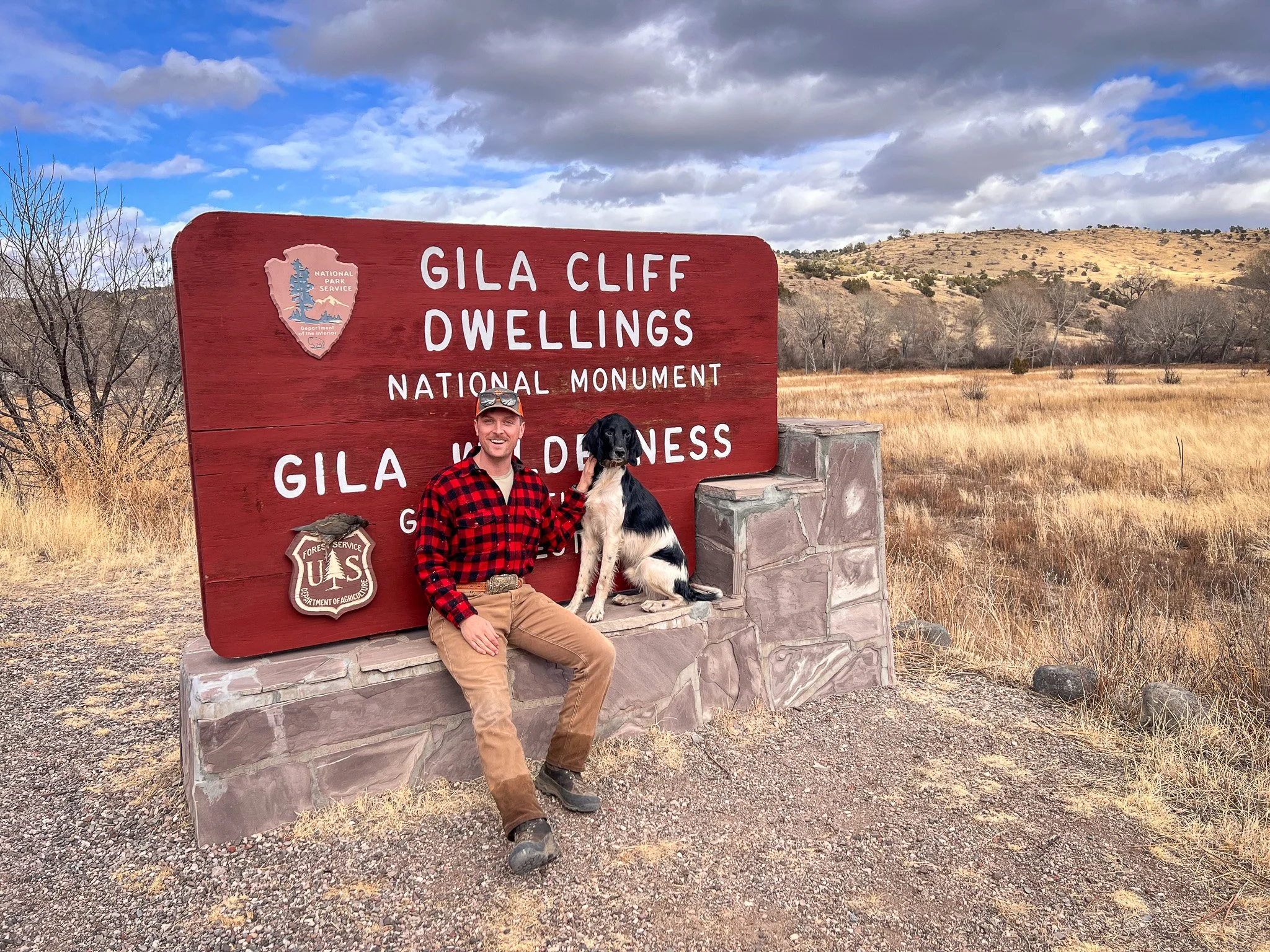
Aldo and I in the Gila Wilderness. Our first Gambel’s quail—a trophy— is perched on the USFS emblem.
Today, we inherit a public abundance that we did not build. Just as the inscriptions on the Soldiers' Monument revealed that history is never as settled as we might imagine, neither is the conservation legacy we inherited. Public lands, wilderness protections, and access to wild places exist today because generations before us asked difficult questions, challenged prevailing assumptions, and fought for ideas they believed were worth preserving.
Like any inheritance, that legacy endures only if we understand it well enough to recognize its value. If we fail to learn how this public abundance was won—the hard-fought victories over short-sighted exploitation—we risk taking for granted the very ideas that made it possible.
It looks like we’re headed back to the Palace of the Governors. The sidewalk once again a checkerboard of colorful rugs, adorned with artisan crafts.
“I’ve decided I want to get those earrings,” Alexis said, gesturing back toward the portal. “You know, the tall ones with the coral tips?”
I was right.
“Ah, yes, those ones. Of course! Good choice.” I smiled, catching her eye. She had braved the wind and the dust of the quail country right alongside me, and she had earned her prize. Because no pilgrimage is truly complete without bringing something home.
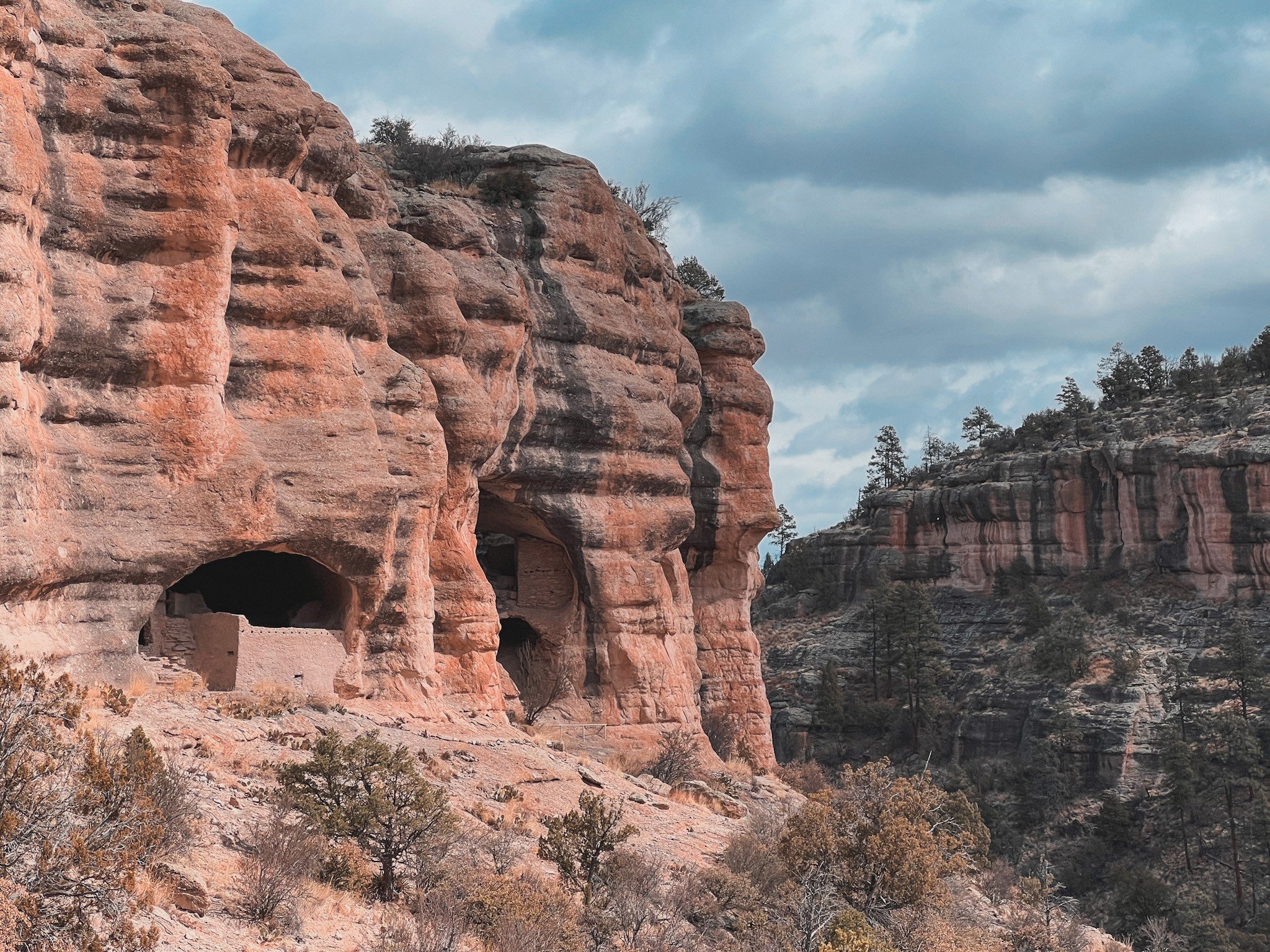
Photos from our pilgrimage


Afterward
I wrote this in May 2026, a bit over a year since this trip occurred. Like so many projects, its creation was a process of fits and starts—sentences written in the margins of days, paragraphs deleted, ideas stewed over, and drafts left to simmer. While some of this delay was born of standard writerly procrastination, much of it was intentional. I needed time to process what I had seen.
This piece was originally conceived as a straightforward account of a wonderful trip with my wife to hunt New Mexico quail and explore an unfamiliar region of America. The boilerplate hunting story, if you will. But as I wrote and reflected over the last twelve months, a relentless wave of executive actions, legislative shifts, and public land controversies unfolded across the country. One after another, decisions were—and are—being made that will fundamentally reshape the future of conservation, wildlife management, and our access to the outdoors.
Suddenly, the landscape I had just left felt incredibly fragile.
The Gila Wilderness occupies a sacred place in the American conservation narrative. It was there that Aldo Leopold first proposed the radical notion that some places should remain wild simply because they are wild. That single idea eventually birthed the National Wilderness Preservation System and permanently altered how generations of Americans view their relationship to the natural world.
A century later, however, those protections feel far less permanent than they once did. This vulnerability stems, in part, from a collective amnesia—a failure to understand our own history as memories and hard-won victories fade from one generation to the next. Apathy plays its part, too, and greed undoubtedly has its seat at the table.
What follows is, on its surface, a morning walk through Santa Fe. But beneath the snow and stone, it is an acknowledgment of our nation’s complex history and a reminder of the vital role that inheritance plays in our modern lives. If we fail to learn how this public abundance was won, we will surely watch it be lost.
2025-2026 Policy Impacting the future of American Wildlife Conservation, Hunting & Outdoor Recreation
as of 01 JUN 2026
Boundary Waters mining moratorium overturned.
Congress overturned the 20-year mining withdrawal near the Boundary Waters; Trump signed it into law in April 2026.
Opens the door to copper-nickel mining near one of America’s premier wilderness watersheds.
U.S. Forest Service reorganization and regional office closure.
USDA announced the Forest Service HQ move to Salt Lake City, closure of all regional offices, and a state-based leadership model.
Risks loss of regional expertise, disruption to forest planning, wildfire work, habitat management, and local institutional knowledge.
Forest Service research station closures.
Reporting and agency materials indicate dozens of research facilities are being evaluated or slated for closure; PBS reported at least 57 of 77 research stations affected.
Weakens science capacity on wildfire, wildlife habitat, invasive species, forest health, watersheds, and climate resilience.
USDA began repeal of the Roadless Rule, which affects roughly 59 million acres of National Forest System lands. Final action expected in late 2026.
Could increase roadbuilding, logging, and fragmentation in high-value backcountry habitat important to elk, deer, trout, grouse, and other species.
BLM Public Lands Rules rescission.
Interior moved to rescind the 2024 Conservation and Landscape Health Rule, which placed conservation on equal footing with other public-land uses.
Reduces formal standing for restoration, habitat health, and conservation leasing on BLM lands.
NEPA implementing regulations removed.
CEQ finalized removal of government-wide NEPA regulations in January 2026.
May narrow or fragment environmental review, reducing consistency across agencies on habitat, water, public comment, cumulative effects, and alternatives analysis.
DOI announced “historic NEPA reform” in February 2026 to streamline environmental review.
Faster permitting may mean less scrutiny for energy, mining, grazing, timber, and infrastructure impacts on wildlife habitat.
USDA NEPA rollback / consolidation.
USDA finalized a rule reducing department NEPA regulations by 66%.
Could reduce review depth for Forest Service, NRCS, APHIS, and other land/wildlife-related actions.
Clean Water Act / WOTUS narrowing.
EPA and Army proposed a new WOTUS definition; comment period closed Jan. 5, 2026.
Threatens wetlands, ephemeral/intermittent streams, prairie potholes, headwaters, and duck/upland habitat.
Endangered Species Act “harm” definition rollback.
FWS/NMFS proposed rescinding the regulatory definition of “harm,” historically including certain habitat degradation that kills or injures wildlife.
Weakens habitat-based protection for listed species.
ESA critical habitat revisions.
Interior finalized ESA revisions in Nov. 2025, relevant into 2026, narrowing approaches to unoccupied habitat and “foreseeable future.”
Makes it harder to protect recovery habitat before species collapse further.
Migratory Bird Treaty Act narrowed interpretation.
Interior reinstated an interpretation limiting MBTA liability to intentional bird take.
Reduces accountability for incidental bird deaths from industrial activity, oil pits, powerlines, and development.
National Park Service proposed cuts.
FY2027 proposal reportedly cuts NPS operations by more than 25% and nearly 3,000 more staff.
Less capacity for resource protection, wildlife management, law enforcement, maintenance, and visitor safety.
Reporting says the FY2027 proposal would cut NOAA Fisheries by 41% and transfer or terminate some ESA/MMPA functions.
Weakens marine habitat, fishery science, species recovery, and coastal ecosystem protection.
National Wildlife Refuge hunting expansion.
DOI proposed opening or expanding hunting/fishing across 92 million acres and 111 locations.
Public access is good; the concern is whether refuge staffing, science, and habitat capacity are simultaneously being cut.
BLM bison grazing permit revocation in Montana.
BLM revoked American Prairie bison grazing authorizations on seven allotments, requiring removal by Sept. 30, 2026.
Signals hostility toward large-landscape restoration models and native-species recovery on working public lands.
Marine monument rollbacks / commercial fishing access.
Trump opened Northeast Canyons and Seamounts Marine National Monument to commercial fishing in Feb. 2026.
Weakens marine protected-area precedent and habitat safeguards.
Federal lands access EO / rescission of prior restrictions.
On May 29, 2026, Trump signed an EO rescinding prior federal-land access restrictions.
Framed as access; conservation concern is whether “access” becomes shorthand for extraction, roads, and weakened protective designations.
FY2027 conservation spending cuts.
Wildlife Society reports the FY2027 budget again seeks to eliminate long-standing conservation programs.
Budget cuts are policy: agencies cannot conserve habitat, recover species, or manage public access without staff and science.