The Best Seat in the House: Gunning for the National Conclave
This was originally published in the 2026 July print issue of the Club de ‘Epagneul Breton of the United States magazine. Photos in the magazine, as well as the photo included in this post, were taken by Steel Horse Studio.
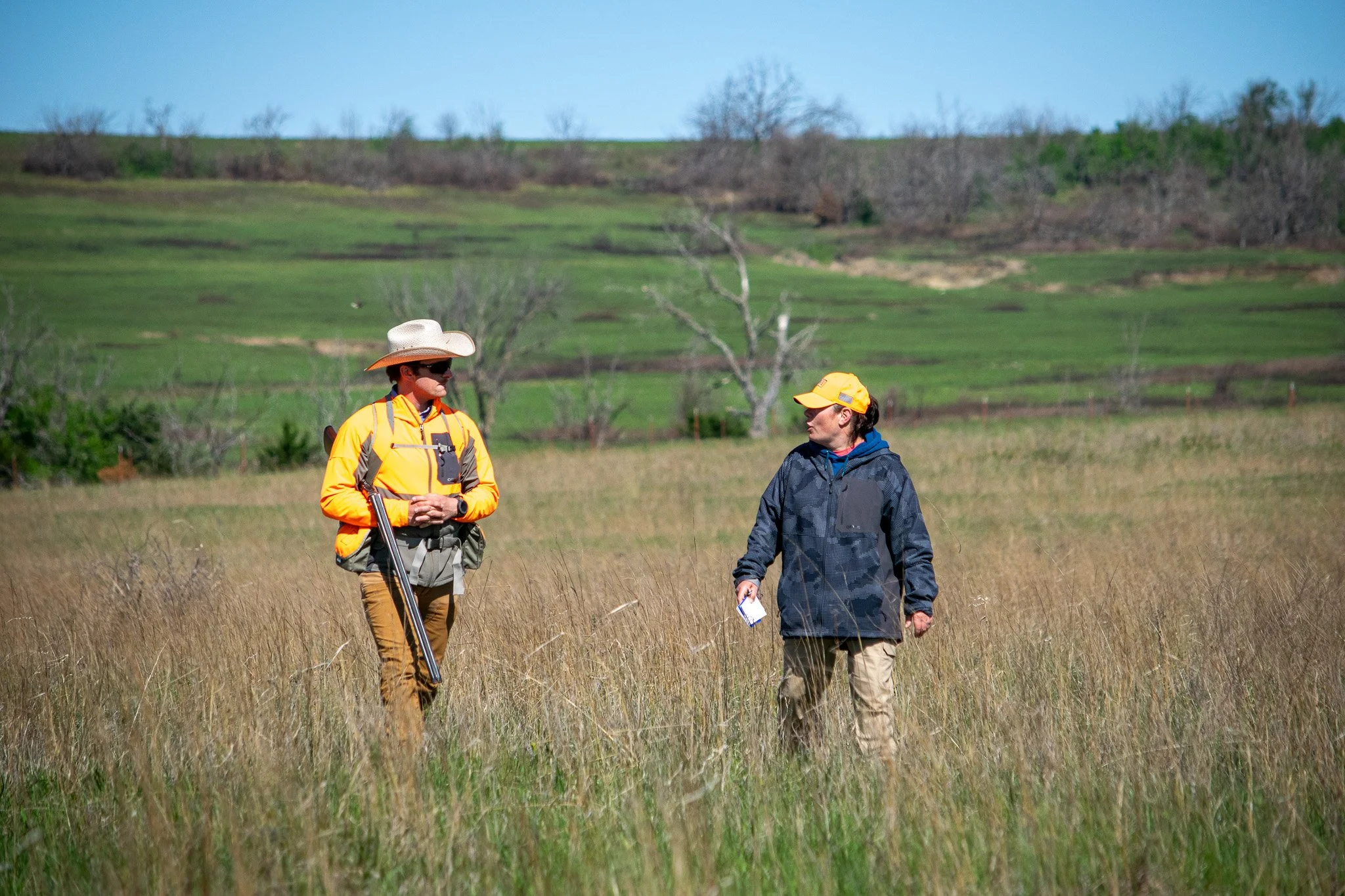
Walking with one of the UKC judges, Tasha Pleskac.
“You’re just in time,” Austin said as I stepped into the barn. “We’re taking the steaks off the grill now.”
His handshake eased the white from my knuckles. Overhead, the sunset wrestled with the storm I had just driven through.
Everywhere I looked, sunburnt faces broke easily into laughter, their color earned from a week behind dogs. Faded photos and banners from field trials years past hung along the wood paneling. A bar at the front of the room sagged under the weight of auction items, prizes, and trophies—each one fitted with a blank plaque, waiting for a name.
I was in good company. Only here would no one blink at the thought of driving through the Flint Hills of Kansas, beneath tornado warnings and alongside power lines aching in the wind, just to watch a dog meet the work it was bred for.
I arrived at this centennial ranch on an invitation to gun for the club’s National Conclave. Gunning wasn’t new to me; I had spent the last several years behind dogs in NAVHDA tests, but this was my first United Kennel Club event. I didn’t quite know what to expect, and that uncertainty was part of the appeal. There are few better ways to learn the format of a test than by stepping into such a role.
Within earshot of a judge’s commentary and in clear view of the dog’s work, gunning offers a vantage point few others get. It puts you in the front row, without the weight of being the evaluated handler. You’re close enough to follow every turn in the field—every point, every retrieve—each revealing something about the dog, the handler, and the work itself.
As plates of warm apple fritters passed from table to table, I met members eager to share what they had seen from their dogs over the course of the week. My affinity for my Large Münsterlander raised a few eyebrows, though many seemed grateful I was willing to spend my weekend gunning for their breed. What I hadn’t expected was the level of hospitality and camaraderie. In an era of digital connectivity, I was in a room where conversation came easily and no one seemed in a hurry to be anywhere else.
Todd Butler took a moment to introduce the landowners, Roger and Erika Bechtel, before kicking off the auction. It was not lost on anyone that the National Conclave, an event so many had worked hard to bring together, would not have been possible without this family. As if the industrial kitchen, hot showers with fresh towels, and nearly 2,000 acres of pristine quail habitat were not enough, the Bechtels took part in the club’s auction later that night. I couldn’t help but take note of their generosity.
By the time the last words of the evening were spoken, the clouds had cleared, and the stars lit my walk back to the truck. In the comfort of my rooftop tent, I drifted off to sleep to the occasional bark of a French Brittany, as if already staking its claim to one of those blank plaques by morning. I smiled.
The morning brought conditions in the dogs’ favor—a crisp wind and grass still wet from the previous day’s storm. I followed the caravan of dog trailers to my first assignment: Open Braces, judged by the event’s senior judge, Dominique Pozo. While I had hunted in braces before, this was my first exposure to a test environment with two dogs on the ground. In NAVHDA, braces are reserved for the Invitational, the organization’s highest level of testing, held once a year and open only to dogs that have earned a Utility Prize I the year prior.
As eager as I was to watch two dogs on the ground at a time, I was particularly excited to observe Dominique judge. Flown in from France, his experience ran deep, though there was nothing in his demeanor, either the night before or that morning afield, that suggested anything other than quiet confidence.
One brace after another moved across the field, and it didn’t take long to notice some of the differences from what I was used to in NAVHDA. There was a brief grace period at the start of each run, a clear expectation that dogs would reach for ground in both directions, fresh ground for each brace, and an unhurried pace set into the wind.
I found myself appreciating Dominique’s subtle guidance to handlers as each brace unfolded. There was authority in it, but never excess. More often than not, he allowed the dog the chance to show before making a call. I also took note of the respect each handler had for his feedback. There was no disagreement or contention; there was only acceptance of the call, followed by a quiet word of thanks as they were dismissed.
When the final brace finished, I moved to a new field to gun for the Gun Solo class, judged by Tasha Pleskac. It was there that I watched a run that told me everything I needed to know about the handlers and trainers in the Club de l’Epagneul Breton.
We were several minutes into the run, and both the judge and handler seemed content with the dog’s performance. It was covering ground with a sense of purpose, carrying a wide search while staying in the sweet spot of depth, just slightly ahead of the three of us.
All eyes were on the dog as it cast left. Then, without warning, a bobwhite quail erupted from under my foot and soared to the right. The dog kept moving, unaware of what had just happened. The handler and I caught each other’s eye—he had seen it too—while the judge remained fixed on the dog.
“Here!” the handler called. The dog turned and came.
“I’m going to pull him. Thank you, Tasha.”
The handler’s decision drew a brief pause from Tasha; she had not seen the bird.
Whatever had been invested in that dog, from the years of effort to the expense of the journey, was secondary to the truth of the field. Winning was the goal, but the work was the soul of the matter. He chose the standard over the trophy.
It wasn’t an isolated decision. It felt consistent with everything I had seen that weekend—quiet expectations, respect for the work, and a standard of excellence that extended beyond what any judge could enforce. The work, it seemed, was always in service of the dog.
It wasn’t something that needed to be explained. It showed up in moments like that one, but also in the quieter spaces: in the way handlers spoke to one another, in the respect shown to the judges, in the way those judges looked for the best in each dog, and in the shared understanding of what it takes to earn a place on one of those plaques.
I’m grateful for the chance to carry a gun behind those dogs, and to spend a weekend among people who care so deeply about bringing out the best in their breed. It was a privilege to meet you, to watch your dogs, and to play a small part in supporting the 2026 National Conclave. I’d do it again in a heartbeat.
Until then, stay steady. I hope to see you on the prairie somewhere, silhouetted on the horizon, working into the wind.