Non Toxic Pattern, Penetration, & Choke Testing: CZ Sharp-tail, 28ga
January 2026 Update - At the time that this was written in 2024, (and when the pattern testing was conducted), neither Winchester nor Federal Premium offered an over-the-counter bismuth load for 28 gauge. Additionally, Boss has since discontinued their bismuth offerings.
In October of 2023, at the bottom of a dried-up pond in eastern South Dakota, Aldo slammed on a point, his body spinning around as if jerked by a fishing rod. His eyes locked on a scrubby bush, something that likely provided habitat for a largemouth bass at one time. I moved to close the distance as Aldo remained steadfast. A regal statue on the horizon. As I got closer, I could see the vibrant colors of a wily rooster seeping through the dull, dried vegetation. I waited. Aldo waited. Ethan, to my left, waited.
I gave it a few moments before getting even closer, now close enough to kick the scrub. And then, in the blink of an eye, the silence broke. A cackle erupted, wings thrashed, and I shouldered my gun. I swung through and flipped the safety. The world around me dissipated. But then again, it didn’t. My vision was hyper-focused on the multitude of colors dancing across that rooster’s body under the late morning sun. And at the same time, my peripherals confirmed the other critical details. Ethan was still on my left, now raising his gun, and Aldo just to my right, mid-spin as he worked to orient himself in the direction of the bird’s travel. In the backdrop, only a clear, beautiful autumn sky.
I was in a flow state that only comes from years, and miles, of repetition. Everything slows down and becomes calculated, but in its own paradoxical form, reactive. The unimportant is gone and the important only more prominent. My finger entered the trigger well and I squeezed the trigger, discharging 5/8th of an ounce of Federal Upland Steel shot from my CZ Sharp-tail. The rooster, maybe twenty yards now, crumpled to the ground. I grinned as I lowered my gun. Before I could exclaim my excitement to the team, and much to my bewilderment, that rooster popped up like a kernel of Orville Redenbacher and kicked it into high gear.
We spent the next thirty minutes scouring the area to no avail. That rooster got away. I couldn’t believe it. That was a layup! I couldn’t have designed a better scenario if I tried! Just two weeks prior, I had been chasing roosters in Montana, and I hadn’t encountered anything like this. It would be arrogant to proclaim that my shooting is SO excellent that such a thing couldn’t happen to me, but I did feel a bit bamboozled given the success rate just a few weeks ago. And then it hit me, I was using different ammo. We were stomping through a waterfowl production area that had a non-toxic shot requirement, and this was the first time I was using these steel loads on roosters. I made a note to self - I needed to do some testing with these shells when I get home.
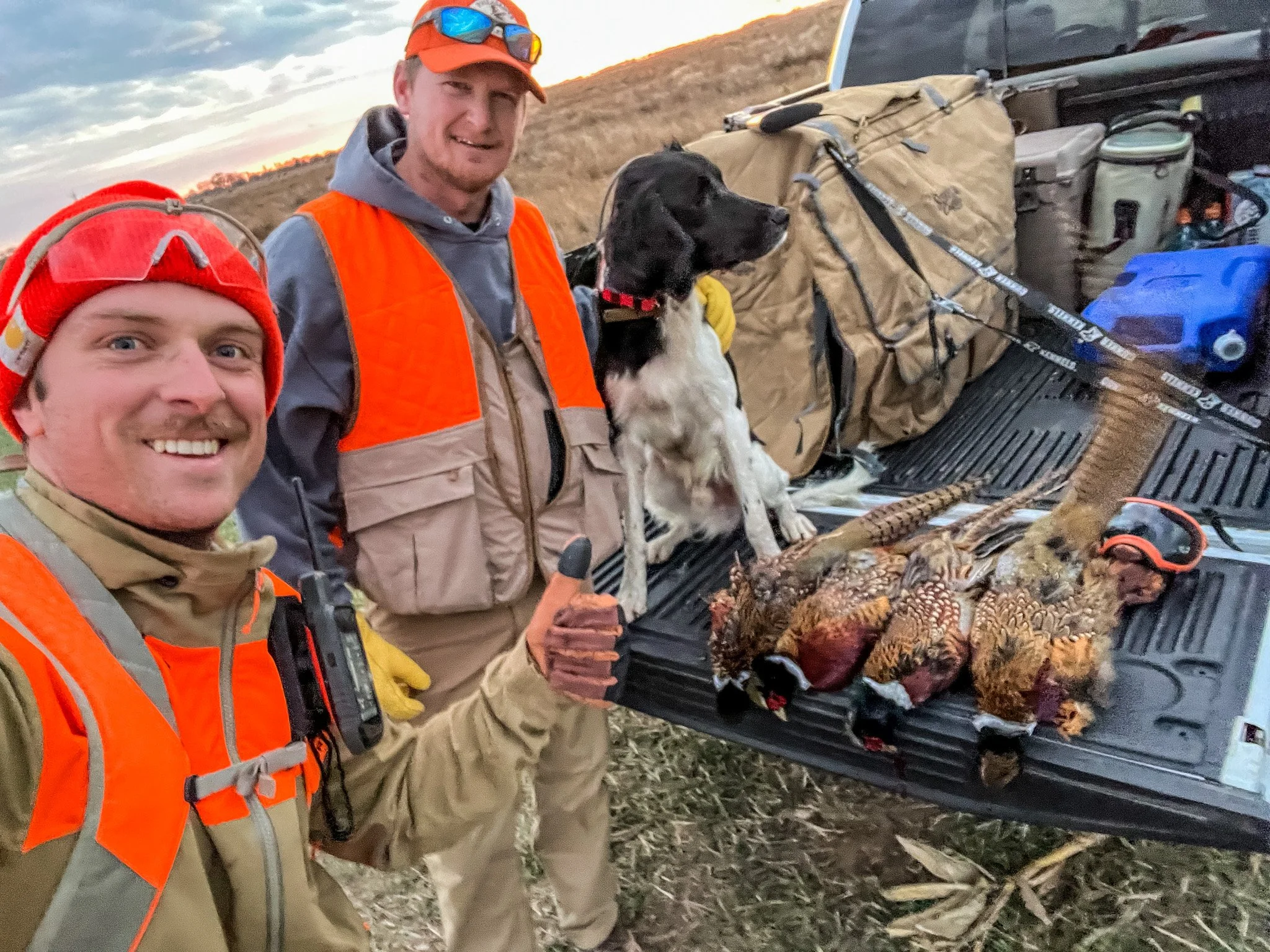
My friend, Ethan, me, and Aldo posing with a few of our South Dakota roosters. This was taken the same day I was unable to recover the “layup” rooster I hit with steel shot. That rooster became the inspiration for this pattern and penetration testing. (Notice the rooster’s tail vibrating in the wind the moment the photo was snapped.)
Now let’s talk about why we’re really here - non toxic pattern, choke, and penetration testing results with a CZ Sharptail 28 gauge side-by-side shotgun.
Unfortunately, there’s no manufacturer guidance on every box of shells that defines what a shooter can expect in terminal pattern or penetration performance, with respect to their own gun, choke, and scenario, when they pick up a particular box of shells. Federal Premium, one of the leading manufacturers of shot shell today, adheres to a SAMMI standard that payloads will achieve a 70% of pattern, in 30” circle, at 40 yards with a full choke. What this means is that, in any given Federal load off the shelf, when fired out of a shotgun equipped with a full choke, a 30” circle placed 40 yards down range of the barrel will be full of 70% of that load’s pellets. Plainly said, if that shot shell has 10 pellets in it, you can expect to find 7 holes in the paper down range.
While this SAMMI standard is a valuable benchmark to the industry as a whole, it doesn’t quite fit my use case. I don’t hunt pheasants with a full choke nor do I take shots at 40 yards. Typically, I’m taking shots on pointed birds (be it grouse, partridge, pheasant, or quail) in the 20 - 30 yard range and I tend to hunt with an Improved Cylinder + Light Modified early in the season and a Light Modified + Improved Modified late in the season (and then Skeet + Improved Cylinder when gunning at NAVHDA training days and tests). The only way I can find out what to really expect is to concoct a set of DIY patterning and penetration tests to draw my own conclusions - so that’s just what I did.
These tests called for cardboard, string, duct tape, poster board, a piece of plywood leaned up against an abandoned cattle oiler, a sharpie, a stool, shooting tripod, ear and eye protection, and four different boxes of shot shells. I grabbed two types of steel shot (one being the same I carried in the South Dakota anecdote I shared earlier) and two types of bismuth shot. I opted to bypass testing the HEVI and tungsten options due to their higher price point. I couldn’t get an exact 1:1 match across the various manufacturers, when it came to the different components that makeup a shotshell, but I was able to match shot size across the four (#6).
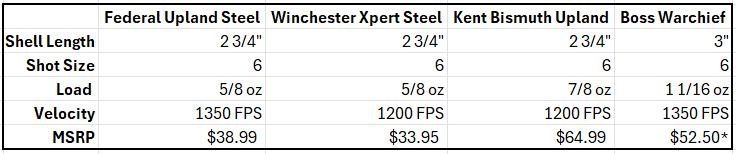
28ga Non Toxic Loads Tested in January 2024 - * adjusted to reflect the price of 25 shells. Boss shells come in 20 shell boxes whereas all others come with 25 shells per box. MSRP for this is $42 for a box of 20.
First up, patterning and choke comparison.
I drew a 13” circle on a piece of 22” x 28” white poster board. The body of a bobwhite quail is, give or take, 8” while on the other end of the spectrum, the body of a ringneck pheasant rooster can be closer to 15”. 13” seemed like a happy medium. I really just needed a point to aim at and the holes in the paper would tell me what I needed to know. I sat on a stool behind a shooting tripod, setting the fore-end on the tripod’s rest to try and minimize unwanted shifts in point of aim, and fired three shots (each shot on a fresh piece of paper), per load, per factory choke, per aftermarket choke, per barrel. I taped the paper up on a piece of plywood leaning up against an old cattle oiler positioned 25 yards from the base of the tripod.
I limited the testing to just one choke constriction, Improved Cylinder, with the factory choke that came with the gun and a Carlson’s Sporting choke tube. I ran through the various loads in the left barrel and then moved the choke over to the right barrel and repeated the process. I was looking to understand not just the pattern itself, but, because this gun lets me select which barrel is fired first, I also wanted to understand if there would be any variance with respect to the individual barrel.
Given that the four shells had varying payloads, and thus different pellet counts, I didn’t want to take a blind count of hits on paper as my only data point. At the surface, it might seem that just counting the pellets on paper would suffice, thus the larger payload would likely have more pellets on paper as there were more pellets to begin with, but that’s where the pattern itself comes into play. Are there gaps in the pattern where a quail might “slip by?” Does the pattern tend to land higher or lower than the point of aim?
In the example below, a shot of Kent Bismuth with a Carlson’s Sporting Improved Cylinder, we can see a hole in the pattern just to the left of the bottom right corner and pellets seem to favor the right side of the 13” target circle. Then, when taking into account the hits themselves, the data becomes a bit more black and white. Only 123 of the payload’s 227 pellets made their way onto paper (54% of the payload) and only 46 of those made it into the 13” circle (20% of the payload, 37% of what made it on paper).
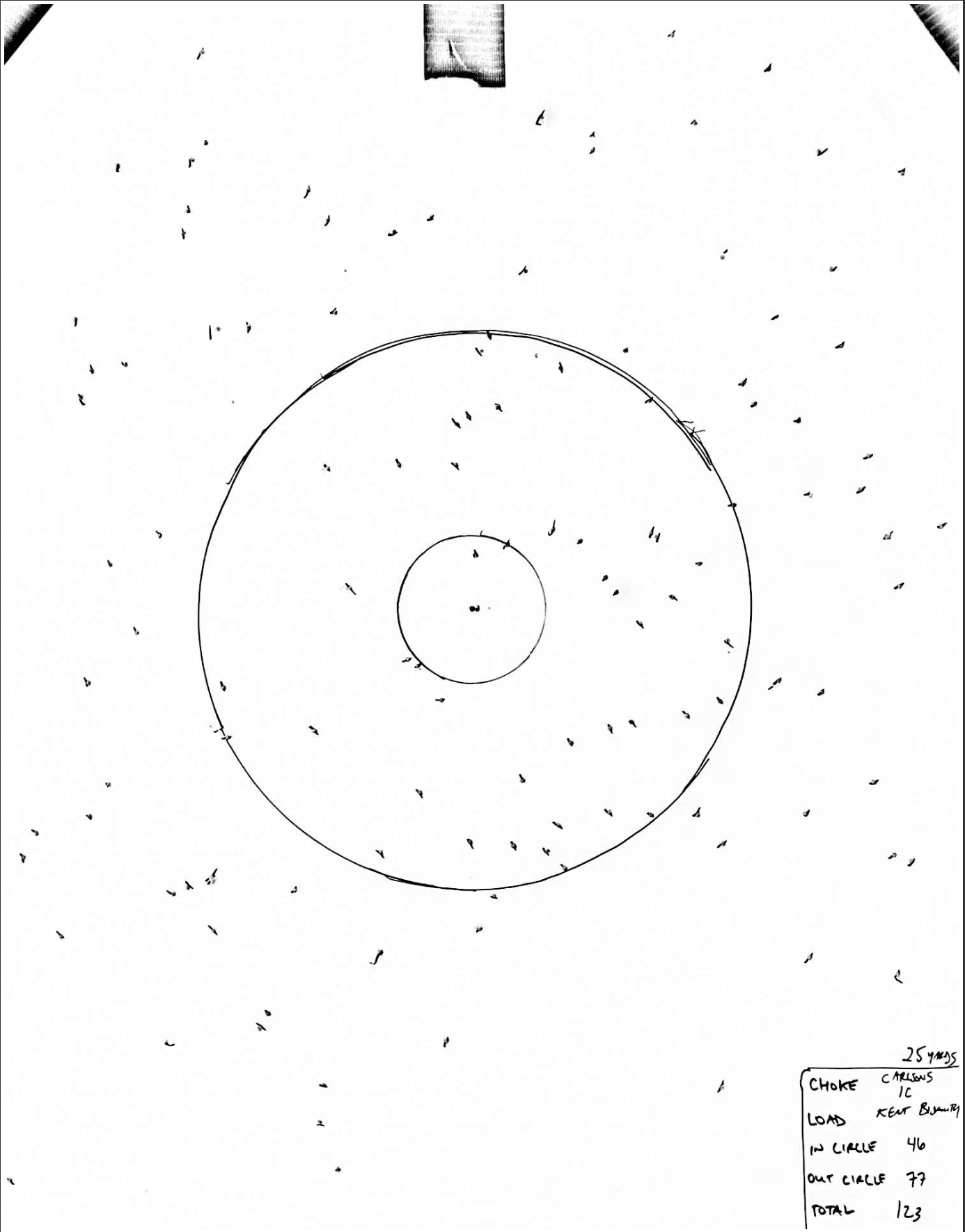
An example of Kent Bismuth with a Carlson’s Improved Cylinder. 123 of the payload’s 227 pellets made it on paper (54% of the payload) and only 46 made it into the 13” circle (20% of the payload, 37% of what made it on paper).
In a vacuum, this might not be the best pattern or count but it’s important to take into consideration the innate variance that comes with shot shell manufacturing. Even setting aside the variables the gun, shooter, and weather bring into the equation, there’s still a great deal of opportunity for one shot shell to be drastically different than the next, within a box, flat, or an entire production lot.
Continuing with this particular example of Kent Bismuth, there are 227 pellets. The pellets alone account for 227 potential variables. The number of permutation quickly grows when thinking about how each pellet isn’t guaranteed to be the exact same weight or shape, or how they’ve been stacked together in whatever manner gravity dropped them into the surrounding plastic wad, encased in a plastic hull, powered by a blend of gun powder, and crimped. When compared to hand-loaded, precision rifle ammunition where tolerances can be extremely tight, shot shell can feel a bit rudimentary (but I think that’s what contributes to making shotgunning more of an art than a science).
I don’t question the safety of a modern shot shell, nor any manufacturer’s commitment to quality assurance, but it’s important to recognize that there’s a great deal of innate variability from shot to shot. This is why I made sure to take several shots before drawing any conclusions, collected data from each, and looked at the overall average of each data point and not just the performance of one particular shot. If time and resources were of no concern, I would have loved to test further in different weather conditions while spanning various manufacturing lots, but at some point, I had to draw a line in the sand of what I would try and control for my DIY backyard testing.
I took photos of every pattern to save for reference and aggregated the pellet hit data - how many made it on paper and of those, how many made it into the 13” circle. This is what I learned:
18% more pellets hit paper out of the left barrel than the right, whether out of the factory choke or the after market choke. This was particularly curious given that the barrels are not fixed choke. The constriction at the end of each barrel was the same for any given test.
The after market choke hits on paper were only marginally better than the factory choke with bismuth. The difference between the Huglu factory choke and the Carlson’s aftermarket choke was only about 4.5% in favor of the Carlson’s. This is likely due to bismuth traditionally performing more similarly to lead than in other alloy comparison, such as steel to lead, and I suspect the factory choke was designed with lead shot in mind.
The factory choke was noticeably less consistent in pattern and had fewer hits on paper than the after market choke with steel. There was a 22% difference among the two, with the Carelson’s choke far outperforming the factory choke.
Steel v Steel, the difference was marginal. Federal eked out a win over Winchester by a mere 1.77% when compared, across both chokes and both barrels.
Steel patterned more consistently than bismuth. This didn’t come as much of a surprise. Steel innately patterns tighter than lead or bismuth. The steel payload “stays together” for a longer duration in flight so seeing a tighter pattern was to be expected but what was interesting was to see how the uniformity of the Kent bismuth did vary. Additionally, bismuth is more brittle than steel or lead and it can fragment in flight.
The results gathered so far were interesting, particularly with understanding the difference between Federal and Winchester, but I still didn’t have the full picture. Now I wanted to get a better understanding of the terminal impact - just how deep did these different loads penetrate a target?
Next, penetration testing.
I looked into ballistic gel that you see on crime shows and ammunition advertisements. Turns out, for something that you’re going to effectively destroy, that stuff is pretty darn expensive. At ~$100 per block of gel, which would translate to about $100 per test, I would need to sell a kidney if I was going to use that for my testing. I found some internet lore that talked about how to make DIY ballistic gel, but the instructions were questionable at best, and I’m no chemist. I thought back to the testing Bob Brister did in the 1970’s and recorded in his book, Shotgunning: The Art and Science. Bob used cardboard for his tests. Now that was something I could source!
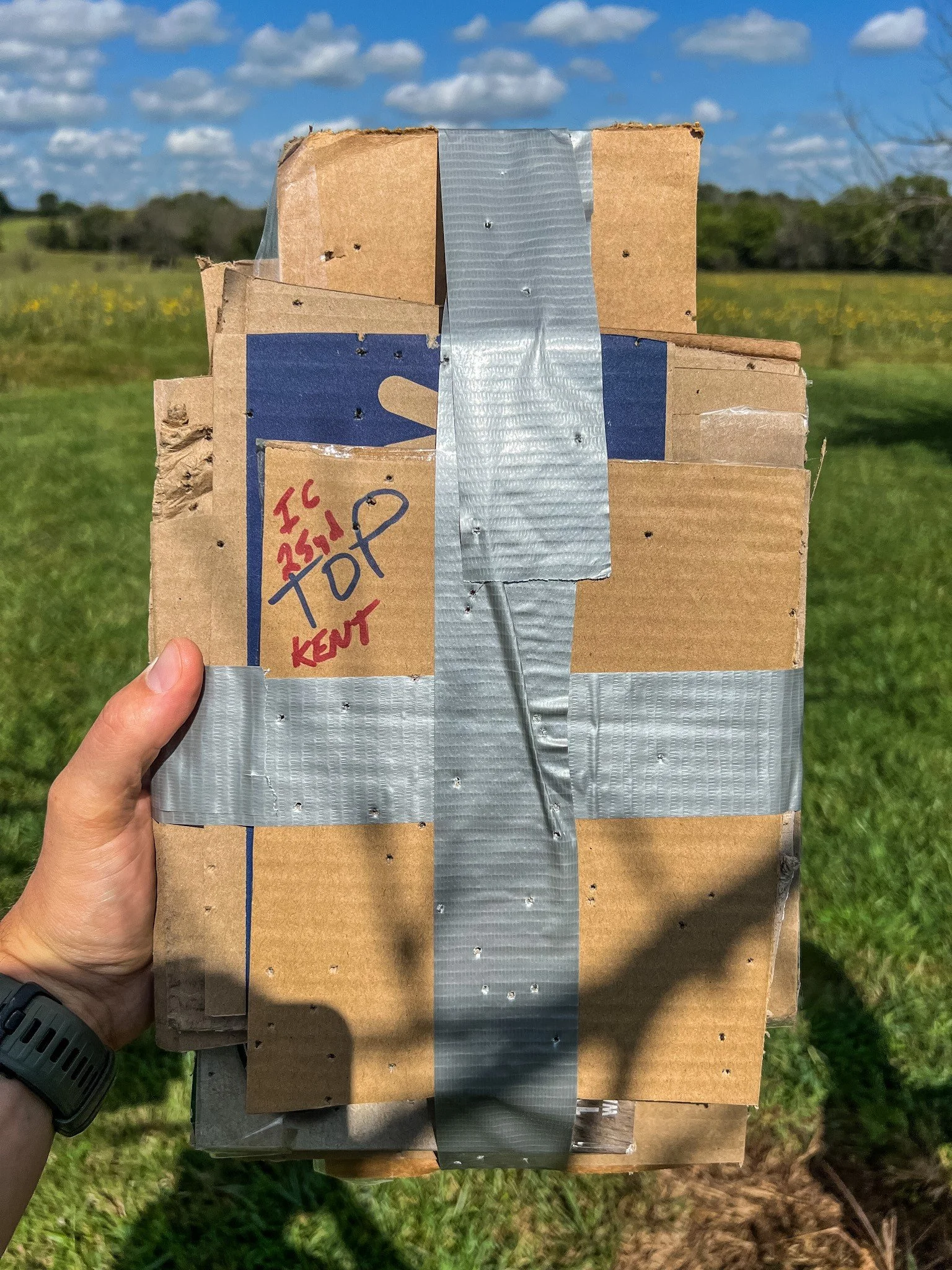
Each penetration target was made by stacking pieces of cardboard, from the same cardboard source, creating a 16 layer, 3.5" thick target.
I gathered up a wide assortment of cardboard only to realize that there are quite a few types or styles of cardboard with varying construction and depth. Trying to make the most of what I had on hand, I cut up pieces from all the boxes I had and created twelve “equal” stacks. What I mean by this is that Stack 1 had a piece of Cardboard A, Cardboard B, Cardboard C, etc. and, in the exact same A, B, C order, so did Stack 2, and 3, and so on until I had twelve (three for each shell being tested) stacks of nearly identical cardboard. Each stack was 3.5” deep and consisted of 16 layers of cardboard.
I duct taped each stack together in as close of a similar fashion to one another as possible and I had my DIY penetration testing material. Post shot, I would cut the duct tape, and pull layer after layer until I could visibly see pellets beginning to stop penetrating as well as to which layer that pellets penetrated the furthest. Not quite as exact and controlled as ballistic gel, but I thought it was fairly intuitive and equitable.
For the test itself, I hung each cardboard stack, or target, with 550 para cord from a tree. I took my shots from 25 yards, a fresh target for each, and labeled each target for posterity. Afterwards, I removed the duct tape and began peeling back the layers to determine at which layer the pellets began to stop penetrating as well as at which layer the furthest pellet did penetrate.
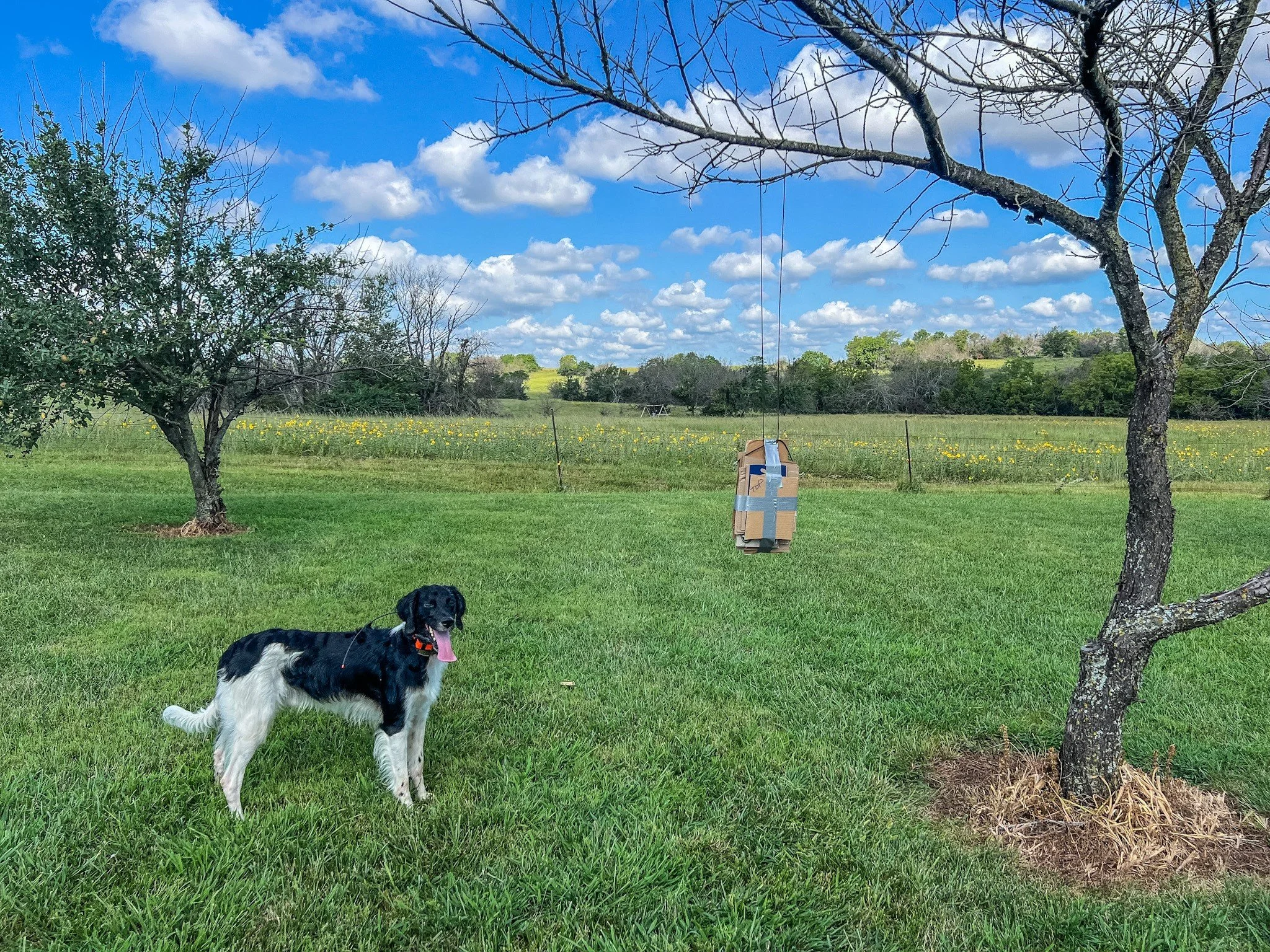
Hovering at approximately four feet in the air, each target was shot from 25 yards with an Improved Cylinder choke. (Note, Aldo was NOT near the target whenever I was shooting.)
After peeling back all of the layers, this is what I learned:
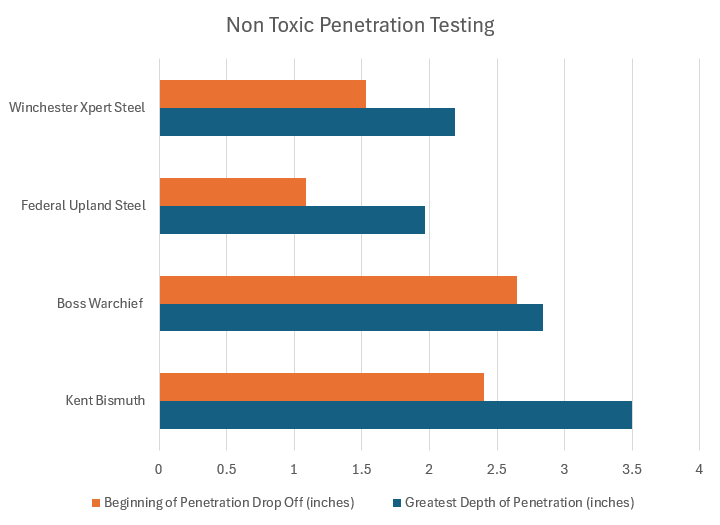
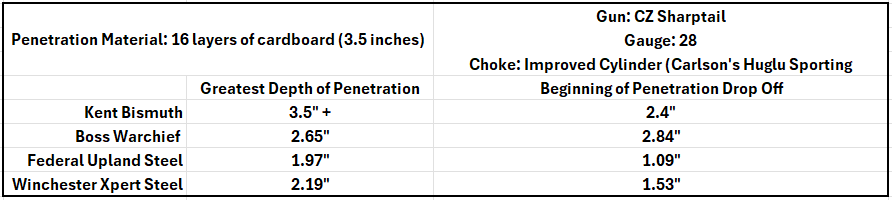
Bismuth penetrates much further than steel. In some cases, bismuth penetrated over twice as far as steel.
Winchester steel penetrates further than Federal steel. Both in terms of when the pellets began to drop off, as well as furthest penetration, Winchester was the clear frontrunner.
Boss Warchief Bismuth had the smallest variance. This was a significantly larger payload than the others tested, but the consistency was noticeable and likely speaks to the high quality of its production.
In Conclusion…
I know there is a multitude of reasons that rooster got away that day, many of which could (and likely are) the shooter’s fault. That being said, it initiated this series of tests for which I am grateful. These tests resulted in a more intimate understanding of my shotgun and of how much of a difference there can be across different shot shell loads and chokes. The penetration difference between steel and bismuth was very eye-opening for me.
I now hunt exclusively with the Carlson’s Sporting choke tube that I tested with and when I’m hunting somewhere that requires non toxic shot, I reach for a box of bismuth and not for a box of steel.
In a perfect world, I would have established a control data set by going through this same series of tests with lead #6’s but at the time I was mostly focused in understanding, between steel and bismuth, what will be the best fit for my gun and my style of hunting. I’m sure I will conduct similar tests in the future as more 28 gauge loads and new shot shell technology enters the market.
“Shoot, shoot, shoot and then shoot some more. When the time comes to kill an animal, your responsibility is to do so efficiently.”